 editer@kidkosh.in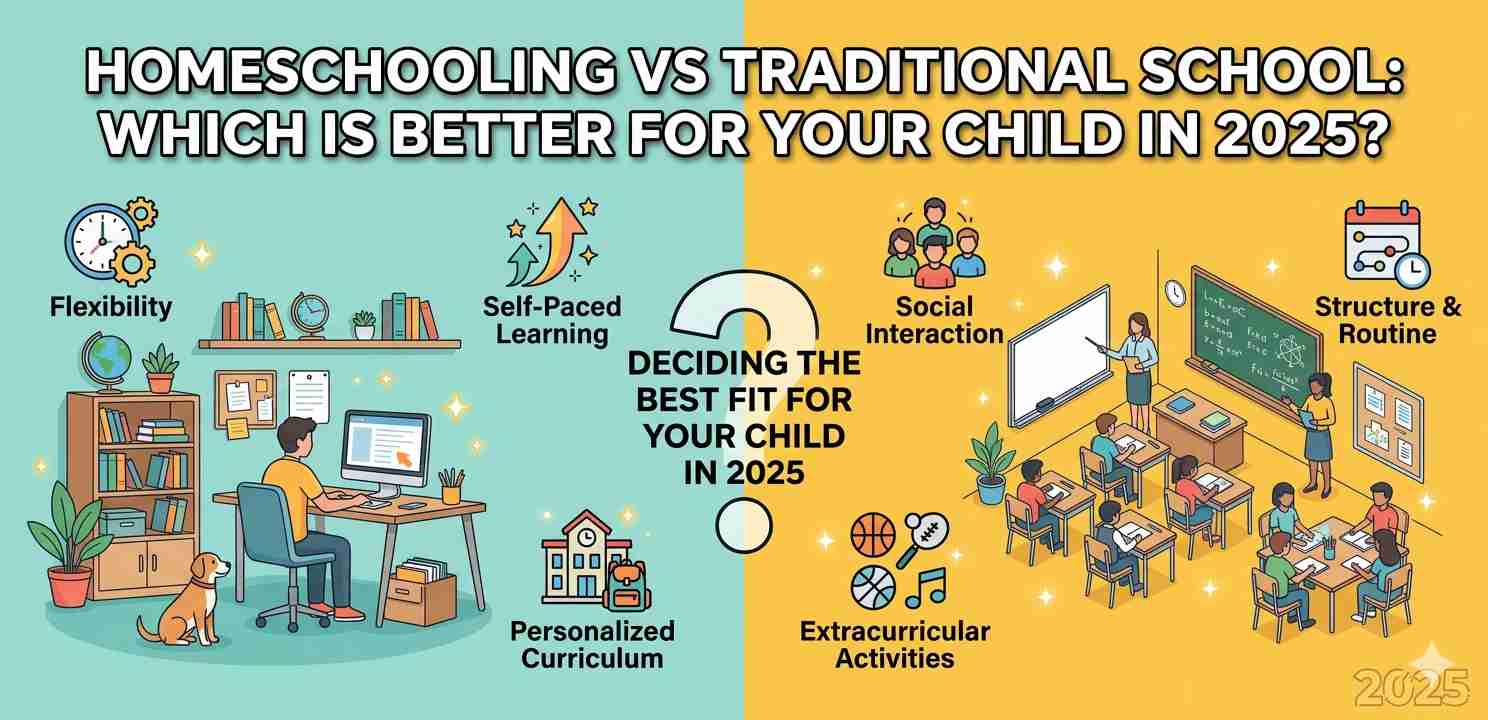
Choosing between homeschooling vs traditional school is one of the most important decisions a parent can make. It’s not just about academics — it touches your child’s social life, mental health, daily routine, and long-term future. In 2025, this conversation has become louder than ever, especially after the major shifts in education that the world experienced in recent years.
There’s no single right answer. Every child is different. Every family situation is different too. So instead of telling you what to do, this guide is designed to help you understand both sides clearly — so you can choose what actually fits your child.
What Is Homeschooling, Really?
A lot of people still picture homeschooling as a parent sitting at a kitchen table, drilling math problems all morning. That image is pretty outdated.
In 2025, homeschooling vs traditional school looks very different than it did even ten years ago. Homeschool families now have access to full online curriculums, co-op groups, virtual tutors, and even hybrid programs where kids attend a physical school part-time. Some parents use structured schedules. Others follow an unschooling approach, letting the child’s interests guide learning.
According to the National Center for Education Statistics, the number of homeschooled students in the US has steadily grown, and post-pandemic numbers pushed that growth even further.
Homeschooling today is flexible, diverse, and more organized than most people assume.
What Traditional School Actually Offers
Traditional schooling — whether public, private, or charter — comes with a built-in structure. Children go to a physical building, interact with peers and trained teachers, and follow a set curriculum aligned with state or national standards.
When parents consider homeschooling vs traditional school, they often overlook what traditional schools do well consistently: socialization, routine, extracurricular exposure, and professional instruction across multiple subjects.
A trained science teacher explaining photosynthesis is not the same as a parent reading from a textbook. For many families, that professional touch matters enormously, especially in subjects like mathematics, lab science, or foreign languages.
Traditional school also provides something invisible but valuable — a daily structure that gives children a sense of rhythm. For kids who thrive on predictability, that matters.
Academic Performance: Which Environment Produces Better Learners?
This is where the debate often heats up. Research on homeschooling vs traditional school academic outcomes is genuinely mixed.
Some studies show that homeschooled students score higher on standardized tests and are more likely to pursue higher education. But critics point out that homeschool families who voluntarily choose that path tend to be more engaged, educated, and financially stable — which naturally produces better academic outcomes regardless of method.
Traditional schools serve a much wider demographic. They’re accountable to standards and required to educate every child, including those with learning disabilities, language barriers, and difficult home environments. That’s a much harder task, and test scores alone don’t capture how well they handle it.
Personalized Learning vs Standardized Pacing
One of the clearest advantages in the homeschooling vs traditional school debate is pace. A homeschooled child who loves history can spend three weeks on ancient Rome and move through fractions in two days. A child in a traditional classroom has to move with the group.
That flexibility is genuinely powerful. But it also requires a parent who can recognize when a child is falling behind — and who knows what to do about it.
Not every parent has that skill or that time. It’s honest to acknowledge this.
The Social Question Everyone Asks
“But what about socialization?” It’s the first thing most people say when homeschooling comes up.
In the homeschooling vs traditional school debate, socialization is real and worth thinking about. Kids in traditional schools navigate friendships, peer conflict, group projects, and diverse social environments daily. These are genuinely useful life experiences.
But the assumption that homeschooled kids are isolated is not really accurate anymore. Most homeschool families actively build social environments — through co-ops, sports teams, community theater, religious groups, and local clubs.
The difference is that social interaction in homeschooling is chosen and curated. Whether that’s better or worse depends entirely on the child. An introverted child who was being bullied at school might flourish in a more controlled social setting. An extroverted child who feeds on peer energy might struggle.
See also: How to Support Your Child’s Social Development at Home — practical strategies for parents building social routines outside school.
Flexibility and Lifestyle Fit
One underappreciated part of the homeschooling vs traditional school comparison is how differently families actually live.
Some families travel frequently. Some have children with chronic illness or anxiety that makes daily school attendance painful. Some live in rural areas with genuinely poor local school options. For these families, homeschooling isn’t an ideological choice — it’s practical.
On the other hand, many parents simply don’t have the time, energy, or confidence to teach effectively. A single parent working full-time cannot realistically homeschool. A parent who struggled with math themselves may not be equipped to explain algebra to a teenager.
Traditional school, for all its limitations, is consistent. You drop your child off, they get educated by trained professionals, and you pick them up. That reliability matters for a huge number of families.
Cost: Homeschooling vs Traditional School in 2025
Public traditional school is free (funded by taxes). Private traditional school ranges from a few thousand to tens of thousands of dollars annually.
Homeschooling costs vary wildly. At the low end, a parent using library books and free online resources might spend a few hundred dollars a year. At the high end, with full curriculum packages, tutors, co-op fees, and materials, the cost can rival private school tuition — plus the invisible cost of a parent’s time.
For families comparing homeschooling vs traditional school on budget, the math isn’t always as simple as “homeschool is cheaper.” It depends on what program you choose and whether one parent has to reduce work hours.
You can explore affordable homeschool resources at Khan Academy, which offers free, high-quality instruction across all grade levels and subjects.
Special Needs: Which Setting Works Better?
This is an area where the answer genuinely depends on the child.
Traditional public schools in the US are legally required to provide services for children with documented learning disabilities, autism spectrum conditions, speech delays, and other special needs. These include IEPs (Individualized Education Programs), speech therapy, occupational therapy, and specialized classrooms.
In the homeschooling vs traditional school conversation, parents of special needs children often land in one of two very different places. Some find that their child thrives in a one-on-one home setting free from sensory overload and classroom stress. Others find that the professional services and trained specialists in traditional schools are impossible to replicate at home.
There’s no universal answer here. Talking to your child’s pediatrician or a learning specialist before making this choice is genuinely worthwhile.
See also: Homeschooling a Child with Learning Differences: What Parents Should Know
Teacher Quality and Curriculum Coverage
A traditional school teacher has years of training, subject expertise, and professional accountability. They’ve studied pedagogy — the actual science of how to teach. That’s not a small thing.
When examining homeschooling vs traditional school, parents sometimes underestimate how hard teaching actually is. Explaining fractions to a confused nine-year-old is different from knowing fractions yourself. Keeping a distracted twelve-year-old engaged in grammar lessons requires real skill.
That said, many homeschooling parents develop impressive teaching instincts over time. And with modern online tools — recorded lectures, interactive platforms, and subject-specific tutors — parents don’t have to do everything alone.
The honest answer is that curriculum quality in homeschooling varies enormously. In traditional schools, quality also varies — but there are at least minimum standards enforced by regulations.
What the Research Actually Says
Studies on homeschooling vs traditional school show complicated results. Homeschooled students often score well on tests and college admissions metrics, but research quality varies and self-selection bias is a real problem.
A 2023 review published in education research journals found that homeschooled students performed comparably or slightly above average in academic outcomes — but the studies largely focused on families with motivated, educated parents who chose homeschooling intentionally.
Traditional school research shows significant variation based on funding, location, teacher quality, and family support. A well-funded school in a stable district consistently produces strong outcomes. An underfunded school in a high-poverty area may not.
The comparison isn’t really homeschool vs school. It’s your specific homeschool situation vs your specific local school option.
Making the Decision: Questions Worth Asking
Before settling the homeschooling vs traditional school question for your family, sit with these questions honestly:
- Does my child have specific learning needs that one setting handles better?
- Do I have the time, skills, and patience to teach effectively?
- What are my local school options actually like?
- How does my child handle social environments?
- What are our long-term educational goals?
There’s no shame in choosing traditional school. There’s also no shame in choosing homeschooling. What matters is being honest about your own capacity and your child’s actual needs — not what sounds impressive at a dinner party.
Final Conclusion
The homeschooling vs traditional school question doesn’t have a universal answer — and that’s not a cop-out. It’s the truth.
Homeschooling offers flexibility, personalization, and a learning environment built around your child. Traditional school offers trained teachers, structured socialization, professional resources, and reliability. Both can produce thriving, happy, well-educated children. Both can also go wrong if they’re a poor fit.
What matters most in 2025 is that parents go into this decision with clear eyes — understanding what they’re actually committing to, what their child genuinely needs, and what resources they realistically have available. Talk to other parents who’ve made both choices. Visit local schools. Try things and adjust if they aren’t working.