
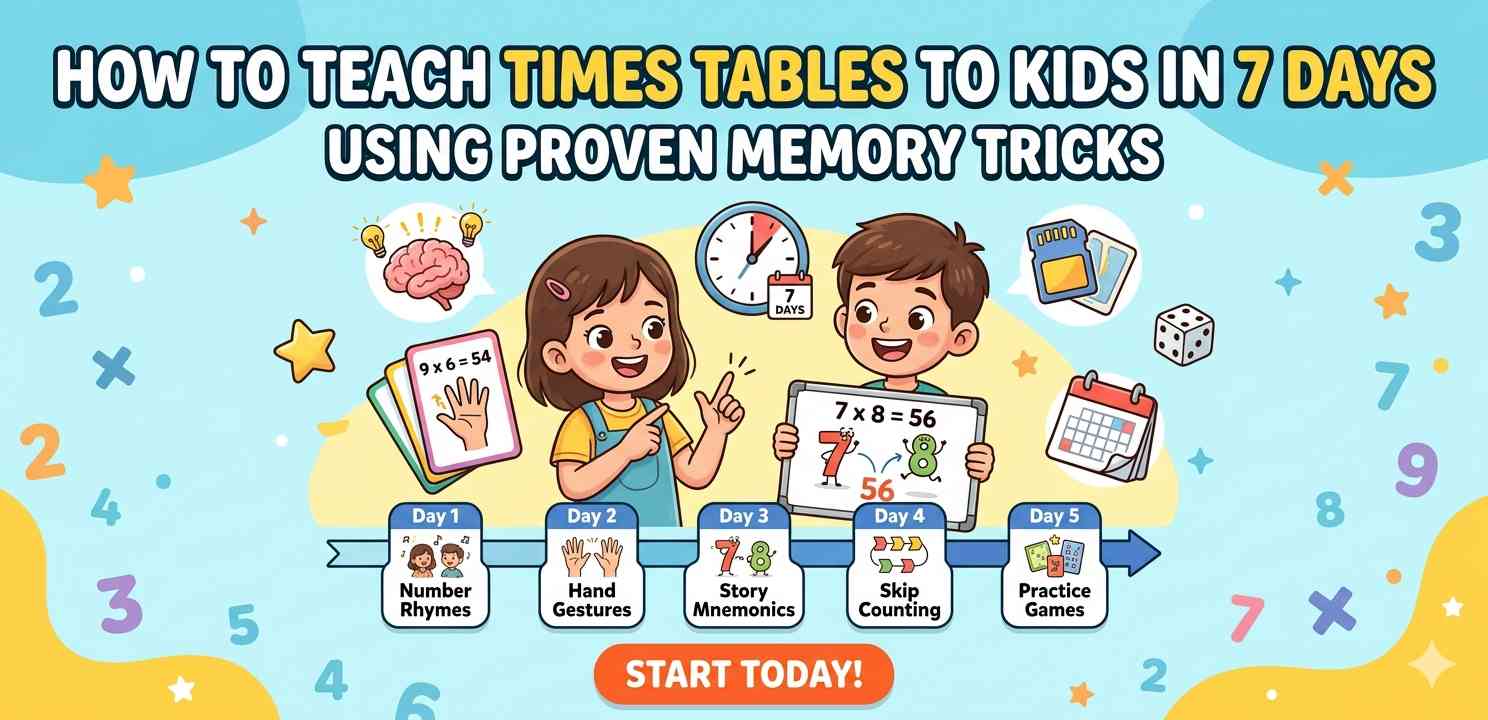
Tag: 7-day multiplication plan

  • How to Teach Times Tables to Kids in 7 Days Using Proven Memory Tricks

    How to Teach Times Tables to Kids in 7 Days Using Proven Memory Tricks

    If you’ve been trying to teach times tables to kids and feel like you’re hitting a wall every single day, you’re not alone. Most parents and teachers struggle with this. Multiplication feels abstract to young children — and honestly, drilling numbers without any real method rarely works. The good news? With the right structure and a few clever memory tricks, seven days is genuinely enough to build a solid foundation.

    This guide walks you through a realistic, day-by-day plan. No worksheets that look like punishment. No yelling. Just things that actually work.

    Why Most Kids Struggle With Times Tables

    Before jumping into the plan, it helps to understand why kids find multiplication hard. It’s not about intelligence — it’s about how the information is being presented.

    Many traditional approaches treat times tables like a list to memorize. But young brains don’t work well with raw repetition alone. They need patterns, stories, rhythm, and connection to things they already know.

    When you teach times tables to kids using only rote repetition, they might remember it today and forget it by Thursday. That’s frustrating for everyone.

    What You Need Before Day 1

    You don’t need fancy tools. A whiteboard or paper, some colored pens, and around 15–20 minutes of focused daily time is all it takes.

    The key is consistency. Short daily sessions work far better than a two-hour cram session on a Saturday. Think of it like brushing teeth — small, regular, and non-negotiable.

    Also, keep the energy low-pressure. If a child feels anxious, their memory actually shuts down. Relax the atmosphere first.

    Day 1: Start With the Easy Wins (2s, 5s, and 10s)

    On the first day, don’t touch the hard ones. Start with the tables that have clear patterns: 2s, 5s, and 10s.

    Why These Three First?

    The 2 times table is just counting in even numbers — most kids already know this without realizing it. The 5s end in 0 or 5 every time, which is easy to spot. The 10s just add a zero. These three alone cover a surprising number of multiplication facts.

    When you teach times tables to kids starting here, they feel successful early. That confidence matters more than you’d think.

    Spend Day 1 on these three only. Use a number line drawn on paper. Jump along it with a finger. Make it visual and hands-on.

    Day 2: Introduce the Concept of Doubling (4s and 8s)

    The 4 times table is just the 2 times table doubled. So if a child knows 2 × 6 = 12, then 4 × 6 is simply 12 doubled, which is 24. Once you explain this connection, many kids get it almost immediately.

    The 8s follow the same logic — double the 4s. It’s a chain.

    A Simple Way to Explain Doubling

    Ask the child: “If I have 3 bags with 4 apples each, how many apples total?” Count them out with real objects if needed. Tangible examples are incredibly effective at this age.

    To teach times tables to kids using doubling is one of the most natural methods. It links new information to something they’ve already learned — that’s how memory sticks.

    Day 3: The 9s Trick That Kids Actually Love

    The 9 times table has one of the most satisfying tricks in all of elementary math. Hold up both hands, fingers spread out. To solve 9 × 4, fold down the 4th finger from the left. The fingers to the left of it show the tens digit (3), and the fingers to the right show the units digit (6). Answer: 36.

    This hand trick is a genuine memory shortcut, not a gimmick. Kids love it because it feels like a secret code.

    Spend Day 3 practicing the 9s using this method. Go through 9 × 1 all the way to 9 × 10. Repeat it a few times with both hands on the table.

    Day 4: The 3s and 6s — Using Skip Counting and Rhythm

    The 3 times table responds well to rhythm. Clapping, stomping, or singing while skip counting (3, 6, 9, 12, 15…) helps the pattern stick in memory.

    The 6s are just the 3s doubled — same principle as Days 2. Teach the 3s first, get comfortable, then double each answer for the 6s.

    Songs and Rhymes Work Surprisingly Well

    There are short multiplication songs available online that cover specific tables. Using audio alongside repetition activates different parts of the brain. If your child connects the tune to the answer, they’ll remember it more reliably.

    When you teach times tables to kids through music or rhythm, it doesn’t feel like studying. That’s the whole point.

    Day 5: The 7s — The Hardest Table, Handled Carefully

    Let’s be honest — the 7s are difficult. There’s no clean visual trick like the 9s. But there is a useful shortcut: by Day 5, most of the 7s have already been covered through other tables.

    7 × 1, 7 × 2, 7 × 3, 7 × 4, 7 × 5, 7 × 6 — these answers were all learned while practicing the 1s, 2s, 3s, 4s, 5s, and 6s. Multiplication is commutative, meaning 7 × 4 is the same as 4 × 7.

    So on Day 5, draw a simple grid and show the child how much they already know. The only genuinely new fact in the 7s is 7 × 7 = 49. Focus there.

    Day 6: Review and Fill in the Gaps

    Don’t introduce anything new on Day 6. Use this day to go back over everything practiced so far.

    A quick quiz format works well — but keep it playful. Call out a random problem: “Quick! 6 times 8!” If they hesitate, that’s useful feedback about where to spend a few more minutes.

    You can also try multiplication games online — there are free, age-appropriate options that make review feel like a game rather than homework. Sites like BBC Teach also have structured activities for primary-age children.

    To properly teach times tables to kids, review is just as important as new learning. Memory consolidates during sleep and repetition — so Day 6 is doing important work even if it feels like a rest day.

    Day 7: Test With Real-Life Scenarios

    On the final day, skip the abstract questions and go practical. Use real-life scenarios:

    • “We have 6 plates. Each plate needs 4 strawberries. How many do we need from the shop?”
    • “You want to share 24 cookies equally between 8 friends. How many does each person get?”

    This bridges multiplication with division naturally and shows the child that what they learned has actual uses — not just school test uses.

    Celebrate What They’ve Done

    Genuinely acknowledge the progress. Seven days of consistent practice is real effort for a young child. A sticker chart, a small reward, or even just enthusiastic praise makes a difference in building a positive association with math.

    When kids associate positive emotions with learning, they retain information better and approach future challenges with less resistance.

    Common Mistakes to Avoid

    Here are a few things that tend to slow down progress when parents or teachers try to teach times tables to kids:

    Starting with the hard tables first. Always build confidence before complexity.

    Doing too much in one session. Twenty minutes daily is enough. Longer sessions cause mental fatigue, especially in children under 10.

    Using only one method. Mix visual, auditory, and hands-on approaches throughout the week.

    Skipping review days. New information fades fast without reinforcement. Don’t skip Day 6.

    How to Keep the Learning Going After Day 7

    Seven days gets you to a solid foundation, not perfection. That’s fine — that’s the goal. After the first week, maintain the knowledge with brief daily practice: five questions at breakfast or before bed.

    You can also find structured resources to supplement your efforts. Sites like Khan Academy Kids offer free, well-structured multiplication content broken down by level.

    The child who can recall tables automatically at age 8 will find algebra far easier at 14. Building this foundation now is genuinely one of the most useful things you can do for their long-term mathematical confidence.

    Final Conclusion

    Learning multiplication doesn’t have to be a battle. The key is breaking the process into manageable steps, using memory tricks that match how children actually think, and keeping the energy positive throughout.

    This 7-day structure gives children early wins, builds on what they know, uses the body and rhythm as memory tools, and ends with real-world practice. When you teach times tables to kids this way — patiently, progressively, and with the right techniques — the results are lasting rather than temporary.