 editer@kidkosh.in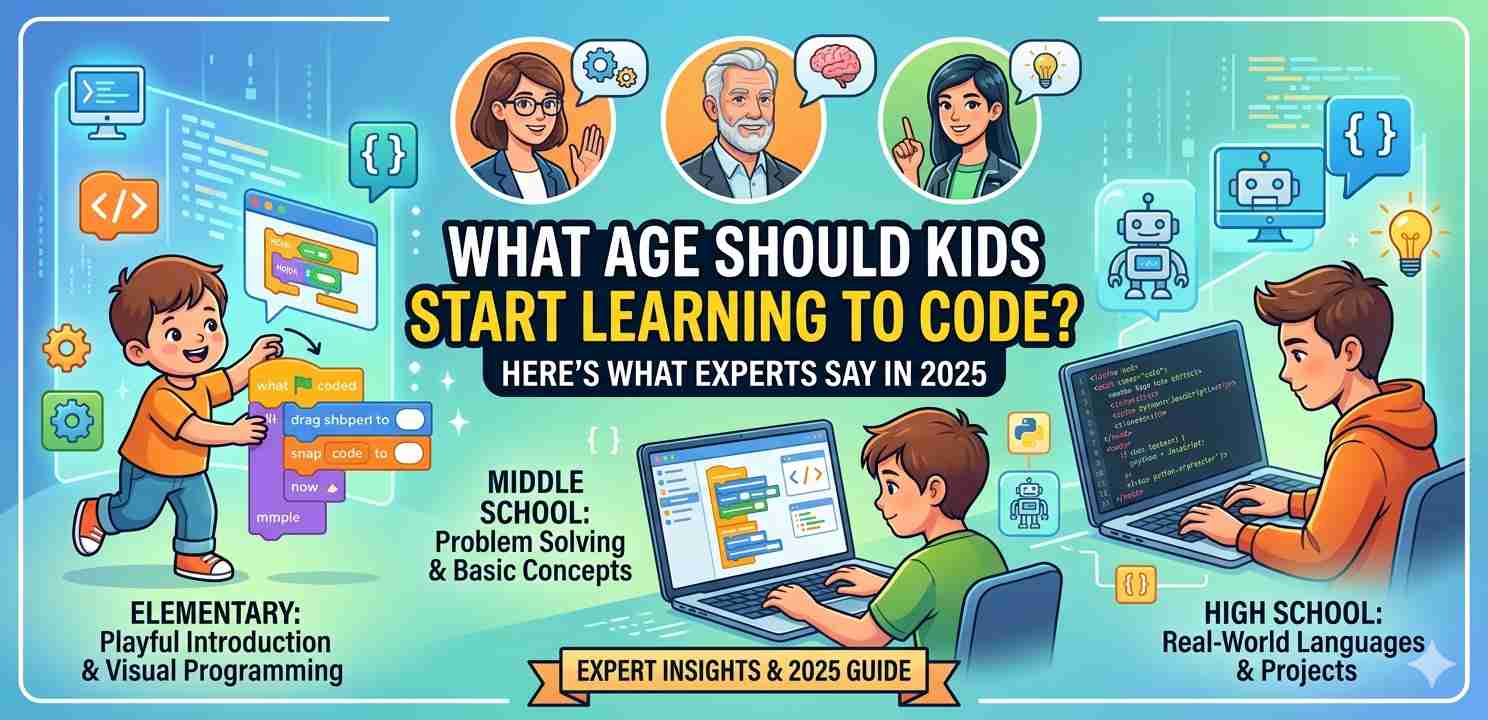
If you’ve been asking yourself when kids start learning to code, you’re not alone. Every week, more parents search for answers to this exact question — and honestly, the advice out there is all over the place. Some say age 5, others say wait till 10. So what’s the real answer?
The short version: there’s no single magic age. But there are clear patterns, developmental milestones, and practical guidelines that can help you make a confident decision for your child.
Why the Question of Age Matters More Than Ever
Learning to Code We live in a world where software runs everything — from your child’s school tablet to the apps on your phone. Coding isn’t just a career skill anymore; it’s becoming a core literacy, like reading or basic math.
That’s why so many schools worldwide have started including it in their curriculum, even at the primary level. And that’s also why parents feel this pressure to “get their kid started early.”
But rushing a child into something their brain isn’t ready for can actually backfire. The goal isn’t to create a prodigy — it’s to build genuine interest and confidence over time.
What Child Development Research Actually Says
Child development experts generally agree that kids start learning to code in meaningful ways around ages 5 to 7. This doesn’t mean they’ll be writing Python scripts. It means they can begin understanding simple logic — sequences, patterns, cause and effect.
According to MIT’s research on early childhood learning, children as young as 5 can grasp computational thinking through play-based tools. Apps like Scratch Jr. were actually designed with this age group in mind.
That said, the type of coding matters a lot at this stage. Block-based, drag-and-drop tools work far better for young children than typing actual syntax. Forcing a 6-year-old to memorize semicolons and variables is a recipe for frustration.
Ages 5–7: The Foundation Stage
At this age, children are learning to think in sequences. They follow multi-step instructions. They understand “if this happens, then that happens” — which is basically the heart of programming logic.
Tools like Scratch Jr. and Code.org’s Hour of Code work really well here. They use colorful blocks, animated characters, and game-like rewards. Your child doesn’t even know they’re coding — they think they’re making a cartoon move.
One parent described it well: “My daughter was 6 when she started using Scratch Jr. She thought she was just playing. But within a few weeks, she was explaining to me why her character wasn’t moving the way she wanted. She was debugging — without knowing that word.”
This stage is about sparking curiosity, not producing output.
Ages 8–10: When Kids Start Learning to Code More Seriously
This is where things get genuinely interesting. At this age, kids have better reading ability, longer attention spans, and stronger logical reasoning. They can follow multi-step tutorials, understand variables at a basic level, and start building small projects on their own.
Scratch (the full version, not Jr.) becomes a great tool here. Many kids in this age range also do well with Tynker, Blockly, or beginner-level Python courses designed specifically for children.
This is also the age where structured learning — like a coding club at school or an online platform — starts to pay off. Before this, most learning should feel like play. At 8–10, kids can handle a bit more structure without losing interest.
Ages 11–13: Transition to Real Code
By middle school, many kids are ready to write actual lines of code. This is when most experts agree kids start learning to code in a format that resembles professional programming.
Python is widely recommended as the first “real” language because:
- Its syntax is clean and readable
- There are tons of beginner resources
- It’s used in real industries (AI, data science, web development)
Kids at this age can build basic games, simple websites, and even beginner automation scripts. If your child is 11 or 12 and hasn’t touched coding yet, don’t panic — they haven’t missed the window. This is actually a great age to begin.
What Experts and Educators Recommend in 2025
In 2025, there’s broader consensus among educators than there was even five years ago. Most coding education specialists agree that:
- Ages 5–7: Play-based, visual, no typing required
- Ages 8–10: Block coding with light project work
- Ages 11+: Transition to text-based languages like Python or JavaScript
The American Computer Science Teachers Association (CSTA) has published updated K–12 frameworks that align with these recommendations. They emphasize computational thinking starting in kindergarten — not writing code, but thinking like a programmer through puzzles and storytelling.
Dr. Marina Bers, a leading researcher at Boston University who focuses on early childhood technology education, has long argued that kids as young as 5 can develop coding concepts through the right tools. Her work on the KIBO robotics kit and Scratch Jr. platform shows that early exposure, when done right, builds real skills.
External Resource: Code.org’s guide to K–12 coding education offers age-specific curriculum recommendations that are freely available for parents and teachers.
Common Mistakes Parents Make
Even well-meaning parents can accidentally make things harder. Here are a few things to avoid:
Starting too advanced too soon. A 7-year-old doesn’t need to learn HTML. That’s like handing a beginner swimmer a diving manual. Match the tool to the developmental stage.
Making it feel like homework. The moment coding becomes a chore, curiosity dies. Let your child lead. If they want to make a game about dinosaurs, let them make a game about dinosaurs.
Expecting fast results. Coding is a skill that compounds over years. A child who starts at 7 won’t write polished code at 8. But at 13, they’ll have a serious foundation that most adults don’t.
Comparing to other kids. Some children are ready to code at 5. Others aren’t genuinely interested until 10 or 11. Both are fine.
Does Gender Play a Role in When Kids Start Learning to Code?
Research consistently shows that girls and boys have equal capacity for coding skills. But girls tend to lose interest in tech subjects around ages 11–13, largely due to social and cultural messaging — not ability.
This is why many educators recommend introducing girls to coding earlier, in a supportive and creative environment, so that interest is established before those social pressures kick in. Programs like Girls Who Code and Black Girls Code specifically target this window.
If you have a daughter who’s interested, don’t wait for school to bring it up.
The Role of Schools vs. At-Home Learning
In 2025, most schools in developed countries have some form of coding in the curriculum. But school-based coding education is often surface-level — an hour a week at best.
If you want your child to genuinely develop the skill, home practice makes a difference. The good news is that most quality platforms are free or low-cost.
Some options worth exploring:
- Scratch (scratch.mit.edu) — Free, browser-based, ages 8+
- Khan Academy Computing — Free, well-structured, ages 10+
- Codecademy — Good for teens, free tier available
- Tynker — Paid but excellent for ages 7–14
You can also check Common Sense Media’s guide to coding apps for kids for reviewed, age-appropriate recommendations.
If you’re thinking about how to complement school learning or set up a home routine, our guide on building screen time habits for young learners walks through practical strategies that actually work.
Signs Your Child Is Ready
Not sure if your child is ready? Look for these signals:
- They ask “how does this work?” about apps or games
- They enjoy puzzles, Lego, or building things systematically
- They can follow multi-step instructions without losing track
- They’re patient enough to try again when something doesn’t work
None of these are requirements. But if you see three or more, your child is probably ready to try some beginner coding activities — regardless of age.
What If My Child Starts Late?
Many people assume that if a child doesn’t start young, they’ve “missed the boat.” That’s not true at all.
Plenty of professional developers started learning in their teens — or later. The brain remains highly capable of learning programming logic well into adulthood. Starting at 12 instead of 6 doesn’t create a disadvantage; it just means the early stages go faster because the child’s reasoning and reading skills are more developed.
If you’re reading this as the parent of a 12-year-old who hasn’t touched coding yet, this is still a great time to begin. For more on how to approach this, our beginner’s roadmap for older kids learning to code covers exactly where to start.
Final Conclusion
The debate about what age kids start learning to code doesn’t have one clean answer — but the evidence points clearly to this: earlier exposure is beneficial when it’s play-based and developmentally appropriate, while serious skill-building naturally fits the 8–13 age range.
What matters most isn’t the exact age you start. It’s whether the learning environment matches where your child is developmentally — and whether it keeps them genuinely curious rather than frustrated or bored.
Start simple. Follow their interest. Let them build things they care about. The rest tends to take care of itself.