 editer@kidkosh.in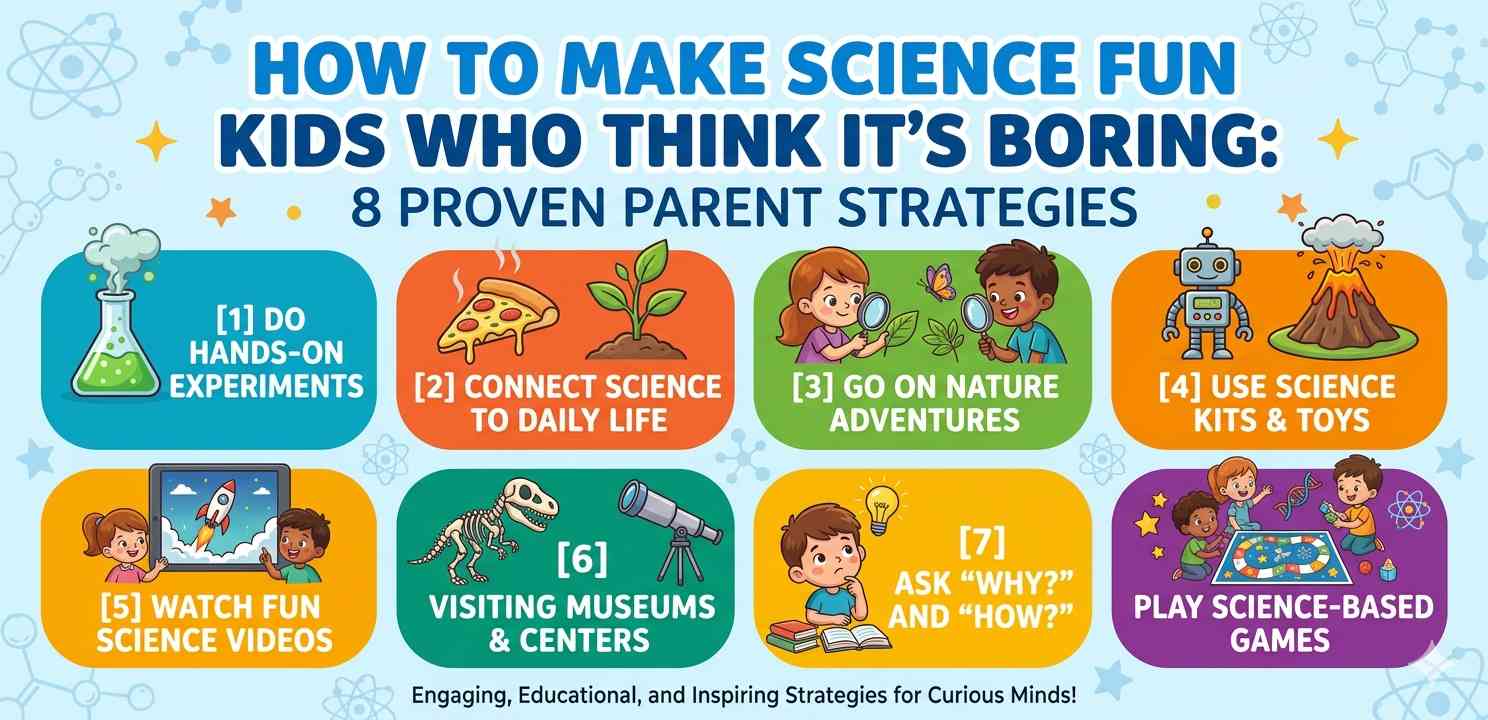
If your child groans every time science homework comes up, you’re not alone. A lot of parents struggle to make science fun for kids — especially when the school textbook makes everything feel like a dry list of facts to memorize. But here’s the thing: kids are naturally curious. They ask “why” about everything. That curiosity is science. It just needs the right environment to grow.
This guide walks you through eight practical strategies that actually work, based on real experiences from parents and educators who’ve been there.
Why Kids Lose Interest in Science in the First Place
Before we get into the strategies, it helps to understand why so many children find science boring.
Most kids don’t hate science itself — they hate how it’s taught. Worksheets, rote memorization, and abstract concepts disconnected from real life make it feel pointless. A child who loves building things in the backyard might still score poorly on a test about Newton’s laws, simply because no one connected the dots for them.
The goal isn’t to replace school. It’s to fill in the gaps at home.
1. Start With What Your Child Already Loves
The easiest way to make science fun for kids is to connect it to something they already care about. Does your child love dinosaurs? That’s paleontology and geology. Do they like cooking? That’s chemistry. Video games? Physics, logic, programming.
Science doesn’t have to start with a textbook. It can start with a plate of food, a toy car, or a question they asked at dinner.
When children see that the things they love have science behind them, their resistance drops almost immediately. This one shift alone can change the entire dynamic.
2. Do Simple Experiments at Home
You don’t need a lab. Some of the best experiments use items already in your kitchen.
Baking soda and vinegar volcanoes. Growing beans in a plastic bag taped to a window. Dissolving different substances in water to see what happens. These activities give children a hands-on experience that no worksheet can replicate.
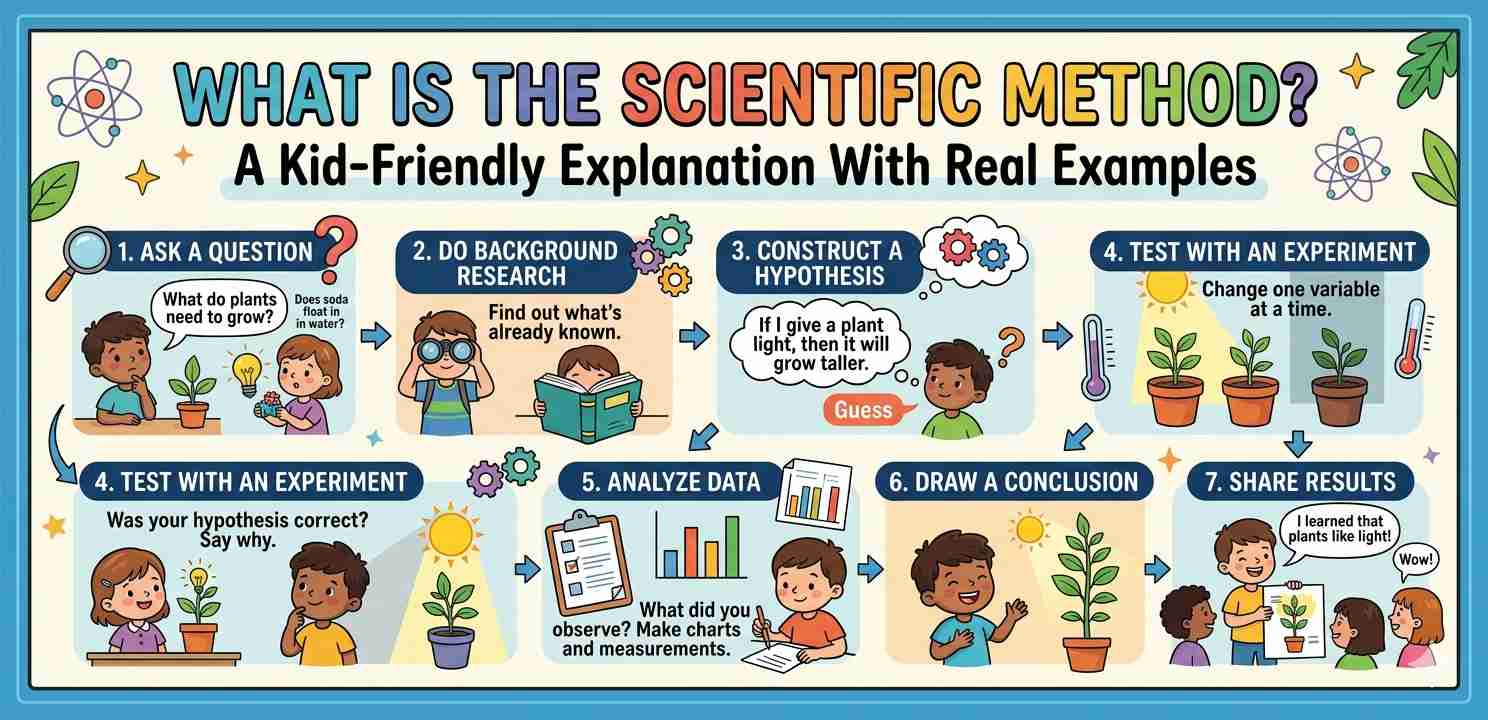
To make science fun for kids through experiments, let them take the lead. Don’t explain everything upfront — let them guess what will happen first. That process of predicting, testing, and observing is literally the scientific method, and it feels like play.
Try platforms like Science Buddies for age-appropriate experiment ideas organized by grade level.
3. Ask Questions Instead of Giving Answers
This one is harder than it sounds, especially when you know the answer and just want to explain it. But one of the most powerful ways to make science fun for kids is to pause and ask, “What do you think would happen if…?”
When a child forms their own hypothesis, they’re emotionally invested in finding out whether they’re right. That investment keeps them engaged far longer than passive listening does.
You don’t have to know all the answers either. “I don’t know — let’s find out together” is one of the best things a parent can say. It models intellectual curiosity and removes the pressure of being right or wrong.
4. Use Videos, Documentaries, and YouTube Channels
Not every child learns well from reading. For visual learners especially, science videos can be transformative. Channels like Kurzgesagt, SciShow Kids, and National Geographic present complex ideas in a way that feels more like entertainment than education.
Watching a documentary about deep-sea creatures or space exploration often sparks more genuine questions than a chapter in a textbook ever will. Those questions are your entry points.
After watching together, ask what surprised them. What would they want to learn more about? That conversation is how you make science fun for kids without it feeling like a lesson.
5. Visit Science Museums, Nature Centers, and Planetariums
There’s something about being physically present in a space dedicated to discovery that shifts a child’s mindset. Science museums are designed specifically to make science fun for kids — interactive, sensory, and memorable.
If you don’t live near a big museum, nature centers, zoos, botanical gardens, and even local parks work just as well. Identifying birds, examining insects, and talking about why the sky changes color at sunset are all science conversations in disguise.
The key is to keep it relaxed. These outings shouldn’t feel like homework. Let your child lead and follow their interest.
6. Connect Science to Everyday Life
One of the most underused strategies is simply pointing out science in ordinary moments. Why does bread rise? Why does your phone get warm when you use it too long? Why do puddles disappear after the rain?
These small moments of curiosity add up. When children start noticing science in the world around them, it stops being a subject and becomes a lens.
This is how you make science fun for kids long-term — not with one big project, but with consistent, low-pressure conversations woven into daily life.
For more ideas on integrating science into everyday routines, the National Science Teaching Association offers free resources specifically for parents and caregivers.
7. Let Them Fail (and Learn From It)
Science involves failure. Experiments don’t always work. Hypotheses turn out to be wrong. That’s not a problem — it’s the point.
Many children fear being wrong because school often punishes mistakes. At home, you can create a different environment. When an experiment fails, ask: “Why do you think that happened? What would you change next time?”
This teaches resilience and critical thinking — two skills that go far beyond science class.
To truly make science fun for kids, they need to feel safe exploring ideas without fear of judgment. Your reaction when something goes wrong will either reinforce that fear or dismantle it.
8. Find a Science Role Model They Can Relate To
Children often need to see themselves in the people doing science before they believe they can do it too. Look for scientists, inventors, and researchers who share your child’s background, interests, or story.
Books, podcasts, and YouTube videos about real scientists — especially those who struggled in school or came from ordinary backgrounds — can be surprisingly motivating. It removes the idea that science is only for a certain type of person.
When a child thinks “someone like me did this,” making science fun for kids becomes a much smaller challenge. The mental barrier lowers, and curiosity takes over.
A Note on Patience
None of this happens overnight. If your child has spent years feeling like science is “not for them,” a single experiment or YouTube video won’t undo that. Progress is usually gradual — a small spark of interest here, a question there.
Keep showing up. Keep making connections. Celebrate small wins. The goal isn’t to raise a future scientist (though that would be great). The goal is to raise a child who doesn’t give up on things just because they seem hard at first.
That mindset will carry them through every subject, every challenge, and eventually, every career.
Final Conclusion
Making science feel exciting for children who’ve already decided it’s boring takes patience, creativity, and a willingness to meet them where they are. The eight strategies here — from connecting science to their hobbies, to doing kitchen experiments, to simply asking better questions — all share one thing in common: they put the child’s curiosity at the center.
You don’t need fancy equipment, a science degree, or hours of extra time. You need a little intention and the understanding that when children feel safe to wonder, explore, and occasionally be wrong, they learn far more than any textbook could teach them.
Start small. Stay consistent. And remember — you’re not trying to make science fun for kids all at once. You’re just trying to open one door.