













Blog

  • How to Teach Times Tables to Kids in 7 Days Using Proven Memory Tricks

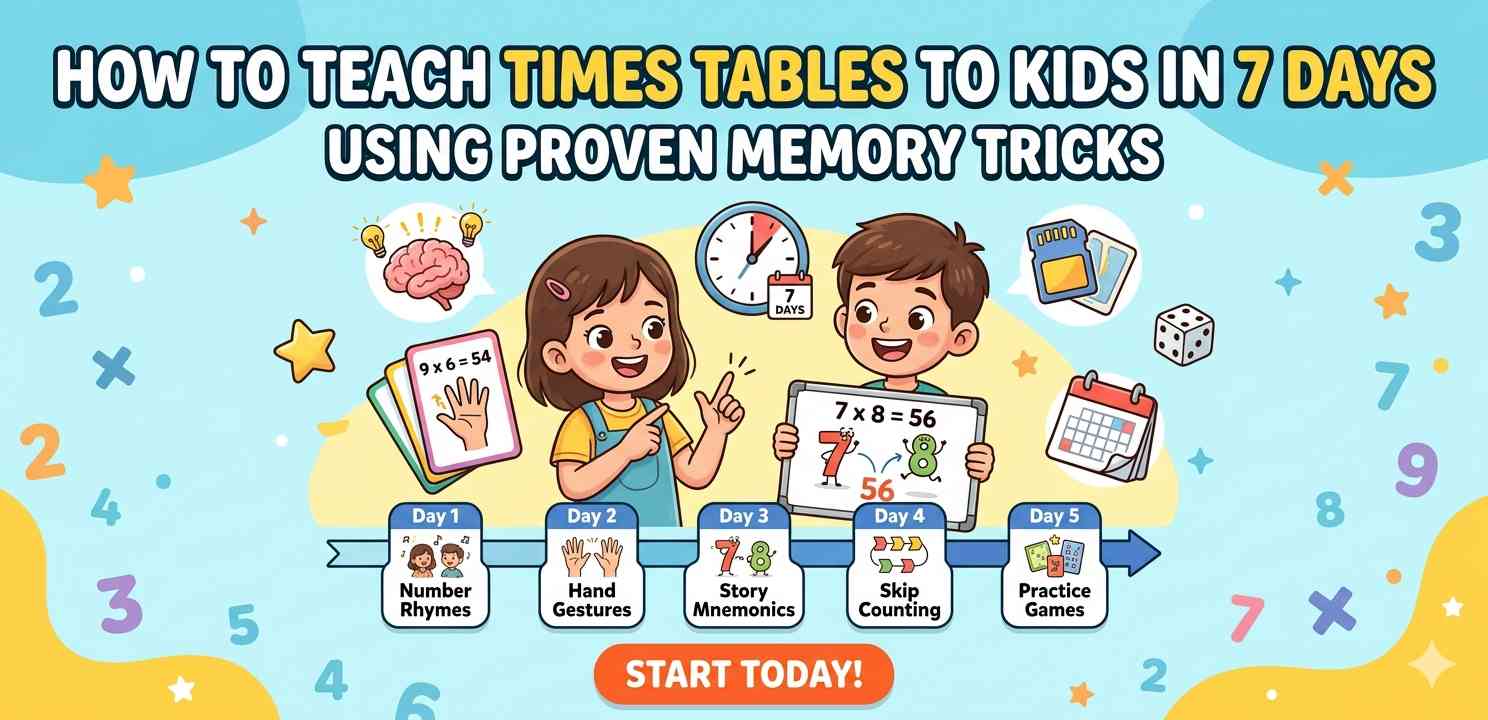
    How to Teach Times Tables to Kids in 7 Days Using Proven Memory Tricks

    If you’ve been trying to teach times tables to kids and feel like you’re hitting a wall every single day, you’re not alone. Most parents and teachers struggle with this. Multiplication feels abstract to young children — and honestly, drilling numbers without any real method rarely works. The good news? With the right structure and a few clever memory tricks, seven days is genuinely enough to build a solid foundation.

    This guide walks you through a realistic, day-by-day plan. No worksheets that look like punishment. No yelling. Just things that actually work.

    Why Most Kids Struggle With Times Tables

    Before jumping into the plan, it helps to understand why kids find multiplication hard. It’s not about intelligence — it’s about how the information is being presented.

    Many traditional approaches treat times tables like a list to memorize. But young brains don’t work well with raw repetition alone. They need patterns, stories, rhythm, and connection to things they already know.

    When you teach times tables to kids using only rote repetition, they might remember it today and forget it by Thursday. That’s frustrating for everyone.

    What You Need Before Day 1

    You don’t need fancy tools. A whiteboard or paper, some colored pens, and around 15–20 minutes of focused daily time is all it takes.

    The key is consistency. Short daily sessions work far better than a two-hour cram session on a Saturday. Think of it like brushing teeth — small, regular, and non-negotiable.

    Also, keep the energy low-pressure. If a child feels anxious, their memory actually shuts down. Relax the atmosphere first.

    Day 1: Start With the Easy Wins (2s, 5s, and 10s)

    On the first day, don’t touch the hard ones. Start with the tables that have clear patterns: 2s, 5s, and 10s.

    Why These Three First?

    The 2 times table is just counting in even numbers — most kids already know this without realizing it. The 5s end in 0 or 5 every time, which is easy to spot. The 10s just add a zero. These three alone cover a surprising number of multiplication facts.

    When you teach times tables to kids starting here, they feel successful early. That confidence matters more than you’d think.

    Spend Day 1 on these three only. Use a number line drawn on paper. Jump along it with a finger. Make it visual and hands-on.

    Day 2: Introduce the Concept of Doubling (4s and 8s)

    The 4 times table is just the 2 times table doubled. So if a child knows 2 × 6 = 12, then 4 × 6 is simply 12 doubled, which is 24. Once you explain this connection, many kids get it almost immediately.

    The 8s follow the same logic — double the 4s. It’s a chain.

    A Simple Way to Explain Doubling

    Ask the child: “If I have 3 bags with 4 apples each, how many apples total?” Count them out with real objects if needed. Tangible examples are incredibly effective at this age.

    To teach times tables to kids using doubling is one of the most natural methods. It links new information to something they’ve already learned — that’s how memory sticks.

    Day 3: The 9s Trick That Kids Actually Love

    The 9 times table has one of the most satisfying tricks in all of elementary math. Hold up both hands, fingers spread out. To solve 9 × 4, fold down the 4th finger from the left. The fingers to the left of it show the tens digit (3), and the fingers to the right show the units digit (6). Answer: 36.

    This hand trick is a genuine memory shortcut, not a gimmick. Kids love it because it feels like a secret code.

    Spend Day 3 practicing the 9s using this method. Go through 9 × 1 all the way to 9 × 10. Repeat it a few times with both hands on the table.

    Day 4: The 3s and 6s — Using Skip Counting and Rhythm

    The 3 times table responds well to rhythm. Clapping, stomping, or singing while skip counting (3, 6, 9, 12, 15…) helps the pattern stick in memory.

    The 6s are just the 3s doubled — same principle as Days 2. Teach the 3s first, get comfortable, then double each answer for the 6s.

    Songs and Rhymes Work Surprisingly Well

    There are short multiplication songs available online that cover specific tables. Using audio alongside repetition activates different parts of the brain. If your child connects the tune to the answer, they’ll remember it more reliably.

    When you teach times tables to kids through music or rhythm, it doesn’t feel like studying. That’s the whole point.

    Day 5: The 7s — The Hardest Table, Handled Carefully

    Let’s be honest — the 7s are difficult. There’s no clean visual trick like the 9s. But there is a useful shortcut: by Day 5, most of the 7s have already been covered through other tables.

    7 × 1, 7 × 2, 7 × 3, 7 × 4, 7 × 5, 7 × 6 — these answers were all learned while practicing the 1s, 2s, 3s, 4s, 5s, and 6s. Multiplication is commutative, meaning 7 × 4 is the same as 4 × 7.

    So on Day 5, draw a simple grid and show the child how much they already know. The only genuinely new fact in the 7s is 7 × 7 = 49. Focus there.

    Day 6: Review and Fill in the Gaps

    Don’t introduce anything new on Day 6. Use this day to go back over everything practiced so far.

    A quick quiz format works well — but keep it playful. Call out a random problem: “Quick! 6 times 8!” If they hesitate, that’s useful feedback about where to spend a few more minutes.

    You can also try multiplication games online — there are free, age-appropriate options that make review feel like a game rather than homework. Sites like BBC Teach also have structured activities for primary-age children.

    To properly teach times tables to kids, review is just as important as new learning. Memory consolidates during sleep and repetition — so Day 6 is doing important work even if it feels like a rest day.

    Day 7: Test With Real-Life Scenarios

    On the final day, skip the abstract questions and go practical. Use real-life scenarios:

    • “We have 6 plates. Each plate needs 4 strawberries. How many do we need from the shop?”
    • “You want to share 24 cookies equally between 8 friends. How many does each person get?”

    This bridges multiplication with division naturally and shows the child that what they learned has actual uses — not just school test uses.

    Celebrate What They’ve Done

    Genuinely acknowledge the progress. Seven days of consistent practice is real effort for a young child. A sticker chart, a small reward, or even just enthusiastic praise makes a difference in building a positive association with math.

    When kids associate positive emotions with learning, they retain information better and approach future challenges with less resistance.

    Common Mistakes to Avoid

    Here are a few things that tend to slow down progress when parents or teachers try to teach times tables to kids:

    Starting with the hard tables first. Always build confidence before complexity.

    Doing too much in one session. Twenty minutes daily is enough. Longer sessions cause mental fatigue, especially in children under 10.

    Using only one method. Mix visual, auditory, and hands-on approaches throughout the week.

    Skipping review days. New information fades fast without reinforcement. Don’t skip Day 6.

    How to Keep the Learning Going After Day 7

    Seven days gets you to a solid foundation, not perfection. That’s fine — that’s the goal. After the first week, maintain the knowledge with brief daily practice: five questions at breakfast or before bed.

    You can also find structured resources to supplement your efforts. Sites like Khan Academy Kids offer free, well-structured multiplication content broken down by level.

    The child who can recall tables automatically at age 8 will find algebra far easier at 14. Building this foundation now is genuinely one of the most useful things you can do for their long-term mathematical confidence.

    Final Conclusion

    Learning multiplication doesn’t have to be a battle. The key is breaking the process into manageable steps, using memory tricks that match how children actually think, and keeping the energy positive throughout.

    This 7-day structure gives children early wins, builds on what they know, uses the body and rhythm as memory tools, and ends with real-world practice. When you teach times tables to kids this way — patiently, progressively, and with the right techniques — the results are lasting rather than temporary.

  • Best Educational Subscription Boxes for Kids in 2025: Ranked by Age Group

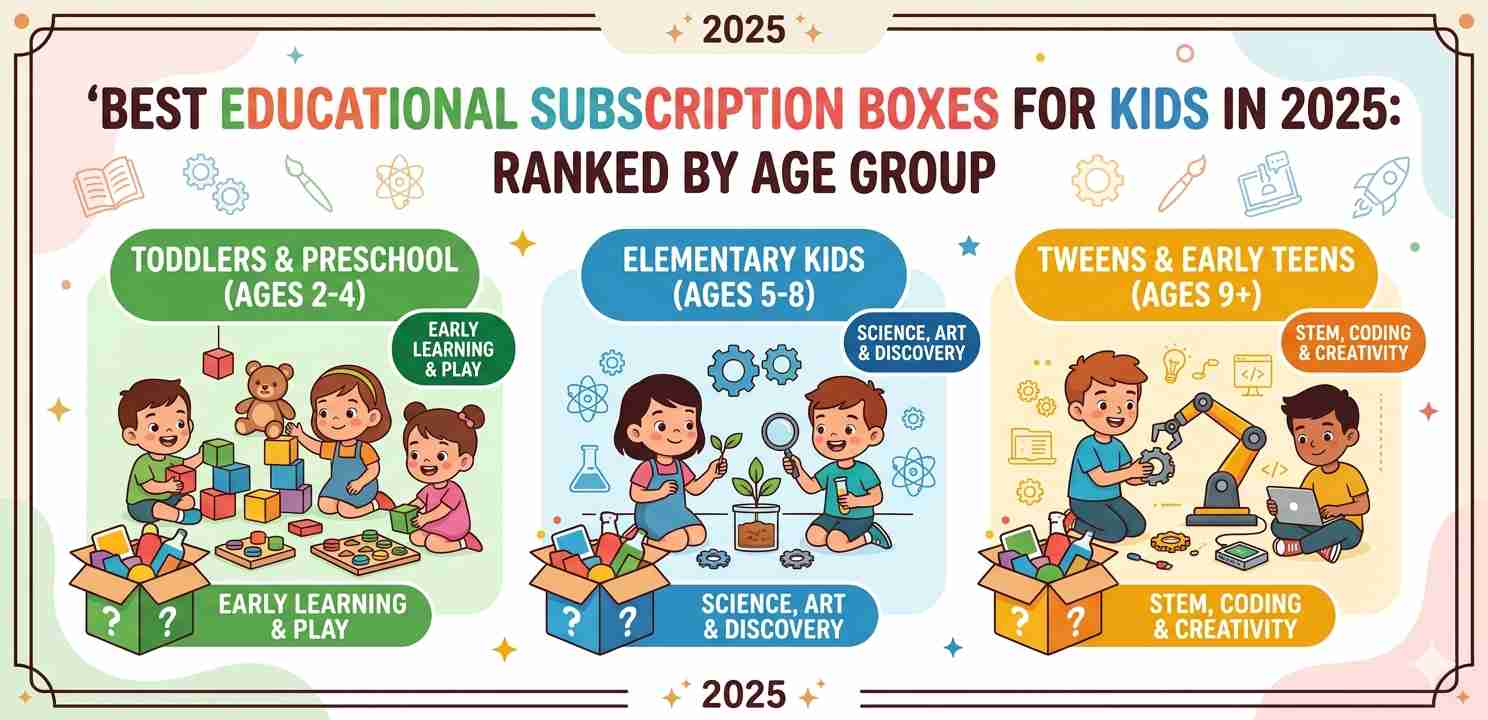
    Best Educational Subscription Boxes for Kids in 2025: Ranked by Age Group

    If you’ve been searching for a meaningful gift that keeps giving, educational subscription boxes for kids might be exactly what you’re looking for. These aren’t just random activity kits — they’re thoughtfully designed learning tools that arrive at your door every month, packed with projects, experiments, books, or puzzles suited to your child’s age and development stage.

    As a parent or educator, choosing the right one can feel overwhelming. There are dozens of options out there, all claiming to be the “best.” So this guide cuts through the noise and ranks the most reliable educational subscription boxes for kids in 2025, sorted by age group so you can find what actually fits your child.

    Why Educational Subscription Boxes for Kids Are Worth It

    Most parents I’ve spoken with start skeptical. They wonder if these boxes actually get used or just pile up in a corner. Honestly, that can happen — but usually when the box isn’t matched well to the child’s age or interests.

    When done right, educational subscription boxes for kids offer something screens often can’t: hands-on, focused attention. A child sitting down to build a circuit kit or paint a ceramic piece is practicing patience, problem-solving, and creativity at the same time.

    And the subscription model helps too. The anticipation of a new box arriving each month becomes its own motivation.

    Ages 2–4: Toddler and Early Learner Picks

    Lovevery Play Kits

    Lovevery has built a strong reputation in the toddler space. Their play kits are designed around specific developmental windows — so a 2-year-old and a 4-year-old get completely different materials, not just resized versions of the same thing.

    Each kit includes open-ended toys, simple books, and a parent guide explaining what skills the activities support. It’s one of the more science-backed options in the educational subscription boxes for kids category.

    Best for: Parents who want Montessori-aligned learning at home.

    Kiwi Co Koala Crate

    Kiwi Co’s Koala Crate is designed for ages 2–4 and focuses on early STEAM concepts — like cause and effect, basic colors, and simple building. Projects are safe, age-appropriate, and designed to be done with a parent.

    My neighbor’s 3-year-old has been getting these for about six months, and honestly, the kid asks about “box day” every month now. That level of engagement says a lot.

    Ages 5–7: Early Elementary Favorites

    KiwiCo Kiwi Crate

    Moving up from the Koala, the Kiwi Crate targets 5–8 year olds and introduces more structured projects — things like building a working pulley, creating a marble run, or making a mini terrarium.

    These educational subscription boxes for kids in this age range are especially good because children are old enough to follow steps independently (mostly), which builds real confidence.

    Little Passports World Edition

    For families who want to lean into geography and culture, Little Passports sends monthly packages “from” a different country — including a mini souvenir, a story booklet, and activities tied to that country’s culture or history.

    It’s a gentle, fun way to introduce global awareness. Not the most hands-on option, but kids who love reading and storytelling tend to really connect with it.

    Ages 8–12: Middle Childhood Deep Dives

    KiwiCo Doodle Crate (Art Focus)

    If your kid is more artistic than scientific, Doodle Crate is worth considering. Projects range from embroidery and watercolor to clay sculpting and printmaking. Each box introduces a real art technique with quality materials.

    This is one of those educational subscription boxes for kids that doesn’t feel like school at all — which is kind of the point.

    Mel Science (Chemistry and Physics)

    Mel Science takes things up a notch. Their chemistry sets are actual lab-grade experiments — things like electroplating, growing crystals using real chemical reactions, or making slime with actual polymer chemistry behind it.

    There’s also an AR app that explains the science visually while the experiment is happening. For kids aged 9 and up who love knowing the “why” behind things, Mel Science stands out among educational subscription boxes for kids.

    Highlights Hello / High Five / Highlights Magazine

    Highlights offers different tiers based on age, all built around reading, puzzles, and creative thinking. It’s been around for generations for a reason — the content is reliably good, and kids who enjoy books tend to devour these.

    For more ideas on building reading habits alongside hands-on learning, you might also want to check out how to build a home learning environment that actually works.

    Ages 13+: Teen-Friendly Options That Don’t Feel Childish

    KiwiCo Eureka Crate (Engineering)

    Teens often reject anything that feels too “young” — and fairly so. Eureka Crate pitches itself to 14+ and the projects are legitimately complex: building a trebuchet, engineering a working electric generator, constructing a hydraulic arm.

    These are educational subscription boxes for kids (older kids) that can take a full afternoon to complete and come with real explanations of the physics and engineering concepts behind each build.

    STEAM Powered Family Mystery Science Box

    This one’s a bit less mainstream but worth mentioning. Each box presents a real-world scientific mystery and challenges the teen to investigate it using included materials. It’s more self-directed than most, which appeals to independent learners.

    Book of the Month (Teen Edition)

    Okay, it’s not a STEM kit — but not every teen is into building things, and that’s fine. Book of the Month’s teen-oriented curation helps young readers discover books they might not find on their own, with solid picks across genres including science fiction, historical fiction, and biography.

    For parents thinking about combining reading subscriptions with other learning tools, this roundup of at-home learning resources for teens might also be helpful.

    What to Look for When Choosing Educational Subscription Boxes for Kids

    It’s easy to get swayed by nice packaging or a well-designed website, so here are the things that actually matter:

    Age appropriateness. This is the biggest one. Educational subscription boxes for kids are most effective when the difficulty level matches what the child can do — and stretches them just slightly beyond it.

    Subject alignment. Does your child love science? Art? Stories? Coding? There’s a box for each. Don’t buy a chemistry kit for a kid who’s really into drawing.

    Completion rate. Some boxes arrive with ambitious projects that never get finished. Read reviews from parents, not just curated testimonials on the brand’s website.

    Value for money. Most boxes run between $20–$50 per month. At that price point, look for boxes where the materials quality justifies the cost. A box with cheap plastic components loses its educational value fast.

    A Few Things to Watch Out For

    Not everything marketed as “educational” actually is. Some educational subscription boxes for kids lean heavily on the branding but deliver very thin content. Watch out for boxes that are mostly consumable items with little reuse value, or ones where the “learning” is surface-level at best.

    Also, subscription boxes can pile up if your child loses interest. Most reputable companies offer easy cancellation — but it’s worth reading the fine print before committing to a 6-month plan.

    One more thing: always check if the box ships to your region. Several popular options are US-only, and international shipping can add significant cost.

    How to Try Before You Subscribe

    A few brands — including KiwiCo and Little Passports — offer one-time gift boxes or trial months. This is the best way to test whether a specific box actually resonates with your child before you commit to a recurring charge.

    You can also find reviews and unboxing videos made by actual parents (not sponsors) on YouTube. Look for recent 2024–2025 videos since box content changes regularly.

    For a broader overview of what developmental experts say about hands-on learning tools, the American Academy of Pediatrics has published useful guidance on play-based learning worth reading. And for curriculum-aligned options, the National Education Association occasionally reviews at-home learning resources.

    Final Conclusion

    Finding the right educational subscription boxes for kids in 2025 isn’t about picking the most popular one — it’s about matching the box to your child. A toddler needs open-ended exploration. A 10-year-old science lover needs real experiments. A teenager needs something that respects their intelligence.

    Use this guide as a starting point, look at trial options where available, and don’t be afraid to switch if the first choice doesn’t click. The goal is a child who’s genuinely engaged — and that’s worth getting right.

  • Hello world!

    Welcome to WordPress. This is your first post. Edit or delete it, then start writing!