 editer@kidkosh.in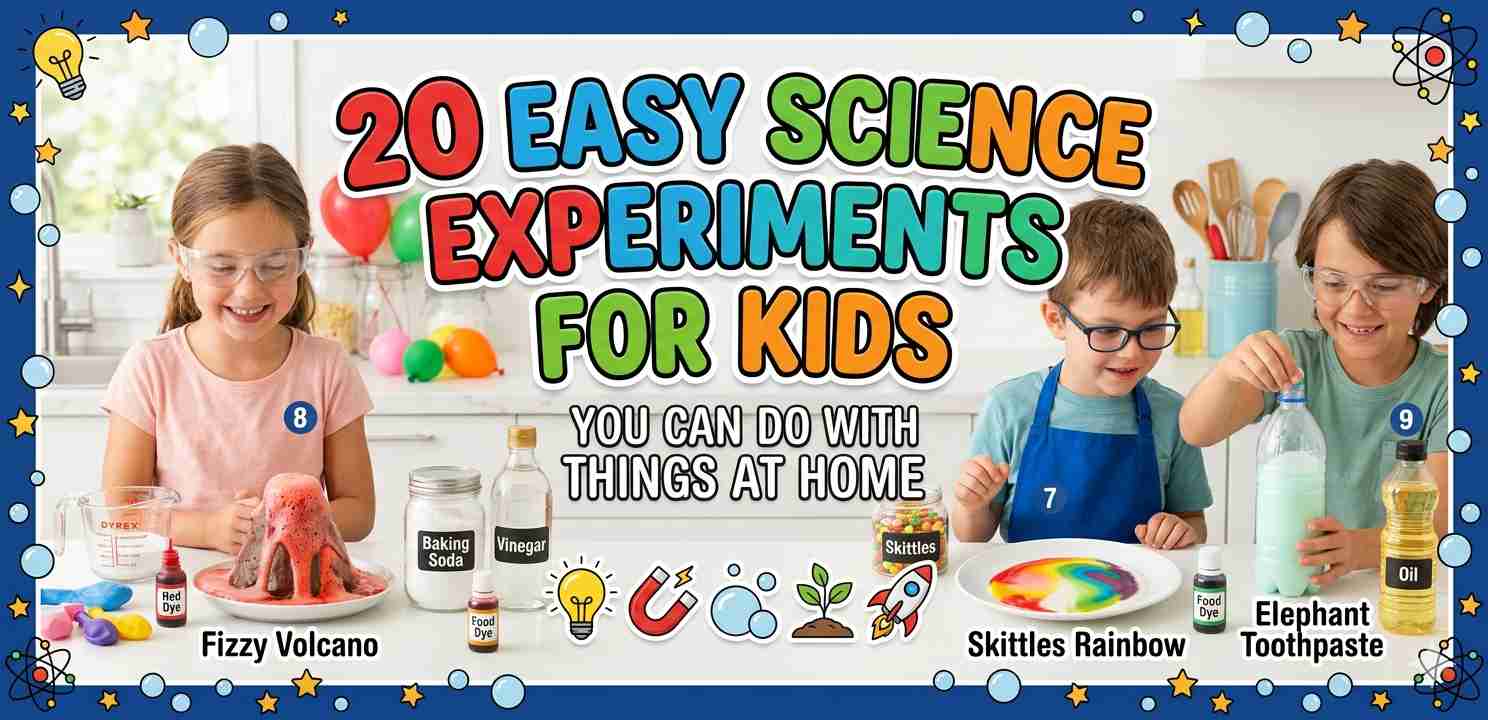
If you’re a parent or a teacher trying to make learning more engaging, easy science experiments for kids are one of the best tools you have. No need to buy a fancy kit or visit a science lab. Most of what you need is already sitting in your kitchen or bathroom cabinet.
Science stops being scary when kids can touch it, watch it happen, and ask “why did that do that?” This guide puts together 20 experiments that are simple enough for beginners, safe for young children, and genuinely fascinating to watch.
Why Easy Science Experiments for Kids Actually Matter
There’s a difference between reading about how volcanoes work and watching a baking soda reaction bubble up like lava in your kitchen sink. Easy science experiments for kids build curiosity, improve observation skills, and make abstract ideas feel real.
Studies in early childhood education consistently show that hands-on activities help children retain concepts longer than passive learning. When a child mixes vinegar and baking soda and sees the fizzing reaction, they’re learning about chemical reactions — without it feeling like a lesson.
It also builds confidence. When an experiment works, kids feel like they figured something out on their own. That’s a really good feeling to nurture early.
What You’ll Need (General Supplies)
Most of these easy science experiments for kids use items you already own. Here’s a general list:
- Baking soda and vinegar
- Food coloring
- Water and cooking oil
- Salt and sugar
- Balloons
- Eggs (raw and hard-boiled)
- Plastic bottles and glasses
- Paper towels
- Toothpicks and string
- A torch or flashlight
You might need one or two specific items for some experiments, but nothing expensive or hard to find.
20 Easy Science Experiments for Kids at Home
1. Baking Soda Volcano
The classic. Mix baking soda inside a clay or bottle “volcano,” then pour in vinegar mixed with red food coloring. The chemical reaction produces carbon dioxide gas, which pushes the liquid up and out like a mini eruption.
It teaches: acid-base reactions, gas production.
2. Walking Water Experiment
Fill three cups — two with colored water (different colors) and one empty in the middle. Connect them with strips of paper towel. Over a few hours, watch the colored water “walk” up the paper and mix in the empty cup.
It teaches: capillary action, color mixing.
3. Homemade Lava Lamp
Fill a clear glass with water and vegetable oil. Add a few drops of food coloring, then drop in a small piece of an effervescent tablet (like Alka-Seltzer). Watch the blobs rise and fall as the gas bubbles interact with the liquids.
It teaches: density, liquid separation, gas behavior.
This is one of the most visually engaging easy science experiments for kids and works especially well at night with a flashlight underneath the glass.
4. Dancing Raisins
Drop a handful of raisins into a glass of carbonated water (like soda water or lemonade). The bubbles cling to the raisins, lift them up, pop at the surface, and the raisins sink again.
It teaches: buoyancy, gas bubbles, density.
5. Egg in a Bottle
This one looks like magic. Hard-boil an egg, peel it, and place it over the mouth of a glass bottle (the egg should be slightly too big to fall in). Drop a lit piece of paper inside the bottle quickly, place the egg on top. The egg gets sucked in.
It teaches: air pressure, the behavior of gases when heated and cooled.
6. Invisible Ink Letters
Mix lemon juice with a little water. Use a cotton swab to write a message on white paper. Let it dry. Hold it near a lamp or warm bulb. The heat makes the writing appear.
It teaches: oxidation, how heat affects chemical compounds.
Easy science experiments for kids like this one are perfect for combining creativity and science in one activity.
7. Milk and Vinegar Plastic
Heat milk (with adult help), add a splash of vinegar, stir, and watch it curdle. Strain the solid lumps, mold them into a shape, and let them dry overnight. You get a hard, plastic-like material.
It teaches: chemistry, polymers, protein reactions.
8. Pepper and Soap Surface Tension
Sprinkle pepper on the surface of a bowl of water. Touch the center with a soapy fingertip. The pepper shoots to the edges instantly.
It teaches: surface tension, how soap reduces it.
9. Cloud in a Jar
Pour hot water into a jar, place an ice cube on the lid, and let a drop or two of hairspray in first. In a few seconds, a visible cloud forms inside the jar.
It teaches: condensation, how clouds form in the atmosphere.
10. Balloon Rocket
Tie a string across a room. Thread a straw onto the string before tying one end. Blow up a balloon, tape it to the straw (don’t tie the balloon), and let go. It shoots across the string.
It teaches: Newton’s third law of motion — every action has an equal and opposite reaction.
11. Elephant Toothpaste
Mix hydrogen peroxide (3%) with a little dish soap in a tall bottle. In a separate cup, dissolve dry yeast in warm water and add it to the bottle. A huge, foamy “toothpaste” erupts out.
It teaches: catalysts, exothermic reactions, decomposition of hydrogen peroxide.
This is one of those easy science experiments for kids that gets a huge reaction (literally and figuratively) every single time.
12. Homemade Rain Gauge
Cut a plastic bottle in half. Invert the top half and place it inside the bottom half as a funnel. Mark measurements on the side with a marker. Leave it outside to collect and measure rainfall.
It teaches: measurement, weather observation, data collection.
13. Cornstarch and Water (Oobleck)
Mix 2 parts cornstarch with 1 part water. Poke it slowly and your finger sinks in. Hit it fast and it feels solid. Kids love this one.
It teaches: non-Newtonian fluids, how some substances behave differently under pressure.
14. Floating Egg
Fill one glass with plain water and another with very salty water. Drop an egg into each. The egg sinks in the plain water and floats in the salty water.
It teaches: density, how dissolved solids affect buoyancy.
15. Static Electricity Butterfly
Cut a butterfly shape out of tissue paper. Rub a balloon vigorously on your hair or a wool sweater. Hold it near the butterfly. The wings lift and flutter.
It teaches: static electricity, positive and negative charges.
16. Tornado in a Bottle
Fill a plastic bottle two-thirds with water. Add a drop of dish soap and some glitter. Tape a second empty bottle mouth-to-mouth on top using strong tape. Swirl the bottles in a circle and flip. A mini tornado forms inside.
It teaches: vortex motion, centripetal force, fluid dynamics.
17. Paper Bridge Strength Test
Build a bridge out of a single sheet of paper (folding it in different ways — accordion, tube, arch). Test which shape holds the most weight using small coins.
It teaches: structural engineering, force distribution.
Among easy science experiments for kids, this one is surprisingly good for developing logical thinking and problem-solving.
18. Ice Cream in a Bag
Combine milk, sugar, and vanilla in a small zip bag. Place it inside a larger zip bag filled with ice and salt. Shake hard for about 10 minutes. You get ice cream.
It teaches: freezing point depression, how salt lowers the temperature of ice below 0°C.
19. Chromatography with Markers
Draw a thick dot with a water-soluble marker near the bottom edge of a paper towel. Dip just the very bottom of the paper into water. Watch the colors separate and travel up as the water rises.
It teaches: chromatography, how mixed pigments separate in a solvent.
20. Seed Germination Observation
Place a bean or lentil seed inside a zip bag with a damp paper towel. Tape it to a window. Check it every day and record observations.
It teaches: plant biology, germination stages, patience and scientific documentation.
Tips for Making These Experiments Work Better
Running easy science experiments for kids at home goes smoothest when you:
- Read the steps before starting — don’t improvise mid-experiment
- Prepare your materials in advance — scrambling for supplies breaks the flow
- Let kids make predictions before each experiment. Ask them: “What do you think will happen?”
- Discuss what happened after — even a failed experiment is a learning opportunity
- Keep a notebook — drawing what happened builds scientific thinking habits
For more structured science activities by age group, the Exploratorium Science Snacks collection is an excellent free resource. And for curriculum-aligned activities, Science Buddies offers detailed, well-researched project guides for kids at every level.
You might also find it useful to check our guide on STEM activities for rainy days or our post on how to build a simple science habit at home — both are good follow-up reads for parents starting this journey.
Safety Reminders
Even simple experiments need basic precautions. A few things to always keep in mind:
- Use protective gloves when working with hydrogen peroxide
- Adult supervision is recommended for experiments involving heat, fire, or sharp tools
- Keep chemicals (even household ones) away from eyes and mouth
- Work on a surface that’s easy to clean — newspaper works well
None of these easy science experiments for kids use anything dangerous, but a bit of care goes a long way.
Final Conclusion
Science doesn’t need to happen in a classroom or a lab. With a few kitchen staples and a bit of curiosity, children can observe real scientific principles playing out right in front of them.
These 20 easy science experiments for kids are designed to be accessible, low-cost, and genuinely educational — not just fun for five minutes. They cover chemistry, physics, biology, and engineering in ways that children can understand and remember.
Start with one experiment this week. See how your child responds. Chances are, you’ll both end up wanting to try more.