
 editer@kidkosh.in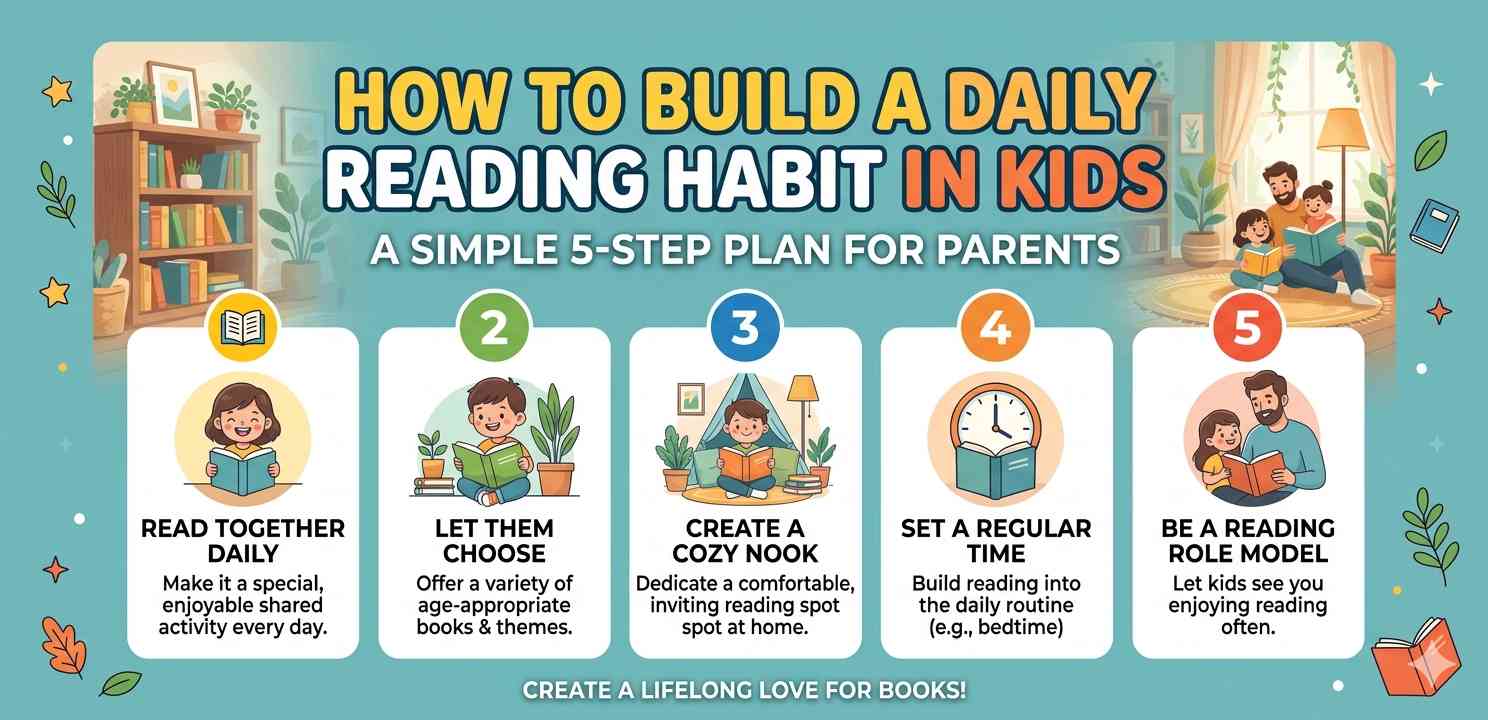
Every parent wants their child to love books. But most of us have tried handing a child a book and watching them drift toward a screen within three minutes. Building a daily reading habit in kids isn’t something that happens overnight — and that’s completely okay.
It takes consistency, patience, and a little bit of knowing what actually works. This guide walks you through a practical 5-step plan, based on what genuinely helps rather than what sounds good in theory.
Why a Daily Reading Habit in Kids Matters More Than You Think
Before we get into the steps, it’s worth understanding why this habit is so worth building in the first place.
Reading every day — even for just 15 to 20 minutes — strengthens vocabulary, improves focus, and builds the kind of deep thinking that no YouTube video can replicate. Kids who read regularly tend to do better in school not just in language subjects but in math and science too, because reading trains the brain to process information carefully.
More importantly, a daily reading habit in kids builds something intangible: a quiet confidence that comes from exploring ideas on their own.
The challenge isn’t convincing kids that reading is good for them. They don’t care about that — and honestly, they shouldn’t have to. The goal is to make reading feel natural, enjoyable, and just part of their day.
Step 1: Start With the Right Books, Not the “Right” Books
One of the biggest mistakes parents make is choosing books they think their child should read. Classic literature. Award-winning stories. Books with impressive vocabulary.
Here’s the thing — if a child finds the book boring, they won’t read it. And forcing them to finish it will make them associate reading with frustration.
When you’re trying to build a daily reading habit in kids, the first priority is finding books they’re genuinely curious about. That might be graphic novels. It might be books about dinosaurs, football, or a series with funny characters and bad puns.
None of that is “less than.” It’s all reading. It all counts.
How to Find the Right Match
- Let your child pick books at the library or bookstore, even if your first instinct is to guide them elsewhere
- Try a few genres before settling — some kids discover they love fantasy or mystery only after stumbling into it
- Check age-range suggestions but don’t treat them as rules; some 8-year-olds comfortably read at a 10-year-old level, and that’s fine both ways
The point is: interest drives habit. A child who wants to know what happens next will pick up the book again tomorrow.
Step 2: Build a Consistent Reading Time Into the Day
Consistency is what separates a habit from a one-time activity. For a daily reading habit in kids to truly stick, it needs a regular time slot — not just “whenever we find time,” because that time rarely shows up on its own.
Most families find that one of these three windows works best:
Right after school — before screens go on. The brain is still in learning mode and it’s easier to slot in 15 minutes here than it seems.
Before bed — the classic, and for good reason. Reading before sleep calms the nervous system, makes falling asleep easier, and creates a warm association with books.
Morning reading — less common, but some kids (especially early risers) genuinely enjoy starting the day with a book.
You don’t need to force a long session. Start with 10 to 15 minutes. That’s genuinely enough to build the daily reading habit in kids you’re aiming for. Once the habit forms, the time naturally expands because they start wanting more.
A Word on Screens
Try to keep reading time screen-free — that means phones put away for you too. Kids notice when a parent is half-reading emails while asking them to focus on a book. It sends a mixed message.
Step 3: Read Together, Even When They Can Read Alone
A lot of parents stop reading aloud once their child can read independently. That’s understandable, but it’s actually one of the most useful things you can continue doing.
Reading together does a few things that silent reading alone can’t easily replicate. It lets you model expression, pacing, and the way a good reader brings a story to life. It also creates shared experiences around books — you both know the characters, you can talk about what might happen next, and that conversation keeps the story alive outside of reading time.
If your child is working on building a daily reading habit in kids, shared reading adds a social layer that makes the whole thing feel less like a solo task and more like something they do with people they like.
Even 10 minutes of reading together before they read independently on their own makes a real difference in keeping engagement high.
Step 4: Create a Reading-Friendly Environment at Home
Environment matters more than most people realize. If books are buried in a pile or stored on high shelves that require effort to reach, kids will naturally reach for whatever is closer and easier — usually a device.
Making a daily reading habit in kids easier is partly about reducing friction. That means:
- Keeping a small basket or shelf of books somewhere visible and accessible — near the sofa, beside the bed, or at the kitchen table
- Making sure there’s good lighting in their reading spot (this actually matters; dim lighting makes reading feel like a chore)
- Having a comfortable place to sit — a beanbag, a reading corner with cushions, or just their bed
You don’t need a fancy setup. The goal is just to make picking up a book feel easy and natural.
Let Them See You Read
This is honestly one of the most underrated tools in building a daily reading habit in kids. Children learn an enormous amount from watching adults, especially parents. If they regularly see you reading — a novel, a magazine, even a long-form article — books become part of the normal texture of daily life.
It doesn’t have to be performative. Just let it be visible.
Step 5: Celebrate Progress Without Adding Pressure
There’s a fine line between encouraging a habit and turning it into a stressor. Reading charts, point systems, and prizes can work for some kids — but for others, they shift reading from something enjoyable to something they’re being evaluated on.
Pay attention to which type your child is. Some kids love tracking their progress and feel motivated by a visual chart. Others feel anxious when reading becomes a performance.
The safest approach when building a daily reading habit in kids is to keep praise low-key and consistent. “I love that you read tonight” goes a long way without adding competitive pressure.
What to Do When the Habit Slips
It will slip. A busy week, a school project, a holiday — something will break the streak. That’s normal.
The key is not to treat a lapse as a failure. Just restart the routine the next day without making a big deal of the interruption. Habits aren’t fragile if you approach them with flexibility. One missed day doesn’t undo a month of consistency.
Common Questions Parents Have About Daily Reading
How long should a child read each day? For younger children (ages 4–7), even 10 minutes is meaningful. For older kids (8–12), 20–30 minutes is a solid target. The goal is regularity, not duration.
What if my child only wants to reread the same book? That’s actually healthy. Rereading builds fluency and comprehension. Let them revisit favorites while gently introducing something new alongside.
Should I use e-books or physical books? Both work. Physical books tend to reduce distractions since there’s no notification popping up mid-chapter. But if an e-reader helps a reluctant reader engage, it’s worth using. Building the daily reading habit in kids matters more than the format.
For more research-backed guidance on early literacy, the Reading Rockets resource from public broadcasting is genuinely useful. And for book recommendations by age and interest, the American Library Association’s Booklist has reliable suggestions.
Final Conclusion
Building a daily reading habit in kids is less about discipline and more about designing the right conditions — the right books, the right time, the right environment, and the right kind of encouragement. None of the five steps here require a major overhaul of your routine.
Start small. Be consistent. Read alongside them when you can. And trust that even a small habit, repeated daily, compounds into something genuinely valuable over months and years.
The goal isn’t to raise a child who reads because they have to. It’s to raise one who reads because they’ve found that books give them something they can’t get anywhere else.