 editer@kidkosh.in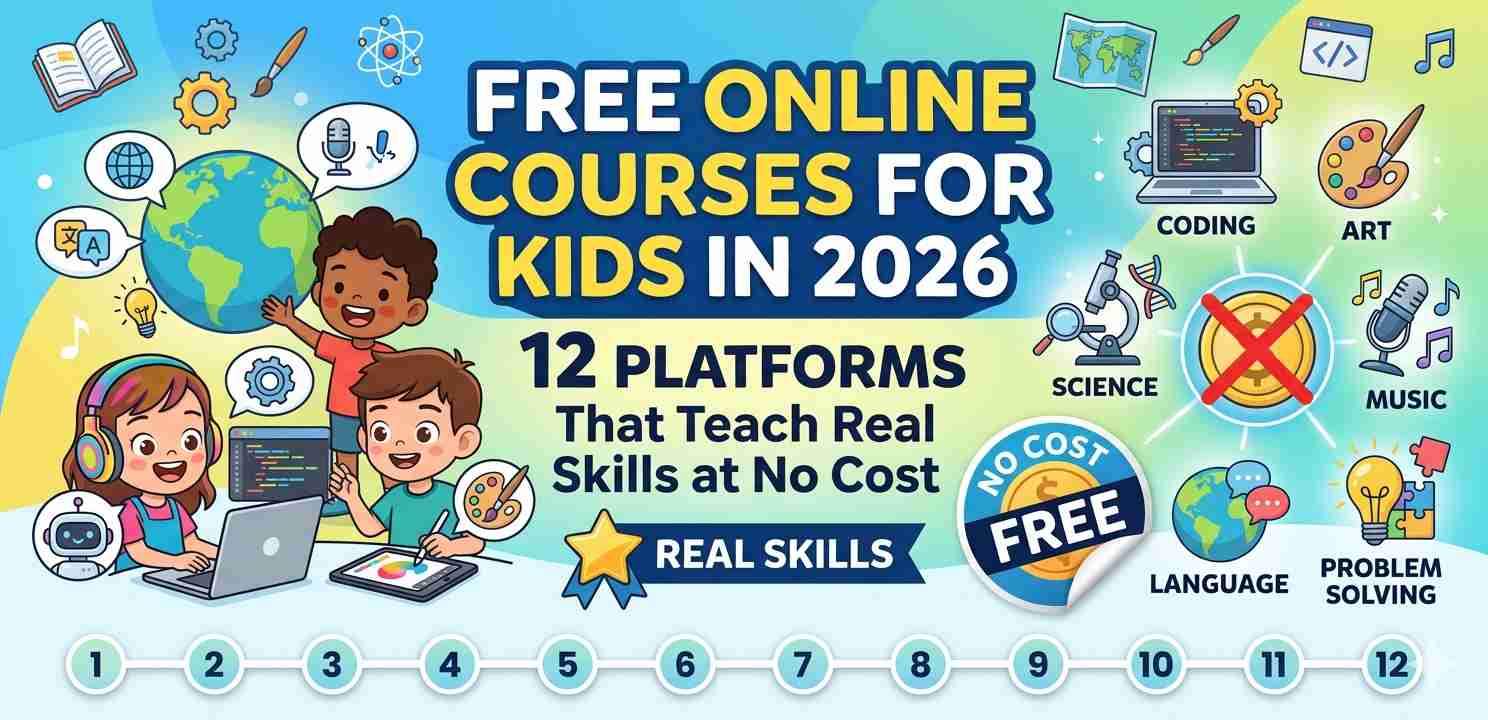
If you’ve been searching for free online courses for kids that actually teach something useful, you’re in the right place. In 2026, there are more quality options than ever before — and most parents don’t even know they exist.
Whether your child is 6 or 16, there are platforms built specifically for young learners. These aren’t just animated videos with nothing behind them. Some of these tools teach real coding, real science, and real math skills that kids can apply in school and beyond.
Why Free Online Courses for Kids Actually Work in 2026
A few years ago, “free learning” meant watered-down content with little structure. That’s changed a lot. Many platforms now offer free online courses for kids with proper lesson plans, progress tracking, and certificates.
The reason this matters: structured learning keeps kids engaged. Random YouTube videos don’t. A platform with levels, badges, and a clear path forward gives children a reason to come back the next day.
Also, parents don’t need to be tech experts to get started. Most of these platforms are designed to work on a basic Android phone or tablet — no special hardware required.
12 Platforms Offering Free Online Courses for Kids in 2026
1. Khan Academy
Khan Academy remains one of the most complete free online courses for kids available anywhere. It covers math, science, history, grammar, and more — from kindergarten level all the way through high school.
Each topic breaks down into short video lessons followed by practice problems. Kids get instant feedback, which really helps with retention. There’s also a parent dashboard to track progress.
2. Code.org
If your child shows any interest in computers, Code.org is a fantastic starting point. It offers free online courses for kids focused entirely on coding — starting from drag-and-drop blocks and progressing to real JavaScript.
The Hour of Code activities are especially good for first-timers. Kids as young as 5 can complete them on a basic Android tablet.
3. Scratch (by MIT)
Scratch is a visual programming platform made by MIT. It’s technically a tool, but MIT also offers guided free online courses for kids through their Scratch curriculum resources.
Children can build their own games, animations, and interactive stories. The learning curve is gentle, and the community is active. You can find Scratch’s educator resources here.
4. Coursera for Kids (via Parents)
Coursera doesn’t market directly to children, but many parents enroll their kids — especially teens — in free audited courses. Subjects range from basic Python programming to introductory science from real universities.
These are genuinely university-level free online courses for kids who are ready for a bit more challenge. A 13 or 14-year-old interested in coding or biology can get real value here.
5. Duolingo
Duolingo is probably the most well-known free language learning platform. But a lot of people don’t know it’s also designed to work really well as a free online course for kids learning English, Spanish, French, or over 30 other languages.
The gamified structure — streaks, experience points, leaderboards — keeps younger learners motivated better than traditional textbooks.
6. NASA Kids’ Club
NASA’s own website offers a surprising amount of free educational content. Their Kids’ Club section has games, activities, and articles that function as structured free online courses for kids interested in space, physics, and earth science.
It’s a great supplement to school science. The content is accurate, safe, and genuinely fascinating for curious children. You can explore it directly at NASA Kids’ Club.
7. Google’s Be Internet Awesome (Interland)
Internet safety is something every child needs to learn. Google’s Interland is a free interactive game-based course that teaches kids how to stay safe online, recognize scams, and protect their privacy.
As a parent, this is one of those free online courses for kids I’d personally make mandatory before handing over a smartphone.
8. Tynker
Tynker offers free and paid plans. The free tier is enough to get a solid start. It’s a structured coding platform designed for kids, with courses built around popular themes like Minecraft and Frozen — which honestly works really well for getting reluctant learners interested.
For free online courses for kids learning to code, Tynker’s free track covers the basics of logic, loops, and conditionals in an age-appropriate way.
9. CK-12
CK-12 is a less-known but seriously underrated platform. It offers free online courses for kids covering STEM subjects — math, science, biology, chemistry, physics — with interactive simulations and adaptive practice.
What makes it different from Khan Academy is the simulation feature. Kids can run virtual science experiments, which is genuinely engaging.
10. Typing.com
Typing might sound basic, but it’s actually one of the most practical digital skills a child can develop. Typing.com offers completely free online courses for kids to learn proper touch typing from the ground up.
Most school curriculums still don’t teach this well. A child who can type 40+ words per minute has a real academic and professional advantage.
11. Canva for Education
Canva’s Education plan is free for verified schools and teachers, but individual learners can also access many free design tutorials through Canva’s own learning hub.
For kids interested in visual creativity, Canva offers free online courses for kids covering design basics, presentation skills, and digital art. These are practical skills that schools rarely teach in depth.
12. edX (Audit Mode)
Like Coursera, edX lets anyone audit courses for free. Teens interested in computer science, data, or even introductory business can find genuinely high-quality free online courses for kids and young adults from MIT, Harvard, and other top institutions.
The key is to filter for beginner-level courses and use audit (free) access rather than paying for certificates.
How to Choose the Right Platform for Your Child
Not every platform works for every child. Here’s a simple way to think about it:
Age 5–8: Start with Scratch, Code.org, or Khan Academy’s early math sections. Keep lessons under 15 minutes.
Age 9–12: Tynker, CK-12, and Khan Academy’s middle school content work really well. Add Typing.com for a practical skill.
Age 13–16: This age group can handle Coursera, edX, or Duolingo for more structured learning. NASA and Canva add creative variety.
The best approach is to let the child explore two or three platforms and see which one they return to voluntarily. That’s usually the best fit.
Tips for Parents Using These Platforms on Android Devices
Most of these platforms work well through a browser on any Android phone or tablet. A few, like Duolingo and Khan Academy, also have dedicated Android apps that are more optimized for mobile use.
Set a bookmark folder on Chrome for your child’s chosen platforms. This makes it easier for younger kids to navigate independently without needing to type in URLs each time. You can also use Android’s “Guided Access” equivalent — called App Pinning — to keep kids focused on a single platform during study time.
Final Conclusion
In 2026, parents no longer need to spend money to give their children access to quality learning. Free online courses for kids now cover everything from coding and science to languages and digital safety — and many of these resources come from genuinely respected institutions.
The most important step is just to start. Pick one platform that matches your child’s age and interest, and let them explore at their own pace. Learning works best when it doesn’t feel like a chore — and most of these platforms are built with exactly that in mind.
If you want to learn more about how to support your child’s digital learning at home, this guide on digital literacy for children from Common Sense Media is a practical place to start.