 editer@kidkosh.in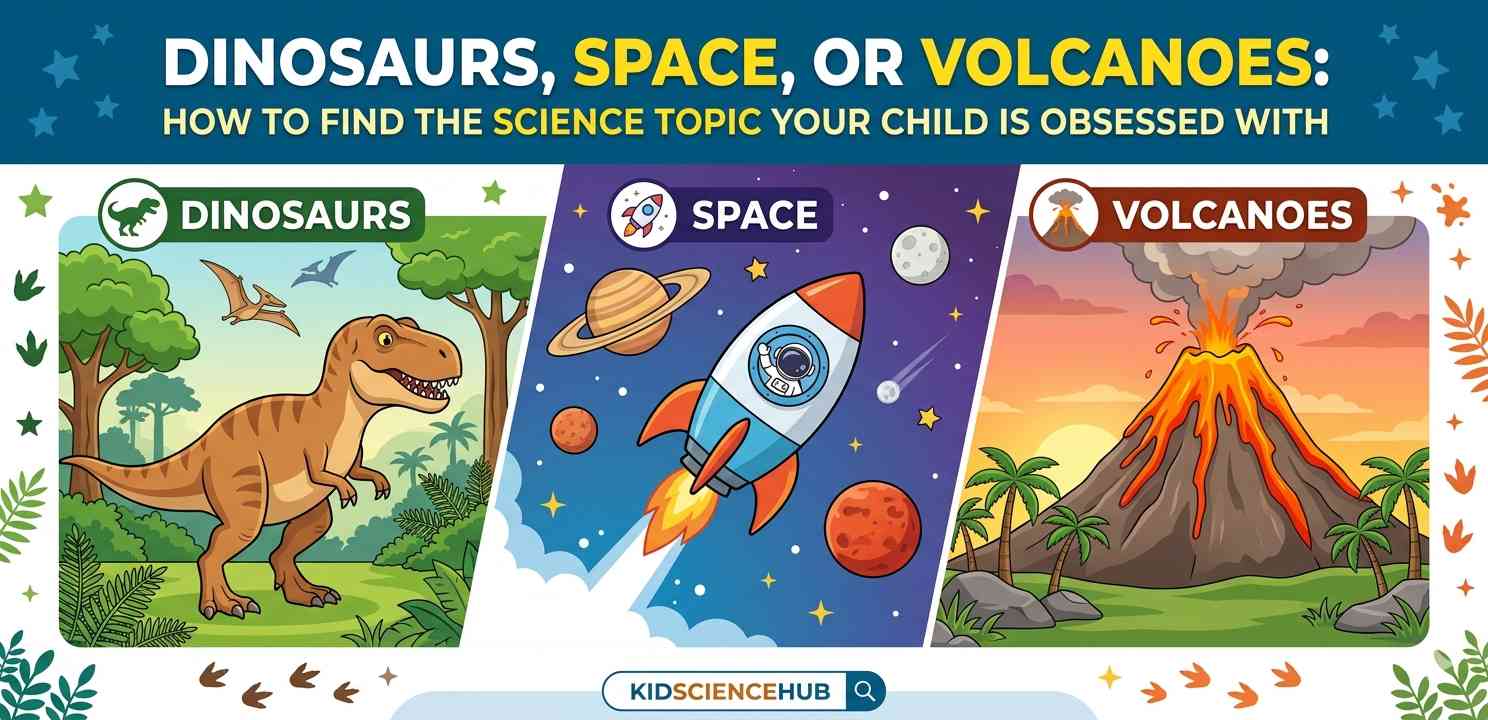
Most parents notice it at some point. Your kid keeps asking the same kinds of questions, wants the same kind of books, or gets unusually excited when a certain topic comes up on TV. That’s not random — that’s a signal. Finding the science topic your child is obsessed with can be one of the most rewarding things you do as a parent, and the earlier you catch it, the better.
This guide is for parents, grandparents, and anyone raising curious kids. We’ll walk through practical ways to spot, confirm, and build on that natural spark — whether it’s about ancient creatures, the solar system, erupting mountains, or something completely unexpected.
Why It Matters to Find the Right Science Topic Early
Children learn best when they actually care about what they’re learning. That might sound obvious, but it has real implications for how you guide them.
When a child finds the science topic your child is obsessed with, they don’t need to be pushed. They ask questions on their own, they remember facts without being drilled, and they connect what they learn at home to what they see at school or outside.
This kind of self-motivated curiosity is exactly what educators want to encourage. It also builds confidence — a child who knows a lot about one area naturally becomes more willing to explore other areas too.
Start by Watching What They Naturally Gravitate Toward
You don’t always need to test your child or sit them down with a quiz. Most of the time, they’re already telling you.
Pay Attention to Their Questions
Kids who are fascinated by space tend to ask things like “How far away is the sun?” or “What would happen if we flew into a black hole?” A child obsessed with volcanoes might ask why the ground shakes or whether lava is hotter than fire.
These questions, especially when they come up again and again, are the clearest sign that you’ve found the science topic your child is obsessed with.
Write them down if you can. You might notice patterns over just a week or two.
Notice What They Draw or Build
Children express curiosity through play and art long before they can explain it in words. If your seven-year-old keeps drawing dinosaurs or building “rockets” from cardboard boxes, that’s meaningful data.
The science topic your child is obsessed with often shows up in creative play before it shows up in conversations.
Common Science Topics Kids Tend to Obsess Over
Every child is different, but certain themes come up again and again. Here are some of the most popular, along with signs that point to each one.
Dinosaurs
Dinosaur obsession is incredibly common, especially between ages three and eight. Kids drawn to this topic usually love sorting things by category, noticing tiny differences between species, and understanding how things existed long before humans.
Signs to watch for: They know the difference between a brachiosaurus and a diplodocus. They correct adults about dinosaur facts. They want every birthday cake to have a T. rex on it.
If this sounds like your household, you’ve likely already found the science topic your child is obsessed with — and it connects to paleontology, biology, and Earth history.
Space and Astronomy
Some kids are drawn to the scale of the universe. The idea that there are billions of galaxies, or that light from distant stars takes millions of years to reach us, genuinely excites them.
Children who lean toward space often enjoy math and patterns naturally. They might ask about the names of all the planets, what astronauts eat, or whether aliens could exist somewhere.
Volcanoes and Earth Science
Kids fascinated by volcanoes are often drawn to the power and drama of natural events. This interest frequently extends to earthquakes, tsunamis, and weather — all forms of Earth doing something dramatic.
They tend to ask “what causes” questions more than “what is” questions. That’s a subtle but important distinction. It suggests an interest in systems and causes, which is a strong indicator you’ve found the science topic your child is obsessed with.
Animals and Ecology
Some children aren’t drawn to one animal — they’re drawn to all of them. They want to know how food chains work, why certain animals go extinct, or what would happen if a species disappeared.
This kind of curiosity often comes with a strong sense of fairness and care for the world, and it can naturally evolve into environmental science, zoology, or marine biology.
Human Body and Medicine
Other kids are fascinated by how the body works. They want to know what happens when you get a cold, how bones heal, or why people need blood.
If your child asks medical questions constantly and isn’t just worried — they’re genuinely curious — this is probably the science topic your child is obsessed with.
Practical Ways to Confirm What They’re Into
Sometimes a child’s interest seems strong but you’re not sure if it’s a passing phase or something deeper. Here’s how to test it gently.
Give Them Two Books and See Which They Reach For
Take a trip to the library or browse online. Pick two science books on different topics and casually leave them out. Don’t make it a big deal. Just see which one gets picked up first, read longer, and asked about more.
This low-pressure approach often reveals the science topic your child is obsessed with more clearly than any direct question.
Use a Science Documentary as a Test
Put on two or three different science documentaries on different evenings. Watch their body language, not just their words. A child who leans forward, asks questions, and wants to keep watching even after bedtime has found something real.
Ask Open-Ended Questions After Activities
Instead of “Did you like it?” try “What was the most interesting part?” or “What would you want to learn more about?” The specificity of their answer tells you a lot.
Children who have found the science topic your child is obsessed with will give you very specific answers. They’ll say “I want to know if any dinosaurs could swim” rather than “I don’t know, it was fine.”
How to Nurture the Interest Once You Find It
Finding the interest is step one. What you do next determines whether it grows or fades.
Build a Small Collection Around That Topic
You don’t need to spend a lot. A few well-chosen books, a poster, maybe one good documentary series — that’s often enough. The goal is to make it easy for your child to keep going deeper on their own time.
For external resources, the NASA Science website for kids and the Natural History Museum’s learning resources are both excellent starting points for astronomy and paleontology respectively. They’re free, reliable, and genuinely interesting for children.
Connect It to Real-World Visits
A nature reserve, a science museum, a planetarium, or even a geology walk in a local park — these experiences make the science topic your child is obsessed with feel real and three-dimensional.
Even a half-hour at a natural history museum can deepen interest more than hours of screen time.
Let Them Teach You
Ask your child to explain what they know. This does two things: it builds their confidence, and it reveals where their understanding is deep versus where it’s still vague. You’ll quickly see whether they’re passionately curious or just casually interested.
Connect It to Other Subjects
Once you’ve found the right science topic your child is obsessed with, you can use it as a bridge. A child who loves dinosaurs can be introduced to geography through fossil sites, art through prehistoric paintings, and writing through storytelling about ancient creatures.
This is one of the great advantages of following a child’s natural curiosity — it connects naturally to many other areas of learning.
You might also find it helpful to explore how science journaling works for kids as a way to combine writing and observation around their favourite topic.
What If They’re Interested in Everything (or Nothing)?
Some children jump from topic to topic, and that’s completely normal. It doesn’t mean they haven’t found their thing — it might mean they’re still exploring.
In this case, don’t rush it. Keep exposing them to a variety of science topics, and pay attention over months rather than weeks. The science topic your child is obsessed with might take longer to emerge for some kids, and that’s fine.
For children who seem resistant to science generally, it’s worth checking whether the issue is the topic or the format. A child who “doesn’t like science” might actually love science when it involves hands-on experiments rather than reading or videos.
Final Conclusion
Every child carries some natural curiosity about the world around them. Your job as a parent or educator isn’t to create that spark — it’s to notice where it already exists and give it room to grow.
The science topic your child is obsessed with might show up in the questions they ask at dinner, the drawings they make on a rainy afternoon, or the way they can’t stop talking about a documentary they watched last week. Pay attention to those moments.
Once you find it, nurture it — with books, experiences, conversations, and the freedom to go deep. A child who develops genuine passion for even one area of science builds habits of curiosity and careful thinking that will serve them their whole life.
You don’t need to be a scientist yourself. You just need to watch closely, stay open, and follow their lead.