 editer@kidkosh.in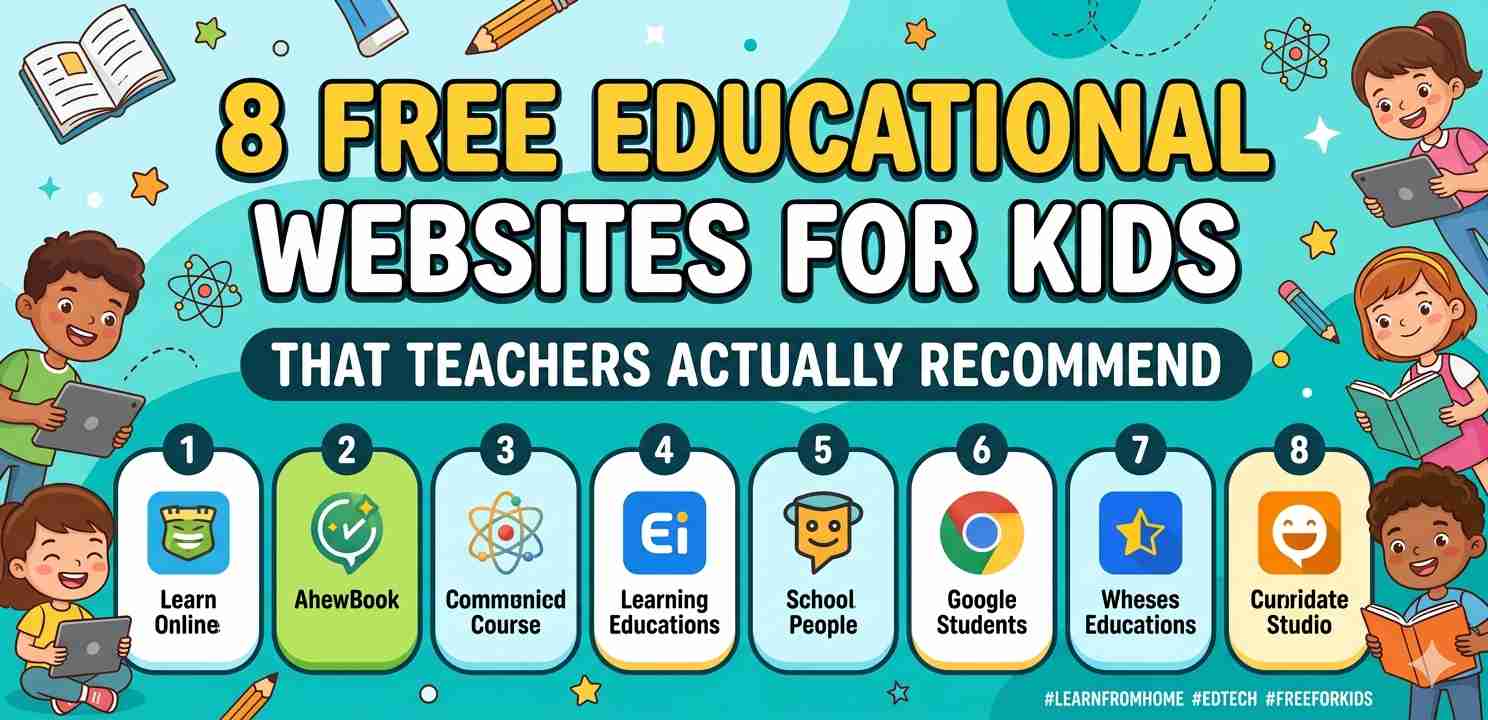
Finding the right learning resources online can feel overwhelming — there are hundreds of websites out there, and honestly, most of them aren’t worth your child’s time. The good news? Teachers spend a lot of time testing these platforms, and a handful of free educational websites for kids have genuinely earned their trust.
This list isn’t based on popularity or ads. These are sites that educators actually use in classrooms, suggest to parents during parent-teacher meetings, and recommend in school newsletters. Let’s go through them one by one.
Why Teacher-Recommended Sites Matter More Than You Think
A lot of parents just Google “learning games for kids” and go with whatever appears first. That’s not always a bad approach, but teacher-recommended free educational websites for kids tend to be more structured, age-appropriate, and curriculum-aligned.
Teachers know what children actually struggle with — whether it’s place value in math, phonics in early reading, or understanding basic scientific concepts. When they recommend a platform, it’s usually because they’ve seen it make a real difference in the classroom.
1. Khan Academy — Still One of the Best Free Learning Platforms
Khan Academy has been around for years, but it keeps getting better. It covers everything from kindergarten math to high school biology, and the lessons are genuinely well-made.
What makes it stand out is the mastery-based learning system. Kids can’t just skip ahead — they earn progress by actually understanding each concept. Teachers love this because it mirrors how a good classroom works.
It’s completely free, has no ads, and works on phones, tablets, and computers. If you’re only going to bookmark one of these free educational websites for kids, this is probably the one.
Grade range: K–12 Best for: Math, science, history, grammar
2. PBS LearningMedia — Curriculum-Aligned and Classroom-Tested
PBS has been creating educational content for decades, and their online platform is a natural extension of that. PBS LearningMedia offers videos, interactive activities, and lesson materials that are directly tied to school standards.
Many of the videos you’ll find here are the same ones teachers play in class. That continuity helps children make connections between what they’re watching at home and what they’re learning at school.
It’s one of the free educational websites for kids that parents don’t always know about, but teachers use it regularly for lesson planning and student activities.
Grade range: Pre-K through 12 Best for: Science, social studies, arts
3. Starfall — Perfect for Early Readers
If you have a child between the ages of 4 and 8 who is just beginning to read, Starfall is genuinely excellent. The phonics instruction is systematic and clear, and the activities are designed to build confidence, not just test it.
Starfall was designed with input from reading specialists, and it shows. The way it breaks down letter sounds and blending patterns aligns well with how teachers approach early literacy instruction.
There’s a free version and a paid tier, but the free content alone is substantial and genuinely useful. For parents of young readers, this belongs on your list of go-to free educational websites for kids.
Grade range: Pre-K through Grade 2 Best for: Reading, phonics, early literacy
4. National Geographic Kids — Learning That Doesn’t Feel Like Learning
Kids often resist anything that looks like schoolwork. National Geographic Kids has somehow figured out how to make science, geography, and nature genuinely exciting — without dumbing it down.
The articles are well-written and age-appropriate. The photography is incredible. And the facts are accurate, which matters a lot when you’re using a site for educational purposes.
Teachers frequently point parents toward this site for homework help, independent reading, and encouraging curiosity about the natural world. It’s one of those free educational websites for kids that children will actually choose to visit on their own.
Grade range: Elementary and middle school Best for: Science, nature, geography, animals
Learn more about National Geographic’s educational mission
5. Funbrain — Games with Real Academic Value
Funbrain has been around since 1997, and it’s evolved quite a bit since then. It blends reading, math, and problem-solving into game-style activities that feel fun but are built around educational goals.
There are also books available to read directly on the site — including some popular series that kids actually enjoy. It bridges the gap between entertainment and academic skill-building in a way that works for a lot of kids.
It’s not as structured as Khan Academy, but it’s a great option for children who learn best through play. Several teachers in lower elementary grades suggest it as an option for weekend or evening practice — especially for math fluency and reading comprehension.
Grade range: Pre-K through Grade 8 Best for: Math, reading, language arts
6. CoolMath Games — Yes, This One Is Legitimate
A lot of parents assume CoolMath Games is just a distraction. And fair enough — it looks like a gaming site. But many of the games genuinely require logical thinking, pattern recognition, and mathematical reasoning.
Teachers sometimes suggest it as a reward activity, but also as a way to develop number sense and problem-solving skills in kids who struggle to engage with traditional math formats.
It’s worth noting that the site also has a more straightforward tutorial section — CoolMath.com — with explanations for pre-algebra and algebra concepts. Among free educational websites for kids who find math frustrating, this one has helped a surprising number of students build genuine confidence.
Grade range: Grades 3–8 Best for: Math, logical thinking, problem-solving
7. Newsela — Building Reading Skills Through Real News
Newsela takes current events and news articles and adapts them to different reading levels. So a single article about climate change, for example, can be read by a third grader or a seventh grader — both get the same story, just written at their level.
This is a site that teachers use in class almost every week in many schools. It builds reading comprehension, vocabulary, and awareness of the world, all at the same time.
There’s a free tier with limited access, but even that provides solid value. For older elementary and middle school students, Newsela is one of the most practical free educational websites for kids available.
Explore Newsela’s free resources for learners
Grade range: Grades 2–12 Best for: Reading, nonfiction comprehension, critical thinking
8. Scratch — Teaching Kids to Think Computationally
Scratch is a programming platform developed at MIT. Kids use colorful drag-and-drop blocks to create their own games, animations, and interactive stories. It sounds simple, but the thinking behind it is surprisingly deep.
Even children who have no interest in becoming programmers benefit from Scratch because it teaches logical sequencing, debugging, and creative problem-solving. These are skills that transfer across every subject.
Many schools use Scratch as part of their technology or STEM curriculum. Teachers across grade levels have found it especially effective for children who get bored easily — building something you made yourself is a powerful motivator.
Grade range: Ages 8 and up Best for: Coding, creative thinking, logic, STEM
You can also check out our guide to STEM activities for kids at home and our overview of screen time strategies for parents for more ideas on balancing digital learning with offline activities.
How to Use These Sites Without Overdoing Screen Time
Even the best free educational websites for kids work better when they’re used with intention. A few practical suggestions:
Set a time limit before you start. Even 20–30 minutes of focused, purposeful learning is more valuable than two hours of scattered browsing.
Let your child choose which site they want to explore on a given day. Giving them some ownership over their learning tends to increase engagement and reduce resistance.
Check in after sessions. Ask them what they learned or made — this reinforces retention and opens up conversation about what they’re curious about.
Final Conclusion
There’s no shortage of content online, but genuinely useful, teacher-trusted free educational websites for kids are rarer than you’d think. The eight platforms covered here — from Khan Academy’s structured lessons to Scratch’s creativity-driven coding environment — represent the kind of resources that hold up over time.
They’re free, they’re safe, and they actually work. That combination is harder to find than it should be. Whether your child is just learning to read or starting to tackle algebra, these sites offer something meaningful. Start with one or two and see which ones click — every child learns a little differently.