 editer@kidkosh.in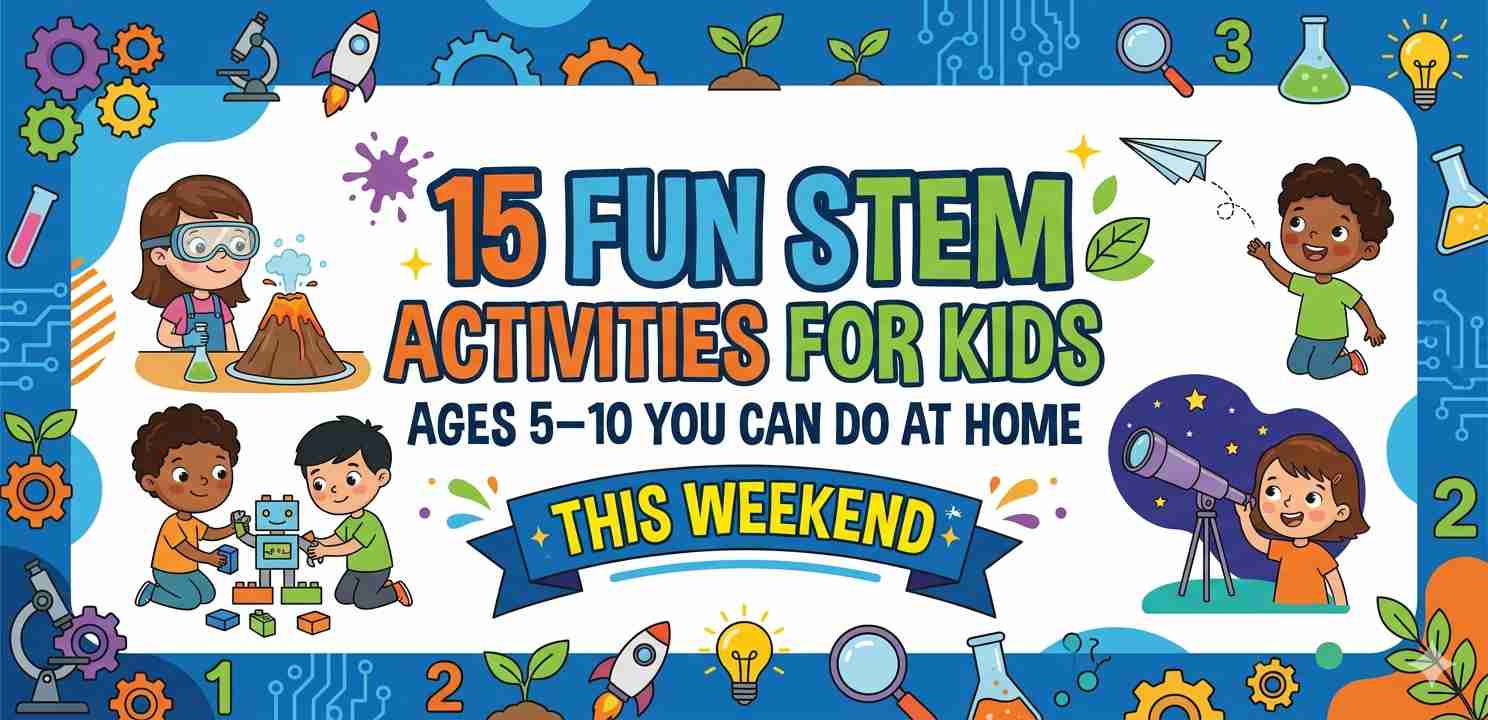
If you’ve been searching for genuinely useful STEM activities for kids that don’t require a science lab or a big budget, you’re in the right place. Most of these ideas use things already sitting in your kitchen or junk drawer — and kids actually enjoy doing them.
STEM stands for Science, Technology, Engineering, and Math. But honestly, at this age, it’s less about categories and more about getting kids to think, try, and figure things out. That’s the real goal.
Why STEM Activities for Kids Matter More Than You Think
A lot of parents assume STEM is just for “smart kids” or future engineers. That’s really not true. STEM activities for kids at a young age are more about building habits — curiosity, patience, problem-solving — than memorizing facts.
When a 6-year-old figures out why a bridge they built from popsicle sticks collapsed, they’re learning more than any worksheet could teach. They’re learning to try again. That’s huge.
What You’ll Need (Not Much, Really)
Before jumping into the list, here’s a quick heads-up. Most of these STEM activities for kids need:
- Baking soda and vinegar
- Paper, cardboard, tape
- Plastic cups or bottles
- Measuring spoons and kitchen scale
- Colored water or food coloring
You probably have 80% of this already. Let’s get into it.
15 Fun STEM Activities for Kids You Can Start Today
1. Baking Soda Volcano
Classic for a reason. Mix baking soda inside a clay or playdough “mountain,” then pour in vinegar. The fizzing reaction always gets a big reaction from kids — even if they’ve seen it before.
This is one of the easiest STEM activities for kids because there’s almost no prep. And you can extend it by asking: What happens if we use more baking soda? Less vinegar?
2. Build a Paper Bridge
Challenge your child to build a bridge using only 5 sheets of paper and some tape. Then test how many small objects (coins, erasers) it can hold before it collapses.
Engineering thinking starts young. This activity builds it without them even noticing.
3. Kitchen Density Tower
Layer liquids of different densities — honey, dish soap, water, oil — in a clear glass. Each layer floats on top of the other without mixing. Kids ages 7 and up especially love this one.
This is one of those STEM activities for kids that looks like magic but teaches real science. Ask them to guess the order before you start.
4. Grow Beans in a Zip-Lock Bag
Place a damp paper towel and a few beans inside a clear zip-lock bag. Tape it to a sunny window. Within a few days, kids can watch roots and shoots form in real time.
Simple, slow, satisfying. Perfect for ages 5–7. It also opens a conversation about what plants actually need to grow.
5. Magnetic Maze
Draw a simple maze on paper, place a small metal ball or paperclip inside it, and use a magnet from below to guide it through. You can make the maze harder as your child improves.
One of the more creative STEM activities for kids that mixes problem-solving with a bit of play.
6. Egg Drop Challenge
Wrap a raw egg using cotton balls, rubber bands, straws, and tape. Then drop it from a height (a chair or low balcony works). Did the egg survive?
This one requires a little cleanup prep, but kids love it. It teaches cushioning, force, and creative thinking all at once.
7. DIY Lava Lamp
Fill a bottle with water and oil. Add food coloring and then drop in a fizzing antacid tablet. Watch the colored blobs rise and fall.
This is honestly one of the most visually impressive STEM activities for kids on this list — and it costs almost nothing.
8. Sink or Float Experiment
Fill a large bowl or bucket with water. Collect random household objects — spoon, apple, coin, sponge, crayon — and ask your child to predict whether each will sink or float.
Write down predictions first. Then test. The surprise moments are where learning happens.
9. Simple Circuit with a Battery and Bulb
Using a 9V battery, some copper wire, and a small LED bulb (available cheaply online), build a basic circuit. When the circuit is complete, the bulb lights up.
For kids ages 8–10, this is one of the best hands-on STEM activities for kids to introduce electricity safely and simply. You can find beginner circuit kits on sites like Science Buddies that guide you step by step.
10. Measure and Graph the Weather
Every morning for a week, check the temperature and write it down. At the end of the week, make a simple bar graph together. Talk about patterns.
It’s math, it’s science, it’s data literacy — all wrapped in something they can do in five minutes a day.
11. Paper Airplane Distance Test
Make three different paper airplane designs. Test which flies the farthest. Measure with a tape measure. Record the results.
Then ask: Why do you think that one went farther? Let them hypothesize. That’s real scientific thinking, right there. This is one of the STEM activities for kids that almost always turns into a 45-minute session.
12. Slime (Yes, It Counts)
Mix white school glue with a bit of borax solution or contact lens solution to make slime. While kids mostly just want to squish it, you can talk about polymers and non-Newtonian fluids at whatever level suits the age.
For 5–7 year olds, it’s just fun. For 8–10 year olds, it’s chemistry they’ll remember.
13. Coded Treasure Hunt
Write a simple treasure hunt where clues involve basic math problems or logic puzzles. “Go to the place where 3+4 steps from the door meets the tallest thing in the room.”
This blends coding logic with physical activity. One of the more creative STEM activities for kids that doesn’t need a screen at all.
14. Water Filter Experiment
Layer gravel, sand, and a coffee filter inside a cut plastic bottle. Pour muddy water through and watch it get cleaner. It won’t make it drinkable, but the concept is clear.
Great for environmental science discussions. Kids ages 8 and up especially get into this one.
For more structured experiments like this, the National Geographic Kids Science section has excellent free resources.
15. Build a Straw Rocket
Roll a small piece of paper tightly around a pencil to form a tube. Seal one end. Slide it off the pencil and onto a straw. Blow hard. The rocket flies.
Simple physics. Launch angles, air pressure, distance. Kids could do this for hours. Easily one of the most repeatable STEM activities for kids on this list.
Tips for Making STEM Time Actually Work at Home
Don’t try to teach everything. Pick one idea, do it together, and let curiosity guide the conversation.
Ask questions instead of giving answers. “What do you think will happen?” is a more powerful sentence than any explanation.
If something fails — and it will — treat it as part of the process. That mindset is exactly what STEM activities for kids are meant to build.
Also, don’t worry about being a “science person.” You don’t need to be. You just need to be present and curious alongside them. That’s honestly enough.
Making It a Weekend Habit
One weekend activity won’t change everything. But doing STEM activities for kids consistently — even once every two weeks — slowly builds a child’s comfort with experimentation and problem-solving.
It doesn’t have to be elaborate. Some of the best learning happens with a cup of water, some food coloring, and a curious kid.
You can also combine these with books or YouTube videos for follow-up. There are great channels designed specifically around hands-on STEM activities for kids that explain the “why” in kid-friendly language.
Final Conclusion
Fitting real learning into a weekend doesn’t have to be stressful or expensive. These 15 STEM activities for kids are designed to be accessible, low-pressure, and genuinely engaging for children between 5 and 10 years old.
The goal isn’t to produce future scientists — it’s to raise kids who aren’t afraid to try, fail, and try again. Hands-on STEM activities for kids do exactly that, one small experiment at a time.