 editer@kidkosh.in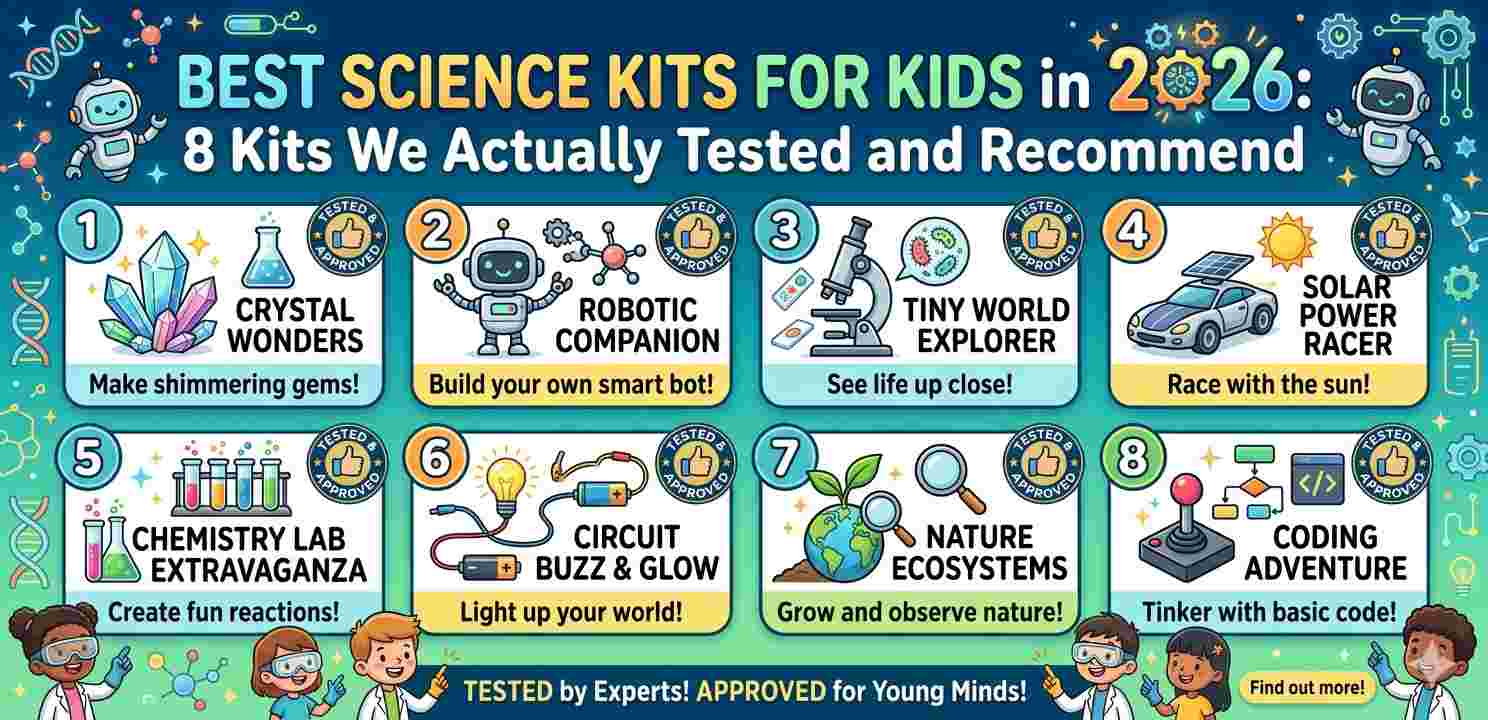
If you’ve ever searched for science kits for kids, you already know how overwhelming the options are. There are hundreds of them — chemistry sets, robotics kits, geology tools, slime labs — and they all promise to be “educational” and “fun.” But not all of them deliver.
We spent several weeks testing eight popular kits with real kids (ages 5 through 13), in actual home and classroom settings. Some kits were genuinely impressive. Others looked great on the box and fell flat on the table. This guide shares what we actually found.
Why Science Kits for Kids Matter More Than You Think
It’s easy to think of a science kit as just a toy. But there’s something that happens when a child mixes two solutions and watches a color change — or builds a small motor and sees it spin. They start asking “why” and “how.” That’s the whole point.
Good science kits for kids don’t just fill an afternoon. They build habits of curiosity, teach basic problem-solving, and quietly introduce concepts that show up later in school.
The tricky part is finding kits that are genuinely well-made, safe, and age-appropriate — without spending $60 on something that gets ignored after one use.
How We Tested These Kits
We set up informal “testing sessions” at home and in one small tutoring group. Each kit was opened and used by kids in its target age range, without adult hand-holding beyond reading instructions together.
We looked at:
- Setup time — How long before anything actually happened?
- Clarity of instructions — Could kids follow them independently?
- Repeat use — Did kids want to come back to it?
- Safety — Any chemical smells, sharp edges, or choking hazards?
- Value — Was it worth the price?
With that context, here are the eight science kits for kids we tested and what we honestly thought of each.
1. Snap Circuits Jr. (Ages 6+)
This electronics kit for beginners is one of the best we tested. Kids can build over 100 different working circuits using color-coded snap pieces — no soldering, no confusion.
A 7-year-old in our group built a working alarm in about 20 minutes. She was genuinely proud of it.
What we liked: The instructions are visual, the pieces are durable, and it encourages logical thinking without feeling like homework. Snap Circuits has been around for a while and the quality shows.
Best for: Kids who enjoy building things and want to understand how electricity works.
2. Mel Chemistry Subscription (Ages 10+)
This is a subscription-based chemistry kit that delivers new experiments monthly. Each box includes real lab-grade equipment, clear instructions, and an app that explains the science behind each reaction.
Among all the science kits for kids we tried, this one felt the most like real lab work. The experiments involve things like crystallization, polymers, and electrochemical reactions. Nothing is dumbed down, which some younger kids found frustrating — but the 11 and 12-year-olds loved it.
One concern: the ongoing subscription cost adds up. But if your child is genuinely interested in chemistry, the quality justifies it.
Best for: Older kids with a serious interest in chemistry and hands-on experimentation.
3. National Geographic Mega Fossil Dig Kit (Ages 8+)
Paleontology doesn’t get enough attention in kids’ science education, which is part of why this kit stood out. Kids dig through a brick of plaster to uncover real fossil replicas — shark teeth, ammonites, and more.
It’s a slower, patience-testing activity, which is actually a feature, not a bug. Kids who stuck with it were seriously engaged. The included guide explains what each fossil is and how it formed.
As one parent watching us test this put it: “He usually can’t focus for 10 minutes. He dug for 45.”
Best for: Kids who love dinosaurs, history, or anything that involves digging.
4. Learning Resources Botley the Coding Robot (Ages 5–10)
Coding toys for young children are everywhere now, but Botley does it well. There’s no screen involved, which is a deliberate design choice. Kids use physical activity cards to program the robot’s movements.
In our testing with 5 and 6-year-olds, Botley was a clear winner among science kits for kids in the beginner range. The concept of sequencing — doing things in order to get a result — clicked quickly, even for kids who had never touched a coding activity before.
It’s not the deepest learning tool, but for early ages, it’s exactly right.
Best for: Young kids getting their first taste of computational thinking.
5. Thames & Kosmos Hydraulic Machines (Ages 8+)
This kit uses water pressure to power mechanical arms, lifts, and cranes. Kids build the machines themselves using syringes, tubing, and plastic components — then use them to move objects.
It’s one of the more engineering-focused science kits for kids we’ve come across. The connection between pushing water and moving a crane arm is immediately visible, which makes the physics concept stick.
Fair warning: it can get a bit messy. Lay down a towel before you start.
Best for: Kids who enjoy hands-on construction and want to understand how real-world machines work.
Learn more about engineering kits and their benefits at Science Buddies
6. 4M Eco Engineering Kit (Ages 8+)
This one surprised us. The 4M Eco Engineering Kit focuses on renewable energy — kids build small working models powered by solar and wind. The instructions are slightly less polished than some others, but the experiments themselves were engaging and felt relevant.
One of the teens in our group commented that it “actually made sense” why people talk about solar energy after building a small solar-powered car.
These kinds of science kits for kids connect classroom concepts to real-world issues, which is something many kits miss entirely.
Best for: Kids interested in environment, energy, or just building things that actually work.
7. Gravity Maze by ThinkFun (Ages 8+)
Technically a puzzle more than a traditional science kit, but Gravity Maze belongs in this list. Kids use marble runs and gravity to solve increasingly complex challenges. Each puzzle has one correct solution, which makes it genuinely satisfying when kids figure it out.
We included it because it builds spatial reasoning and physics intuition — and it’s one of the most re-playable items we tested. Kids kept coming back to it.
It also travels well, works without batteries, and doesn’t require a table covered in small parts.
Best for: Kids who enjoy logic puzzles with a physical, hands-on component.
8. STEM Experiment Box by KiwiCo (Koala Crate, Ages 2–4 / Kiwi Crate, Ages 5–8)
KiwiCo has multiple subscription lines based on age, and the two we tested — Koala Crate and Kiwi Crate — were both well-executed. The younger set (Koala) focused on sensory and creative exploration. The older set (Kiwi) had more structured engineering and science projects.
Among subscription-based science kits for kids, KiwiCo is consistently praised by parents and educators, and our testing confirmed why. Boxes arrive ready to go, materials are pre-measured where needed, and the instructions are genuinely readable for kids.
One small issue: some of the projects felt like crafts with a science label. But overall, the quality is high and the age-targeting is accurate.
Best for: Families who want a reliable monthly activity without having to source materials.
KiwiCo’s official site has a full breakdown of each age-based subscription
What to Look for When Buying Science Kits for Kids
Now that you’ve seen our picks, here’s a quick framework for evaluating any science kit — including ones we haven’t tested.
Match the age range honestly. Manufacturers sometimes stretch age ranges for marketing. If your 7-year-old gets frustrated easily, don’t buy a kit rated 6–14. Look at the lower end of the range.
Check if supplies run out. Some kits are one-time-use. Others have components that can be reused or refilled. For the price, knowing this upfront helps.
Read the instructions before gifting. Seriously. A quick 5-minute scan will tell you if the kit needs constant adult help or if a child can genuinely work through it independently.
Prioritize curiosity over curriculum. The best science kits for kids aren’t the ones that align perfectly with school subjects. They’re the ones that make kids ask questions they didn’t know they had.
Age-by-Age Quick Reference
- Ages 3–5: Botley Coding Robot, KiwiCo Koala Crate
- Ages 6–8: Snap Circuits Jr., National Geographic Fossil Dig, Gravity Maze
- Ages 8–11: Thames & Kosmos Hydraulic Machines, 4M Eco Engineering, KiwiCo Kiwi Crate
- Ages 11+: Mel Chemistry Subscription
Final Conclusion
Choosing the right science kits for kids doesn’t have to be complicated. The best ones are the kits that hold a child’s attention past the first hour — and leave them thinking, asking questions, or wanting to try something again.
From electronics to chemistry to marble-run logic puzzles, the eight options in this guide each bring something different. Match the kit to the child’s interests and your patience for mess, and you’ll be in good shape.
Science at home doesn’t need to be perfect. It just needs to be curious.