 editer@kidkosh.in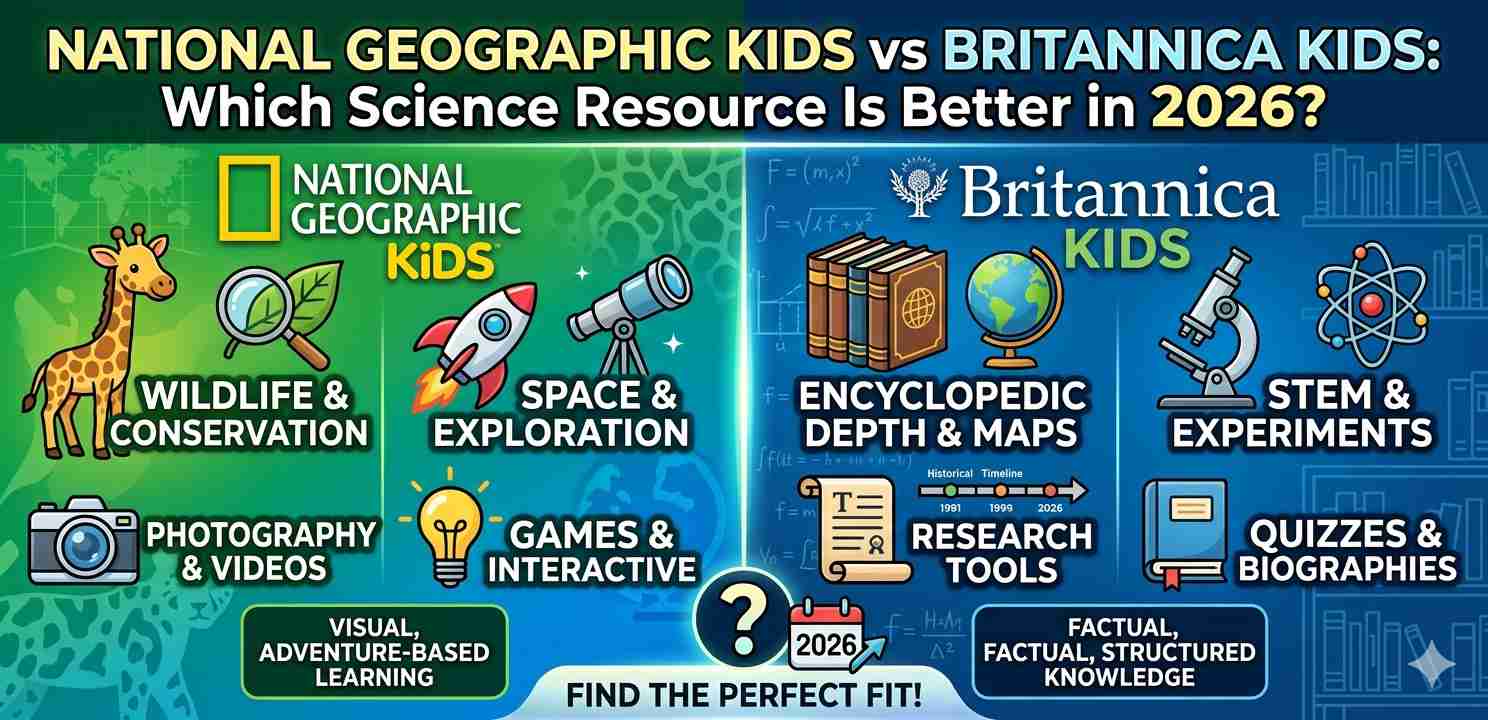
If you’ve been searching for the right online science resource for your child or student, you’ve probably already come across the National Geographic Kids vs Britannica Kids debate. Both platforms are popular, both are trusted names, and both claim to offer quality educational content for young readers. But which one actually delivers when it matters most?
Let’s break it down honestly — no sales pitch, just a real look at what each platform does well and where it falls short.
What Is National Geographic Kids?
National Geographic Kids is the digital and print extension of the well-known National Geographic brand. It’s designed for children roughly between ages 6 and 14, with a heavy focus on wildlife, nature, geography, and environmental science.
The website is bright, visual, and packed with photos. That makes sense, given that National Geographic built its entire identity around stunning photography. Kids can explore animals, learn fun facts, watch short videos, and even play games tied to science topics.
One thing that stands out immediately — the content feels alive. When a child reads about a snow leopard or a coral reef, it doesn’t feel like a textbook. It feels like an adventure.
What Is Britannica Kids?
Britannica Kids comes from Encyclopaedia Britannica, one of the oldest and most respected reference publishers in the world. The platform is split into three levels — Kids, Students, and Teen — which allows it to grow with the learner as they move through school.
The content covers a much wider range than just science. History, social studies, biographies, geography, and current events are all included. But science is still a strong pillar of the platform.
Britannica Kids is often the go-to recommendation in schools and libraries because of its structured, curriculum-aligned content. Teachers trust it because it reads more like a proper reference tool.
National Geographic Kids vs Britannica Kids: Content Depth
This is where things get interesting. In the National Geographic Kids vs Britannica Kids comparison, the two platforms take very different approaches to content.
National Geographic Kids tends to go wide rather than deep. You’ll find articles about hundreds of animals, countries, and natural wonders — but most of them are fairly short. They’re great for sparking curiosity or as a starting point for research. They’re not always ideal for a detailed school project.
Britannica Kids, on the other hand, goes deeper. Articles are longer, more structured, and include source citations. If a student is writing a report on climate change or the human digestive system, Britannica gives them more substance to work with.
For casual science exploration, National Geographic Kids wins. For structured academic research, Britannica Kids has the edge.
Accuracy and Trustworthiness
Both platforms are editorially controlled — which is a big deal. Unlike random websites or social media posts, you won’t find misinformation here.
National Geographic Kids uses professional writers and editors with backgrounds in science journalism. The facts are checked, and the science is sound. However, the articles are written for engagement first, so some complex topics get simplified in ways that might leave gaps.
Britannica Kids has a more formal editorial process, with expert reviewers from academia involved. Articles are updated regularly to reflect new scientific understanding. For topics like space exploration, biology, or climate science, this matters a lot.
Both are trustworthy. But if accuracy and citation matter most to you — say, for school assignments — Britannica Kids edges ahead slightly.
Design and User Experience
Here’s where the National Geographic Kids vs Britannica Kids gap is most visible.
National Geographic Kids is visually stunning. The homepage is full of color, movement, and photos. Kids are naturally drawn to it. Navigation is intuitive even for younger children. The site has quizzes, games, and short videos that make learning feel fun rather than forced.
Britannica Kids is cleaner and more structured, but noticeably less exciting visually. It’s organized and easy to search, but it doesn’t have the same wow factor. That said, the reading experience is comfortable — good font sizes, clear headings, and a layout that doesn’t overwhelm younger readers.
For kids aged 6–10, National Geographic Kids is probably more engaging. For students aged 11 and up doing research, Britannica’s cleaner interface actually helps focus.
Science Coverage: A Closer Look
Since we’re specifically comparing these as science resources, let’s look at what each covers.
National Geographic Kids Science Topics
- Animals and wildlife (extremely detailed and rich)
- Environment and climate
- Geography and natural wonders
- Space (basic coverage)
- Human body (limited)
The strength here is biology and earth science. If your child loves animals, oceans, or nature, National Geographic Kids is genuinely excellent.
Britannica Kids Science Topics
- Life science (plants, animals, human biology)
- Earth and space science
- Physical science (physics, chemistry basics)
- Technology and engineering
- Environmental science
Britannica is more balanced across all science disciplines. A student researching physics concepts or chemical reactions will find more useful material here than on National Geographic Kids.
Accessibility for Different Age Groups
In the National Geographic Kids vs Britannica Kids comparison, age-appropriateness is an important factor.
National Geographic Kids works well for early elementary through middle school. The reading level feels natural, and younger kids can enjoy the photos even if they can’t yet read all the text.
Britannica Kids is tiered — the “Kids” level is for ages 7–10, “Students” for 11–14, and “Teen” for high school. This flexibility is a real advantage. As a child grows, they don’t have to switch platforms entirely. The content grows with them.
Availability: Free vs Paid
Both platforms offer some free content, but the full experience typically requires a subscription or library access.
National Geographic Kids has a lot of free content available directly on its website. Premium features are mostly tied to the print magazine subscription or school/library partnerships.
Britannica Kids usually requires a subscription for full access, though many public libraries offer it for free to cardholders. If you have a library card, it’s worth checking — you might already have access without knowing it.
Cost-wise, National Geographic Kids is more accessible for families on a tight budget.
Which One Is Better for Schools?
In most school settings, Britannica Kids tends to be the recommended choice. Its structured format aligns with curriculum standards, it’s easier to cite in assignments, and the content depth supports project-based learning.
That said, many teachers use National Geographic Kids alongside Britannica — as a way to hook students into a topic before they dive into deeper research. The two platforms actually complement each other well when used together.
Parental Perspective: What Do Parents Actually Say?
Parents who’ve used both platforms tend to agree on a few things. Kids naturally spend more time on National Geographic Kids because it’s more fun. But when it comes to homework help, they end up on Britannica Kids.
One common observation: National Geographic Kids is where kids go by choice, and Britannica Kids is where they go because they need to. That’s not a criticism of either — it just reflects how differently they’re designed.
Final Conclusion
So, in the National Geographic Kids vs Britannica Kids debate, there’s no single winner — because they serve different purposes.
If your goal is to build a child’s love for science, spark curiosity, or make learning feel fun, National Geographic Kids is hard to beat. It’s visual, engaging, and genuinely exciting for young minds.
If your goal is academic research, homework support, or building a solid foundation of scientific knowledge across disciplines, Britannica Kids is the stronger tool.
The best approach? Use both. Let National Geographic Kids light the spark, and let Britannica Kids add the depth. Together, they cover more ground than either can alone.