 editer@kidkosh.in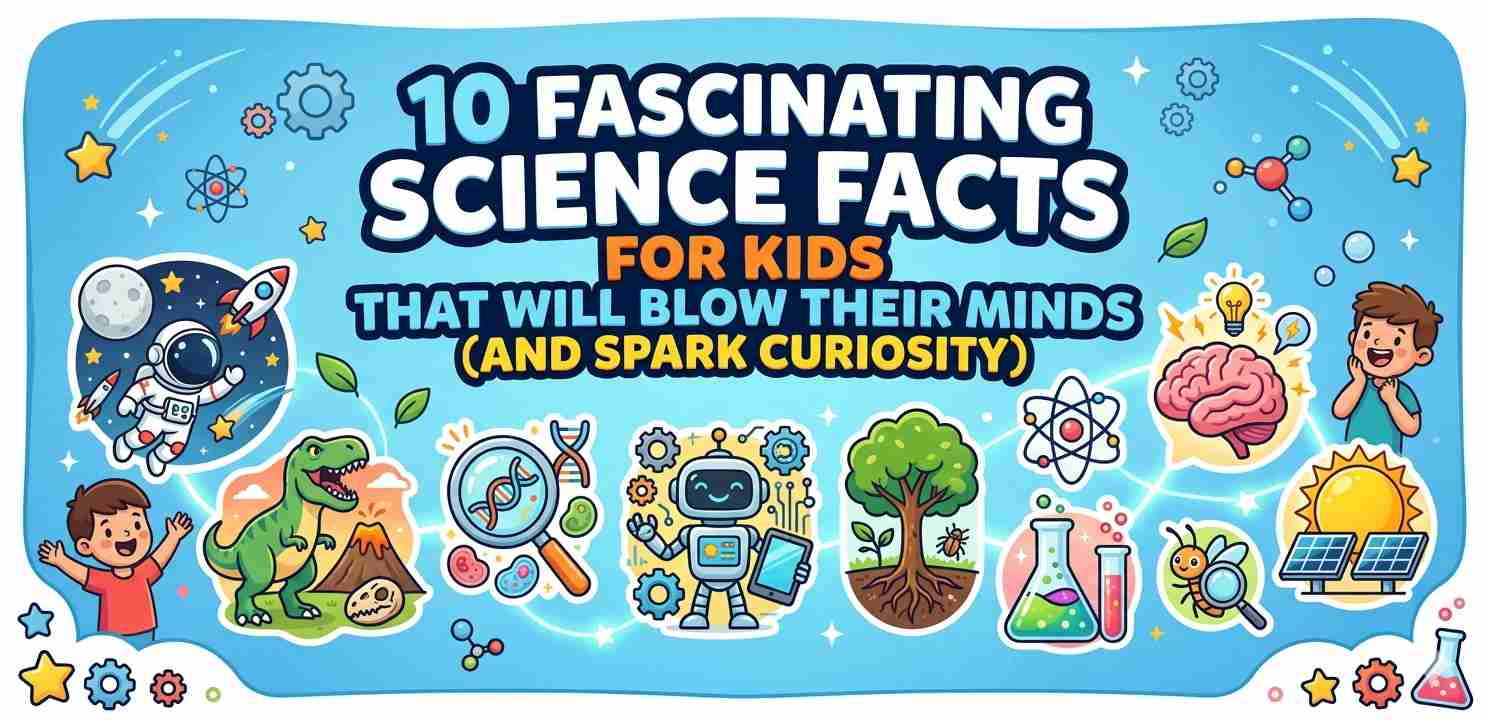
Science is everywhere. It’s in the sky, under your feet, inside your body, and even in the food you ate for breakfast. But here’s the thing — most kids think science is only something that happens in labs or textbooks. That couldn’t be further from the truth.
These science facts for kids are real, strange, and honestly kind of unbelievable. Some of them might make you say “no way” out loud. And that’s exactly the point.
1. Your Body Has More Bacteria Than Human Cells
Let’s start with something a little gross — but also incredibly cool.
Your body is home to trillions of tiny bacteria. In fact, scientists believe there are roughly as many bacterial cells in your body as there are human cells. These bacteria live in your gut, on your skin, and even in your mouth.
Most of them aren’t harmful. Many are actually helpful — they assist with digestion, protect you from illness, and keep things balanced inside your body.
This is one of those science facts for kids that makes you look at hand-washing a little differently. It’s not about getting rid of all bacteria. It’s about the balance.
2. Hot Water Can Freeze Faster Than Cold Water
This one sounds totally backward — and that’s what makes it one of the most talked-about science facts for kids in classrooms around the world.
Under certain conditions, hot water can freeze faster than cold water. This is called the Mpemba Effect, named after a Tanzanian student who noticed it while making ice cream in the 1960s.
Scientists still debate exactly why this happens. Some think it’s related to evaporation, dissolved gases, or how the water molecules behave at higher temperatures.
The lesson? Science doesn’t always follow the rules you expect.
3. Trees Talk to Each Other Underground
Yes, really.
Forests have an underground communication network made of fungi. Trees send nutrients, water, and even chemical warning signals to nearby trees through this network. Scientists sometimes call it the “Wood Wide Web.”
When a tree is under attack by insects, it can send chemical signals through the fungal network to warn neighboring trees. Those trees then start producing defensive chemicals in their own leaves.
Among all the science facts for kids about nature, this one might be the most mind-bending. Trees aren’t just standing there. They’re having a conversation.
4. Octopuses Have Three Hearts and Blue Blood
Octopuses are basically aliens that decided to live in the ocean.
They have three hearts — two that pump blood to their gills, and one that pumps blood to the rest of the body. When an octopus swims, the main heart actually stops beating, which is why they prefer crawling over swimming most of the time.
Their blood is blue because it contains a copper-based molecule called hemocyanin instead of the iron-based hemoglobin that makes human blood red.
This is exactly the kind of science facts for kids that turns a boring biology lesson into something unforgettable.
5. The Sun Is About 4.6 Billion Years Old — And Halfway Done
Our sun has been burning for about 4.6 billion years. It’s a middle-aged star. Scientists estimate it has roughly another 5 billion years of fuel left before it expands into a red giant.
Don’t worry — Earth won’t be here by then anyway (in the scientific timeline sense).
What’s wild is that the light reaching your eyes from the sun right now left the sun about 8 minutes ago. So you’re always seeing the sun as it was — not as it is at this exact second.
Space-related science facts for kids like this one remind us just how enormous and strange the universe really is.
6. A Day on Venus Is Longer Than a Year on Venus
Here’s one that will genuinely confuse you for a moment — and that’s okay.
Venus rotates so slowly on its axis that a single day (one full spin) takes about 243 Earth days. But Venus completes a full orbit around the sun in just 225 Earth days.
That means a year on Venus is actually shorter than a day on Venus.
On top of that, Venus spins in the opposite direction compared to most planets. So if you stood on Venus, the sun would rise in the west and set in the east.
Science facts for kids about other planets are guaranteed to make you appreciate how strange our solar system truly is.
7. Lightning Is Hotter Than the Surface of the Sun
A lightning bolt heats the air around it to roughly 30,000 Kelvin — that’s about five times hotter than the surface of the sun, which sits at around 5,500°C.
The reason lightning doesn’t destroy everything it touches is because it lasts only a fraction of a second. The energy is intense but incredibly brief.
Next time you see a storm, remember: that bright flash contains one of the most extreme temperatures on Earth. And it’s happening naturally, right above your head.
8. Honey Never Expires
Archaeologists have found honey in ancient Egyptian tombs — over 3,000 years old — and it was still perfectly edible.
Honey doesn’t spoil because of its low moisture content, natural acidity, and the presence of hydrogen peroxide. Bacteria simply can’t survive in it under normal conditions.
This is one of those science facts for kids that also comes with a practical lesson: proper food storage matters. Honey is naturally self-preserving in a way that almost nothing else is.
9. Your Fingernails Grow Faster on Your Dominant Hand
This one is oddly specific — and surprisingly true.
The fingernails on the hand you use more often tend to grow slightly faster. Scientists think this is because increased blood flow and physical stimulation encourage faster cell growth in the nail bed.
The middle finger nail also tends to grow the fastest overall, while the thumbnail is usually the slowest.
Little observations like these are exactly why science facts for kids don’t always have to involve rockets or explosions. Sometimes the most fascinating things are attached to your own hands.
10. There Are More Stars in the Universe Than Grains of Sand on Earth
Scientists estimate there are around 10^24 stars in the observable universe — that’s a 1 followed by 24 zeros. Current estimates suggest Earth has about 7.5 × 10^18 grains of sand on all its beaches combined.
In other words, there are more stars than grains of sand.
That number is so large it’s almost impossible to picture. And the observable universe is just the part we can see — there’s likely much, much more beyond that.
For science facts for kids about the cosmos, this one hits differently. It makes you feel very small, and very curious, at the same time.
Why Science Facts for Kids Actually Matter
Reading science facts for kids isn’t just a fun activity. It builds a habit of asking “why” and “how.” That curiosity is the foundation of every scientific discovery ever made.
Kids who engage with science early tend to develop stronger critical thinking skills, better problem-solving abilities, and an openness to learning about the world around them.
If you’re a parent or teacher, sharing these kinds of facts casually — during dinner, on a walk, before bed — works better than any worksheet. Curiosity doesn’t need a classroom.
For more science learning tools designed for younger audiences, the NASA Science for Kids portal is genuinely excellent. And National Geographic Kids covers biology, space, and earth science in a way that’s both accurate and engaging.
You might also enjoy exploring how animals adapt to extreme environments or our guide on simple science experiments you can do at home — both connect well with the ideas here.
Final Conclusion
The world is far stranger and more wonderful than it appears on the surface. From the bacteria living inside you right now to the ancient honey that still hasn’t gone bad, science facts for kids reveal a universe full of surprises hiding in plain sight.
What makes these facts valuable isn’t just the wow-factor. It’s that each one opens a door. A kid who learns that trees communicate underground might grow up to study ecology. A kid who discovers that lightning is hotter than the sun might become a meteorologist.
Curiosity, once sparked, tends to stay lit.
Keep asking questions. Keep looking things up. And the next time someone says science is boring, share one of these facts — and watch their face change.