 editer@kidkosh.in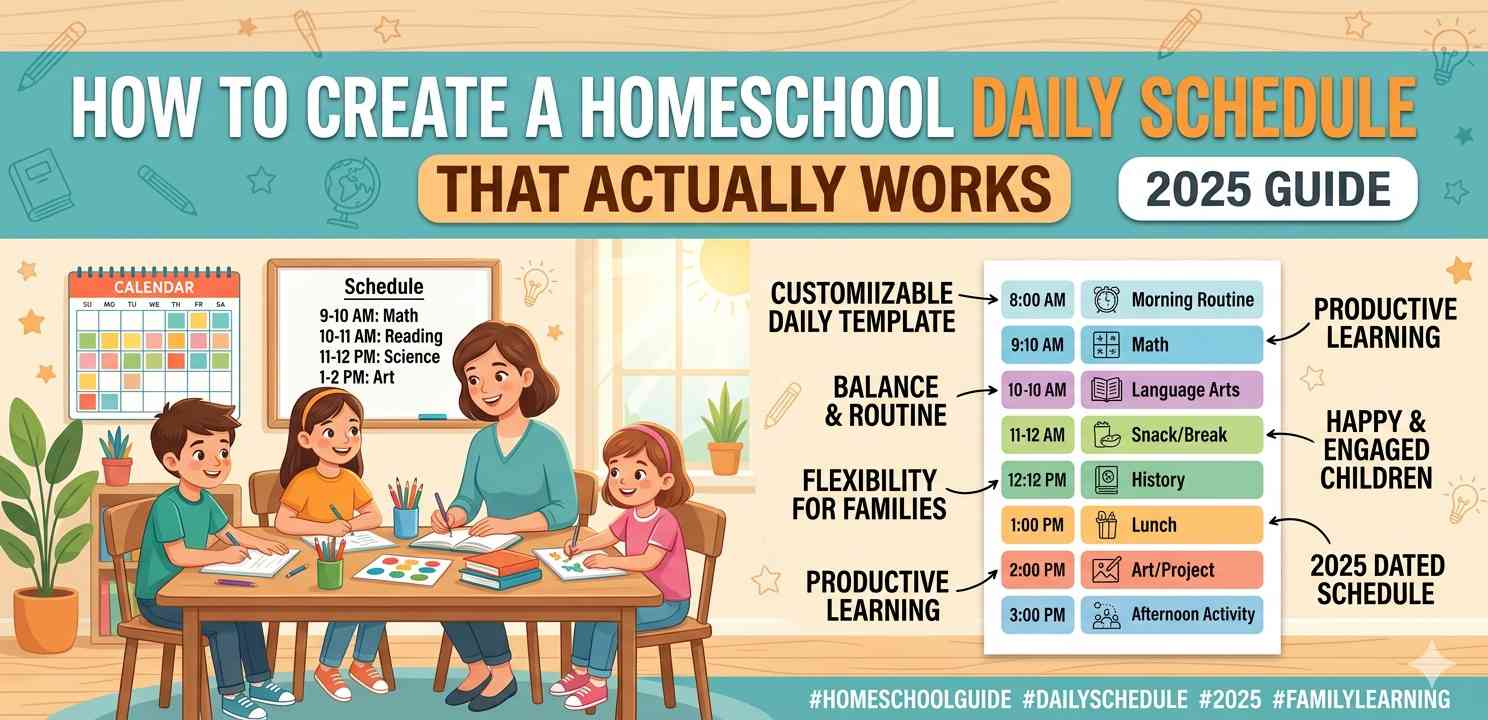
Building a homeschool daily schedule sounds simple — until you actually try it. You write out a neat plan, feel great about it, and by day three your child is refusing to sit down for math and you’re three cups of coffee deep wondering what went wrong.
It happens to almost every homeschool family. The problem usually isn’t the subjects or the curriculum. It’s the structure — or more often, the wrong kind of structure.
This guide is going to walk you through how to build a homeschool daily schedule that your family can realistically stick to, without it feeling like a prison sentence for anyone involved.
Why Most Homeschool Daily Schedules Fail
Before building something new, it helps to understand why the old ones break down.
Most parents start with what school looks like: seven subjects, 45-minute blocks, back to back, starting at 8 AM. That model works in a classroom with 25 kids and a teacher managing the room. At home, with one or two children and a parent who’s also cooking lunch and answering emails, it falls apart fast.
A rigid homeschool daily schedule ignores the reality of home life. Kids at home don’t need bell-to-bell scheduling. They need anchors — clear start times, a predictable rhythm, and some breathing room in between.
Another common mistake is planning for the ideal day instead of the average one. Your schedule needs to survive a bad night’s sleep, a dentist appointment, and a child who’s just not feeling it. If it can’t, it won’t last two weeks.
Start With Your Family’s Natural Rhythm
The first step to a good homeschool daily schedule isn’t picking subjects. It’s observing your family.
For a week, just notice things. When do your kids wake up naturally? When are they sharpest and most focused? When do they get restless, hungry, or distracted? What time does everyone seem to hit a wall?
These patterns matter more than any template you find online.
Some families genuinely function better starting school at 10 AM. Others like to knock out core subjects before 9. Neither is wrong. But if your homeschool daily schedule fights your family’s natural energy, you’ll spend more time managing resistance than actually teaching.
Write down your observations. Even rough notes help. “Kid is sharp 9–11, wiggly after lunch, good again around 3” is useful data.
The Anchor Points Method
Instead of scheduling every minute, try building your homeschool daily schedule around anchor points. These are fixed moments in the day that everything else flows around.
For most families, three to four anchor points are enough:
Morning anchor — a clear, consistent start time with a short transition routine (breakfast, a quick tidy-up, maybe a 5-minute walk outside). This signals to your child’s brain that learning time is beginning.
Core learning block — this is your most focused window, usually two to three hours in the morning. Save your hardest subjects like math and writing for here, when focus is strongest.
Midday break — lunch, free play, movement. This isn’t optional. Kids (and parents) need genuine downtime to reset.
Afternoon block — lighter subjects, projects, reading aloud, or independent work. This is also a good time for hobbies, co-op activities, or outdoor time.
That’s it. Your homeschool daily schedule doesn’t need to fill every gap. The space between anchor points is where real learning often happens — curiosity-led, unplanned, and genuinely valuable.
How Long Should Each Subject Take?
This is one of the most common questions, and the honest answer is: less time than you think.
One-on-one instruction is far more efficient than classroom teaching. A concept that takes 45 minutes to cover with 25 kids might take 10–15 minutes at home. That’s not a bad thing — it means your homeschool daily schedule can be genuinely lighter than a school day and still cover more ground.
A rough guide by age:
Ages 5–8: 1.5 to 2 hours of structured learning per day is plenty. The rest should be play, exploration, and read-alouds.
Ages 9–12: 3 to 4 hours works well. At this stage, kids can handle more independent work, which frees up your time too.
Ages 13+: 4 to 6 hours, depending on the complexity of the coursework. High school subjects naturally take longer.
These are guidelines, not rules. Some days your child will finish everything in 90 minutes. Some days a single math concept takes an hour. A flexible homeschool daily schedule accounts for both.
Building Your Schedule: A Practical Template
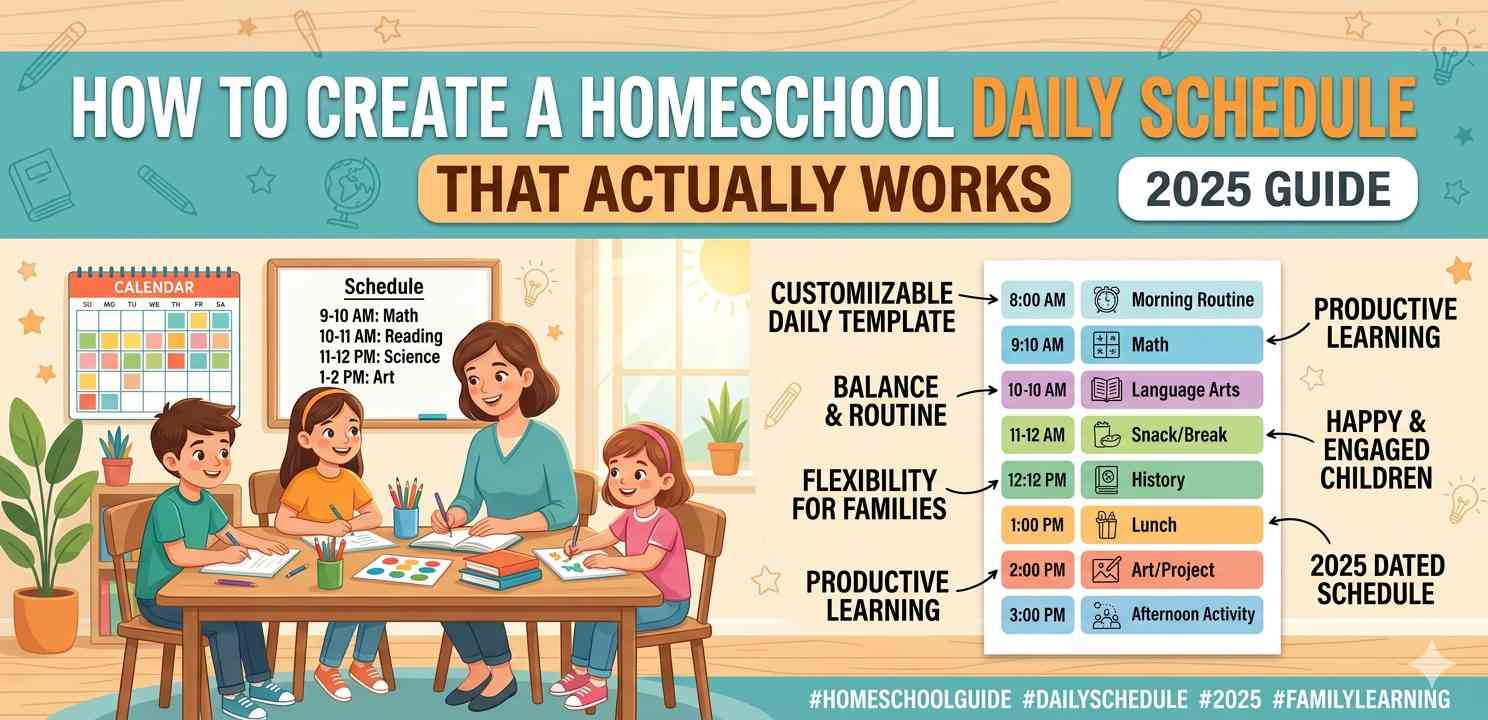
Here’s a simple framework you can adapt for your own family:
7:30–8:30 AM — Wake up, breakfast, morning routine
8:30–9:00 AM — Transition time (read independently, journal, light review)
9:00–10:00 AM — Math
10:00–10:15 AM — Short break (movement, snack)
10:15–11:00 AM — Language arts or writing
11:00–11:45 AM — Science or history (alternating days)
11:45 AM–1:00 PM — Lunch and free time
1:00–2:00 PM — Independent reading, projects, or second language
2:00 PM onward — Extracurriculars, outdoor time, free choice
This is just a starting point. Adjust the blocks based on your observations from the rhythm-watching exercise.
You can also explore homeschool schedule templates and planning tools at Homeschool.com to compare different approaches before committing to one.
How to Handle Multiple Ages
If you’re homeschooling more than one child, building a shared homeschool daily schedule gets more complex — but not impossible.
The key is to look for where subjects can overlap. History, science, and read-alouds can often be done together across a wide age range. Math and writing usually need to be separate since skill levels differ so much.
A good approach is “together, then apart.” Start the morning with something everyone can do together — morning meeting, read-aloud, a discussion about something you’re studying. Then split for individual work in the core subjects.
This also helps younger kids feel included and older kids feel less isolated, which is a common concern among families with wide age gaps.
For more detailed guidance on multi-age scheduling, HSLDA’s planning resources offer practical advice from experienced homeschool families.
Dealing With Days That Fall Apart
Even the best homeschool daily schedule will have bad days. A child who’s off, an unexpected errand, a parent who’s exhausted — it happens. Planning for this in advance makes a real difference.
Keep a “light day” backup plan. This is a pre-made list of low-effort but still educational activities: audiobooks, documentaries, educational games, art projects, nature walks. On bad days, you pull from this list instead of trying to force the regular schedule.
This isn’t giving up. It’s being realistic about sustainability. Homeschooling is a long game, and burning out in month two helps no one.
Also, give yourself permission to shift subjects around. If your child is not ready for math at 9 AM today, start with reading instead. A flexible homeschool daily schedule that you actually use beats a perfect one that causes daily battles.
Reviewing and Adjusting Your Schedule
No homeschool daily schedule should be set in stone. Plan to review yours every four to six weeks, especially in the beginning.
Ask yourself a few honest questions: Is the schedule actually running close to what I planned? Are there consistent friction points — same time, same subject, same child? Is there enough unstructured time, or does the day feel relentless?
Adjust based on what you find. Move a difficult subject to a better time. Shorten a block that’s dragging. Add a break you skipped. Small changes often make a big difference.
Kids can be part of this process too, especially older ones. Asking “what’s not working for you?” gets useful information and helps them feel some ownership over their learning day.
Tools and Resources That Actually Help
You don’t need expensive software to manage your homeschool daily schedule. A simple paper planner or a whiteboard works well for many families.
That said, a few digital tools are worth knowing about:
A shared digital calendar helps if you have multiple children or outside activities to coordinate. A simple checklist app — even a basic notes app on a phone — can let older kids track their own tasks, which builds independence.
What matters less is the tool, and more is consistency. Whatever system you choose for your homeschool daily schedule, use it the same way every day until it becomes habit.
Final Conclusion
Creating a homeschool daily schedule that actually works isn’t about finding the perfect template. It’s about understanding your family, building around your natural rhythms, and staying flexible enough to adjust when things change — and they will change.
Start simple. Use anchor points instead of minute-by-minute blocking. Leave room for the unexpected. Review your schedule regularly and refine it. And most importantly, don’t compare your homeschool day to what you see on social media. Real homeschooling is messier and more interesting than that.
Done thoughtfully, a good homeschool daily schedule becomes less of a constraint and more of a foundation — something that holds the day together without holding your family back.