 editer@kidkosh.in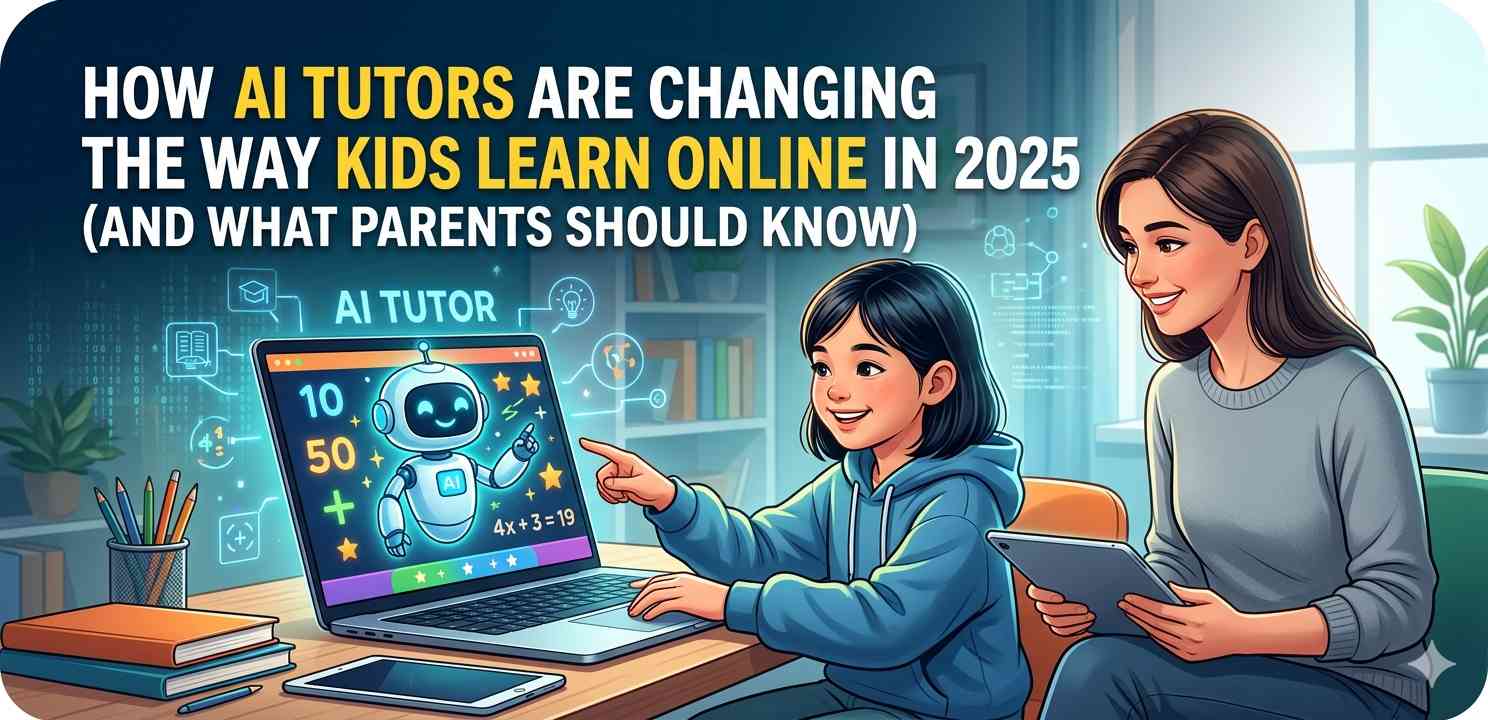
Something big has quietly happened in education over the last couple of years. AI tutors — software-powered learning assistants that can teach, explain, quiz, and guide students — have moved from experimental tools into everyday classrooms and living rooms. And honestly, the shift is faster than most parents realize.
If your child uses Khan Academy, Duolingo, or even certain school-issued apps, there’s a good chance they’ve already interacted with an AI tutor without either of you thinking of it that way. Understanding what these tools actually do, where they genuinely help, and where they fall short — that’s what this article is for.
What Exactly Are AI Tutors?
An AI tutor is a software system that uses artificial intelligence to deliver personalized educational content to a student. Unlike a static video lesson or a textbook, AI tutors respond to what the learner does — adjusting difficulty, offering hints, re-explaining concepts in different ways when a child gets stuck.
Think of it like having a very patient teaching assistant available at 10 PM when your kid suddenly remembers there’s a math test tomorrow. The AI tutor doesn’t get tired, doesn’t get frustrated, and doesn’t charge by the hour.
Most AI tutors work through a browser or an app. Some are built specifically for subjects like math or reading. Others try to cover broader curriculum areas. A few, like those powered by large language models, can hold what feels like a real back-and-forth conversation with a student.
How AI Tutors Actually Work in 2025
The technology behind AI tutors has gotten noticeably smarter. Earlier versions mostly followed decision trees — if a student got question 3 wrong, show them a hint; if they got it wrong twice, show a video. That was useful but limited.
Modern AI tutors use machine learning to build a kind of profile of each student over time. They track which concepts the child struggles with, how long they take on certain problems, and what explanation style seems to click best.
Some platforms now use natural language processing, which means a child can type or even speak a question in their own words — “I don’t get why fractions need the same bottom number” — and the AI tutor will respond in a conversational, understandable way rather than showing a generic popup.
This is genuinely different from what existed even three years ago. And it’s one reason AI tutors are getting more attention from schools and parents alike.
Real Benefits Parents Are Seeing
AI Tutors Offer True Personalisation
One of the most consistent things parents report is that their child gets less frustrated when learning with an AI tutor compared to group instruction. That makes sense. In a classroom of 30 students, a teacher can’t slow down for one child who needs five extra minutes on long division without losing the rest of the class.
An AI tutor has no such constraint. It simply moves at the pace the learner needs. If your child grasps percentages quickly, the system moves on. If they need to revisit it eight times from different angles, that’s fine too.
Availability Without Scheduling
Traditional tutoring requires coordination — booking a slot, finding a qualified tutor, paying per session. AI tutors are available any time your child sits down to learn. That kind of frictionless access matters a lot for busy families or for kids in areas where subject-specialist tutors are hard to find.
Reduced Pressure and Anxiety
A fair number of students — especially those who feel embarrassed asking questions in class — find it easier to admit they don’t understand something to an AI tutor. There’s no social risk. No one’s watching. They can ask the same question five times without feeling judged.
This is a genuine psychological benefit, and it’s something human tutors sometimes struggle to replicate, especially with teenagers.
What AI Tutors Still Can’t Do Well
They Can’t Read a Child’s Emotional State
A good human tutor notices when a student is distracted, anxious, exhausted, or dealing with something outside of school. AI tutors largely can’t do this, at least not reliably. Some platforms are experimenting with sentiment analysis, but it remains limited.
If your child is struggling because of something happening at home or with friends, an AI tutor won’t pick up on that. It’ll just keep presenting math problems.
Deep Critical Thinking and Debate
AI tutors are quite good at structured subject matter — facts, formulas, grammar rules, problem-solving steps. They’re weaker at facilitating genuine intellectual debate, helping a student wrestle with ambiguous questions, or pushing back meaningfully when a child forms a shaky argument.
For subjects like philosophy, history, or advanced essay writing, a human teacher still brings something AI tutors currently don’t.
Accountability and Relationship
Learning is partly relational. The respect a student has for a teacher, the sense that someone genuinely believes in them — this motivates in ways that software can’t fully replicate. AI tutors don’t build relationships. They can be engaging, even fun, but they’re not mentors.
What Parents Should Actually Check Before Choosing an AI Tutor
There are dozens of AI tutors on the market now, and quality varies significantly. Before you commit to one — especially a paid platform — here are things worth investigating.
Check the Curriculum Alignment
Does the platform align with your country’s or state’s school curriculum? An AI tutor teaching math concepts in a different sequence than your child’s school can actually cause confusion rather than help.
Look for Transparent Progress Reporting
Good AI tutors provide clear reports to parents — what topics were covered, where the child is struggling, how much time was spent. Avoid platforms where this data is vague or buried.
Evaluate the Content Quality
Sit with your child for a session and watch. Is the explanation actually clear? Is the feedback useful when they get something wrong? Some platforms are polished on the surface but shallow in actual instructional quality.
Privacy Matters — Read the Data Policy
AI tutors collect a significant amount of data about your child’s learning patterns and behaviour. Check whether the platform sells data to third parties, how long data is retained, and whether the app complies with children’s data protection laws in your region. This isn’t a minor concern. Common Sense Media’s Privacy Ratings is a useful independent resource for evaluating educational apps.
How Schools Are Integrating AI Tutors in 2025
Many schools are now using AI tutors not as replacements for teachers but as support tools — particularly for after-school practice, homework assistance, and differentiated learning within the classroom.
Some districts in the US and UK have partnered with platforms like Khan Academy’s Khanmigo (which uses a GPT-based backbone) to offer AI-assisted tutoring at scale. The idea isn’t to reduce teacher involvement but to give teachers better data and free up time for the more human parts of teaching.
It’s worth asking your child’s school what AI tools they’re using and how they’re being supervised. Transparency between schools and parents on this front is still catching up to how fast the technology is being deployed.
Age-Appropriate Use: A Rough Guide
AI tutors aren’t one-size-fits-all across age groups.
For younger children (ages 6–9), AI tutors work best when they’re game-like, use visuals heavily, and have significant parental involvement. Younger kids benefit from a parent sitting nearby, at least initially.
For middle schoolers (ages 10–13), AI tutors can be more independent tools — especially for math, reading comprehension, and language learning. This is the age group where many parents see the clearest benefit.
For high schoolers, AI tutors are useful for subject-specific drilling (SAT prep, chemistry formulas, foreign language vocabulary) but less effective as a substitute for the critical discussion that good high school classes ideally provide. For deeper understanding of how AI is being used in education more broadly, the UNESCO report on AI in education is worth a look.
Balancing AI Tutors With Human Learning
This might be the most important point in the whole article. AI tutors are tools — powerful, useful, and genuinely impressive ones — but they work best as supplements, not replacements.
Children still need human teachers who know them as individuals. They still need the friction and growth that comes from learning in groups, from debate, from having to explain their thinking to another person.
The families getting the most out of AI tutors tend to use them for specific, targeted purposes: catching up on a concept, drilling for a test, practising a language. They’re not treating them as an all-in-one education solution.
That balance — using AI tutors strategically rather than exhaustively — seems to produce the best outcomes for most kids.
Final Conclusion
AI tutors have genuinely changed how children can access learning support in 2025. They’re more adaptive, more conversational, and more capable than they were even a couple of years ago. For the right purposes — personalised practice, accessible support, flexible scheduling — they offer real value that many families wouldn’t have had access to otherwise.
But they come with limits. They can’t replace human connection, emotional attunement, or the kind of mentorship that good teachers provide. And not all AI tutors are created equal — some are exceptional, others are clever marketing on top of shallow content.
As a parent, the best approach is to stay informed, stay involved, and treat AI tutors as one tool among many rather than a silver bullet for every learning challenge. The technology will keep improving. Your judgment, as a parent who knows your child, remains irreplaceable.