
 editer@kidkosh.in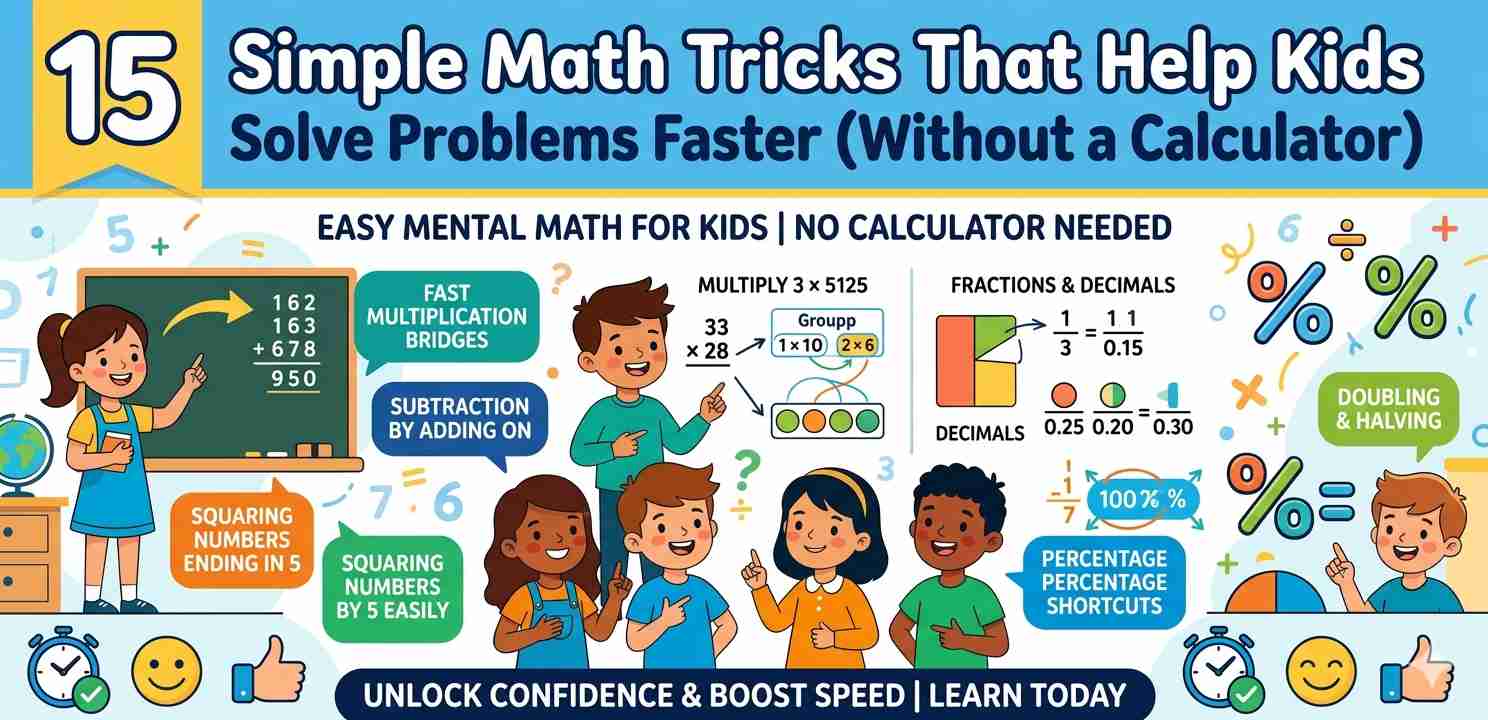
So your child is sitting at the kitchen table, pencil in hand, staring at a page full of numbers like they’re written in a foreign language. Sound familiar? Learning math tricks for kids can completely change that experience — turning frustration into something that almost feels like a game.
These tricks aren’t shortcuts that skip understanding. They’re patterns that already exist in math, and once a child sees them, they tend to stick for life. I’ve watched kids go from dreading arithmetic to actually showing off at school — just because someone took five minutes to explain one of these methods properly.
Why Math Tricks for Kids Actually Work
Before we jump in, it’s worth understanding why these methods help in the first place.
Children’s brains learn through patterns. When a child sees that multiplying any number by 9 always gives digits that add up to 9 (like 9×4=36, and 3+6=9), something clicks. It’s not rote memorization — it’s recognition.
These math tricks for kids also reduce the working memory load. Instead of holding six separate steps in their head, a child needs only one or two. That makes the whole process less overwhelming and faster.
Trick 1 — The Finger Method for the 9 Times Table
Hold both hands out flat. To multiply 9 by any number from 1 to 10, fold down that numbered finger.
For 9×3, fold down the third finger. The fingers to the left (2) give the tens digit. Fingers to the right (7) give the units. Answer: 27.
Kids love this one because their hands literally become a calculator. It’s one of the most reliable math tricks for kids for the early years.
Trick 2 — Adding by Making Tens First
Instead of adding 8+7 by counting up, teach kids to “complete the ten.” Take 2 from the 7 to make 8 into 10, leaving 5. So 10+5=15.
This approach forms the foundation of mental arithmetic. It’s a core part of how math tricks for kids are taught in Singapore’s math curriculum, which consistently ranks among the world’s best. You can explore Singapore Math methods further at mathpickle.com, a free resource packed with number sense activities.
Trick 3 — Doubling and Halving for Multiplication
If a child needs to multiply 16×5, they can think of it as 8×10 instead — because halving 16 and doubling 5 gives the same result.
This doubling-and-halving method is surprisingly powerful. It turns harder problems into easier ones using numbers kids already know well. It’s one of those math tricks for kids that older students still use without realizing there’s a name for it.
Trick 4 — The “Round Up, Then Subtract” Method
For adding numbers like 39+47, round 39 up to 40. Add: 40+47=87. Then subtract the 1 you added: 87−1=86.
This works beautifully for numbers close to a round ten. It’s one of the cleanest math tricks for kids for mental addition, and once a child gets used to it, they’ll apply it automatically.
Trick 5 — Multiplying by 11 (Two-Digit Numbers)
To multiply any two-digit number by 11, split the digits and place their sum in the middle.
For 11×34: split to 3 and 4, add them (3+4=7), place 7 in the middle. Answer: 374. If the middle sum is 10 or more, carry the 1 to the left digit.
This is one of the flashier math tricks for kids — and it’s completely accurate every time.
Trick 6 — The Butterfly Method for Comparing Fractions
When a child needs to decide which fraction is larger, the butterfly method helps without finding a common denominator.
Cross-multiply: for 3/5 vs 2/3, multiply 3×3=9 and 2×5=10. Since 10 is larger, 2/3 is the bigger fraction. It’s a visual trick that makes fraction comparison feel logical rather than abstract.
Trick 7 — Squaring Numbers That End in 5
Any number ending in 5, when squared, follows a pattern. Take the tens digit, multiply it by the next number up, then put 25 at the end.
For 35²: tens digit is 3. Multiply 3×4=12. Answer: 1225. For 75²: 7×8=56. Answer: 5625. This is one of those math tricks for kids that genuinely impresses teachers.
Trick 8 — Subtracting by Adding Up (Shopkeeper’s Method)
Instead of subtracting 67 from 100, count up from 67 to 100: 67→70 (add 3), 70→100 (add 30). Total added: 33.
This is sometimes called the shopkeeper’s method because cashiers have used it for centuries. It removes the anxiety of “borrowing” in column subtraction and replaces it with something intuitive. Definitely worth adding to your toolkit of math tricks for kids.
Trick 9 — Multiplying Large Numbers by Breaking Them Apart
This is the distributive property in disguise. To multiply 6×47, break 47 into 40+7. Do 6×40=240 and 6×7=42, then add: 240+42=282.
Children who understand this method start seeing multiplication as flexible rather than rigid. It’s a building block for algebra later on and one of the most educationally rich math tricks for kids on this list.
Trick 10 — Dividing by 4 in Two Easy Steps
Instead of dividing by 4 directly, halve the number twice.
48÷4: halve 48 to get 24, then halve 24 to get 12. Done. This method works for any even number and keeps the steps simple. For children who find division intimidating, it’s a genuinely helpful entry point.
Trick 11 — Checking Multiplication with the 9s Rule (Digital Root)
If a child wants to check a multiplication answer, they can use digital roots. Add the digits of each number until you get a single digit. Multiply those. That result should match the digital root of the answer.
For 7×8=56: digital root of 7 is 7, of 8 is 8, 7×8=56, digital root of 56 is 11, then 1+1=2. And 7×8=56 → 5+6=11 → 1+1=2. Match! This kind of self-checking habit is rare and valuable in young learners. For more on number patterns like this, the National Council of Teachers of Mathematics has excellent classroom resources.
Trick 12 — The Left-to-Right Addition Method
Most children are taught to add from right to left (units first, then tens). But left-to-right addition is often faster mentally.
For 356+482: add hundreds first (300+400=700), then tens (50+80=130, so 830), then units (6+2=8). Total: 838. It maps more naturally onto how we read and speak numbers. Among math tricks for kids focused on speed, this one has lasting value.
Trick 13 — The Vedic Math Trick for Multiplying Close to 100
For numbers near 100, subtract each from 100, note the differences, then use a cross-addition and multiplication.
To multiply 97×96: 100−97=3 and 100−96=4. Cross-subtract: 97−4=93 (or 96−3=93). Multiply the differences: 3×4=12. Answer: 9312.
This feels like magic when kids first try it. It’s one of the more advanced math tricks for kids, better suited to ages 10 and up.
Trick 14 — Estimating Answers Before Solving
This isn’t a calculation trick — it’s a thinking habit. Before solving any problem, a child should estimate what the answer is roughly going to be.
For 48×22, think: “That’s close to 50×20, which is 1000.” When the exact answer comes out as 1056, they know they’re in the right range. Estimation catches careless errors and builds number sense over time. It’s one of the simplest math tricks for kids but one of the most underused.
Trick 15 — The Grid Method for Multi-Digit Multiplication
For 34×27, draw a 2×2 grid. Put 30 and 4 across the top, 20 and 7 down the side. Fill each cell with the product, then add all four results.
30×20=600, 4×20=80, 30×7=210, 4×7=28. Total: 600+80+210+28=918. The grid slows things down just enough to prevent mistakes while still encouraging mental calculation. It’s one of the most effective math tricks for kids for building towards long multiplication.
How to Practice These Tricks at Home
Don’t try to teach all 15 in one sitting. Pick one or two that match what your child is currently studying.
Use everyday moments — grocery shopping, cooking, road trips — to practice. “If we buy 3 packs of 6 eggs, how many eggs total?” is a better learning prompt than a worksheet most of the time.
Also check out resources like Math Is Fun for interactive practice that reinforces exactly these kinds of methods in a beginner-friendly way.
Final Conclusion
Learning doesn’t have to be a battle with numbers. The right math tricks for kids make arithmetic feel more like problem-solving and less like memorization. Each of the 15 methods here is grounded in real mathematical structure — not guesswork or gimmicks.
When a child understands why a trick works, not just that it works, they build genuine confidence. And confident young learners become stronger thinkers across every subject. Start with one trick this week, make it feel like a discovery rather than a lesson, and see what happens.