 editer@kidkosh.in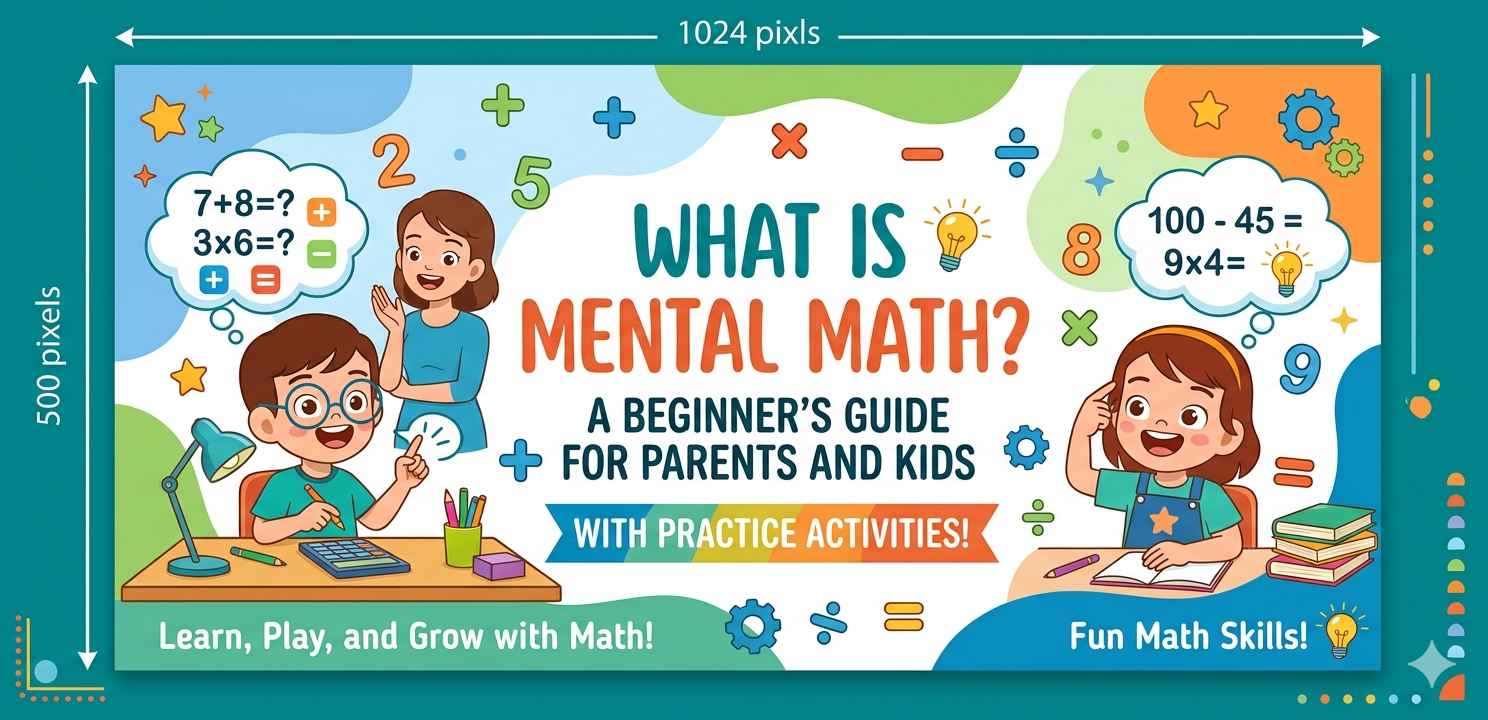
Mental math is one of those skills that sounds more complicated than it actually is. At its core, simply means doing calculations in your head — without a calculator, without a pen, and without writing anything down. You rely entirely on your brain to work through numbers.
If your child has ever figured out how much change they’d get back from a store purchase, or if you’ve quickly estimated the total grocery bill before reaching the checkout, you’ve both already done without even thinking about it.
Why Mental Math Matters More Than People Realize
Most parents focus on written arithmetic — the kind kids practice on paper with long columns and carrying numbers. That’s important too, but builds a different kind of number sense. It teaches kids to think flexibly about numbers, not just follow a set of steps.
Think about real life. When you’re at a market and something costs ₹75, and you have ₹100, you don’t pull out a notebook. You just know the answer is ₹25. That quick, easy calculation? That’s mental in action.
Research consistently shows that children who develop strong mental math abilities tend to perform better overall in mathematics. They become more confident, less anxious about numbers, and more capable of solving word problems independently.
How Mental Math Is Different From Regular Math
Regular math, the kind done on paper, relies on procedures. You line up the digits, follow the steps, and arrive at an answer. It works, but it doesn’t necessarily mean the child understands why the answer is correct.
Mental, by contrast, encourages kids to see relationships between numbers. For example, a child doing mental might solve 48 + 37 by thinking: “50 + 37 is 87, then subtract 2, so the answer is 85.” They’re not following a formula — they’re reasoning through the numbers.
This flexibility is extremely valuable and connects directly to higher-level math skills like algebra and problem-solving. Children who think flexibly about numbers in early grades tend to find abstract math far less intimidating later on.
Common Mental Math Strategies Kids Use
There isn’t just one way to do In fact, one of the most interesting things about it is that different people often arrive at the same answer using completely different mental paths.
The Rounding and Adjusting Method
This is probably the most natural strategy. Round a number to the nearest 10, do the easy calculation, then adjust the answer.
For example: 67 + 28. A child might round 28 to 30, add it to 67 to get 97, then subtract 2 to get 95. Simple and fast.
Breaking Numbers into Parts
Also called decomposition, this method splits numbers into friendlier chunks. To solve 43 × 2, a child might think: “40 × 2 = 80, and 3 × 2 = 6, so the answer is 86.”
Counting On and Counting Back
Younger children often use this for addition and subtraction. If they need to solve 15 + 6, they might just start at 15 and count forward six steps. It’s basic, but it’s a genuine form of that builds number confidence.
Using Known Facts
Once a child knows that 7 × 8 = 56, they can use that fact to quickly solve related problems. 14 × 8 = 112 because 14 is just double 7. Building a mental library of known facts makes much faster and more reliable.
At What Age Should Kids Start Practicing Mental Math?
You can begin introducing concepts very early — even before formal schooling. Children as young as 3 or 4 can start recognizing small quantities without counting (called subitizing), which is the foundation of everything that follows.
By around ages 6–7, most children are ready to start adding and subtracting mentally using simple numbers. By 8–10, they can handle two-digit mental calculations and simple multiplication.
The key is to go at the child’s pace. Pushing too fast creates frustration. Steady, playful exposure works far better.
Practical Mental Math Activities for Kids at Home
This is the part most parents actually want — real activities they can do without any special materials or teaching background.
Activity 1: The Shopping Estimate Game
When you’re at a market or grocery store, ask your child to estimate the total cost of items in the cart. They don’t need to be exact — rounding to the nearest 10 is fine. This makes mental feel purposeful and connected to real life.
Activity 2: Clock Math
Ask your child: “It’s 3:45 now. We’re leaving in 25 minutes. What time will it be?” This builds skills around time — a practical, everyday application.
Activity 3: 100 Target Game
Take turns naming numbers that add up to 100. Start at 0, and each player adds between 1 and 10 on their turn. The person who reaches exactly 100 wins. Kids end up doing a lot of without realizing it.
Activity 4: Number Splits
Give your child a number, say 36, and ask them how many ways they can split it into two parts. 30 + 6, 20 + 16, 18 + 18 — there’s no single right answer, and the exploration itself strengthens flexible thinking.
Activity 5: Daily Countdown Challenges
Give your child 60 seconds and ask them to count backward from 50 or to multiply all numbers from 1 to 6 in their head. Short bursts of focused mental practice are far more effective than long, tedious sessions.
For more structured approaches, the Khan Academy Kids program offers free, age-appropriate mental exercises and games for younger children that work well alongside home practice.
Tips for Parents Who Want to Help
You don’t need to be a math teacher to help your child with mental math. A few simple habits make a big difference.
Ask, don’t tell. When your child is working through a problem, resist the urge to give the answer immediately. Ask them: “What would happen if you rounded that to the nearest 10?” Giving them time to reason independently is more valuable than getting the right answer quickly.
Make it conversational. practice doesn’t need to look like homework. During car rides, meals, or walks, just casually throw in small questions. “We need 3 bags of apples, and each bag has 8 apples. How many is that total?”
Celebrate the process, not just the answer. If your child tries an interesting strategy but gets the wrong answer, focus on the thinking. A child who reasons well will self-correct over time. A child who only memorizes steps will struggle when the steps change.
Don’t overuse calculators for simple problems. Calculators are useful tools, but using them for every small calculation prevents kids from developing their own mental abilities. Encourage phone-free solving for everyday numbers.
You can also explore resources like NRICH Mathematics — a project from Cambridge University that offers free mental challenges and investigations designed specifically for school-aged children.
Mental Math in School vs. Mental Math at Home
Schools do cover mental, but the approach varies a lot between curricula and teachers. Some classrooms have daily warm-ups. Others treat it as a secondary skill.
This means parents have an important role to play. The informal, playful practice that happens at home often has a stronger effect than formal drills because it’s low-pressure and connected to real situations the child cares about.
If you’re not sure what level your child is at, just ask their teacher. Most teachers are happy to suggest specific goals for each age group and share what strategies they’re already teaching in class, so you can reinforce the same methods at home.
Common Struggles Kids Face With Mental Math (And How to Handle Them)
Some kids find genuinely difficult — and that’s okay. Working memory plays a big role in mental math, and some children just need more support and time to build it.
If your child constantly loses track mid-calculation, try breaking problems into smaller steps and saying them out loud together. Verbal (saying the steps as you think them) can help bridge the gap while working memory develops.
If they feel embarrassed or anxious about getting it wrong, keep the environment relaxed and low-stakes. Frame mistakes as useful information, not failure. With patience and regular practice, the vast majority of children can develop solid mental math abilities — it just looks different for each child.
Final Conclusion
Mental math isn’t a special talent reserved for naturally gifted students. It’s a practical skill — one that develops with the right kind of practice, a supportive environment, and real-life opportunities to use numbers in meaningful ways.
For parents, the most effective thing you can do is weave small mental math moments into everyday life. Make it normal, make it casual, and make it feel useful rather than like a test. For kids, the goal isn’t speed — it’s building a genuine comfort with numbers that will serve them for the rest of their lives.
Start small, stay consistent, and watch your child’s number confidence grow in ways that go well beyond the classroom.