 editer@kidkosh.in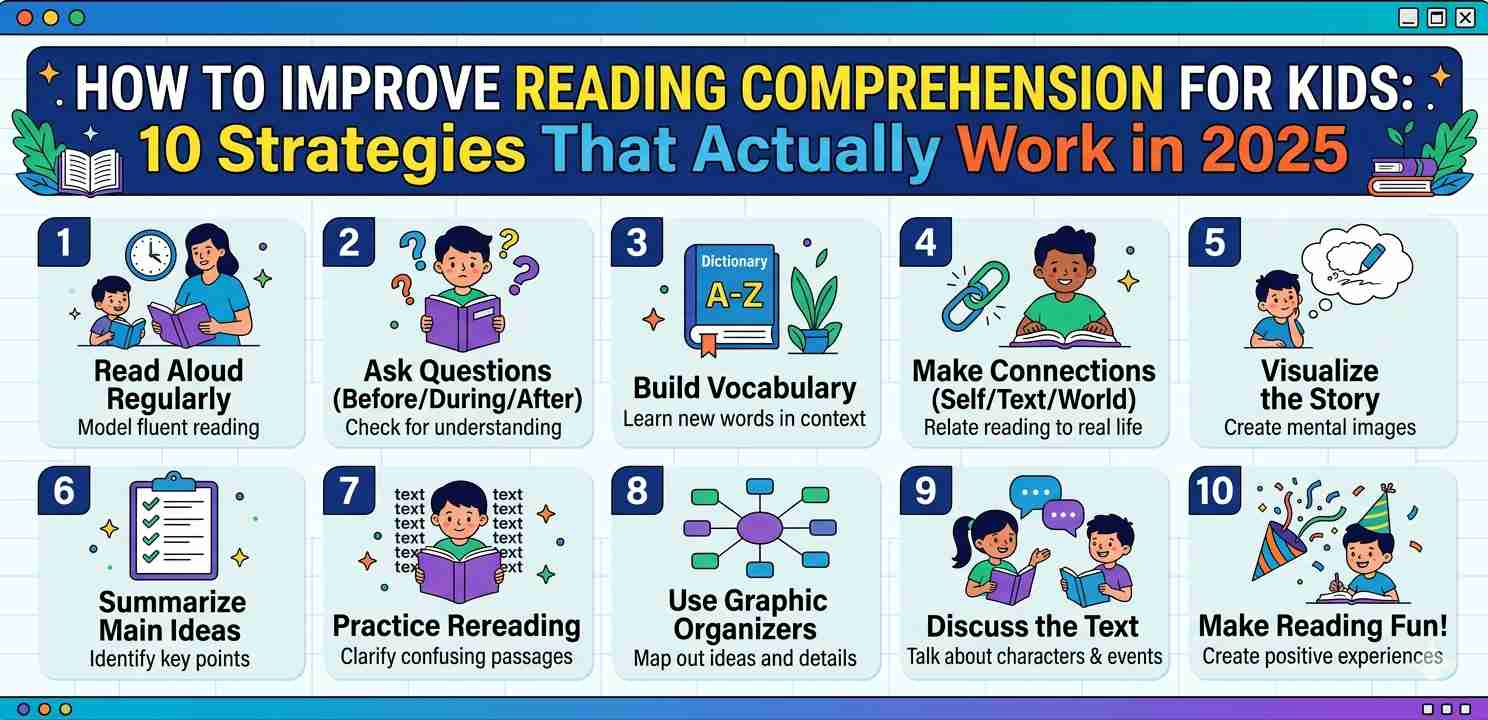
If you’re a parent or teacher trying to improve reading comprehension for kids, you’re not alone. A lot of children can read words out loud just fine — but when you ask them what the story was about, they go blank. That gap between decoding words and actually understanding them is something millions of families deal with every day.
The good news? It’s fixable. And you don’t need expensive programs or special tools to do it.
Why Reading Comprehension Matters More Than Just Reading Fluency
There’s a difference between a child who can read and a child who understands what they read. Fluency is about speed and accuracy. Comprehension is about meaning. Both matter, but comprehension is what actually helps kids in school — whether it’s understanding a science chapter, following math word problems, or writing an essay.
When kids struggle to improve reading comprehension, it often shows up in other subjects too. They might fall behind not because they can’t read, but because they can’t process the information they’ve read. That’s why this skill deserves real attention starting early.
Strategy 1: Read Aloud Together — Even After They Can Read Alone
Reading aloud to your child doesn’t stop being useful once they learn to read independently. When you read together and stop to discuss the story — “Why do you think the character did that?” — you’re actively helping them improve reading comprehension for kids in a really natural way.
It models good reading behavior. It shows that good readers pause, question, and think. And honestly, it’s one of the most enjoyable ways to do it.
Strategy 2: Teach Kids to Ask Questions While Reading
One of the best habits a young reader can build is asking questions as they go. Not after — during. Before starting a chapter, ask: “What do you think will happen?” In the middle: “Why is the character sad right now?” After: “Did anything surprise you?”
This kind of active questioning is central to how you improve reading comprehension for kids long-term. It keeps their brain engaged instead of just scanning words passively.
Strategy 3: Use the “Retelling” Technique
After a reading session, ask your child to retell the story in their own words. Not a quiz — just a casual “so what happened?” conversation. This technique forces them to process and organize what they’ve read, which is exactly the mental work that builds comprehension.
If they struggle, that’s actually useful information. It tells you where the understanding broke down. You can go back and reread that section together.
Strategy 4: Build Vocabulary in Context, Not Lists
Vocabulary and comprehension are directly connected. A child who doesn’t know what “reluctant” or “devastated” means will miss the emotional weight of a sentence entirely. But drilling word lists rarely works for young kids.
A much better approach: when your child hits an unknown word while reading, pause and figure it out together using the surrounding sentences. This teaches them how to use context clues — a skill that’s a core part of how you improve reading comprehension for kids at every grade level.
You can also explore resources like ReadWorks, a free tool with vocabulary-focused reading passages for different grade levels.
Strategy 5: Connect Stories to Real Life
Kids understand things better when they can connect them to something they already know. If a story is about moving to a new school, ask your child if they’ve ever felt nervous about something new. That personal connection makes the text more meaningful.
This is sometimes called “text-to-self connection,” and it’s a powerful tool. It also makes reading feel less like homework and more like a real conversation about life.
Strategy 6: Don’t Skip Non-Fiction Books
Most parents reach for storybooks, which makes sense. But non-fiction reading — about animals, history, space, how things work — actually presents different comprehension challenges. Non-fiction has headings, captions, diagrams, bold words, and indexes. Learning to navigate those features is a real skill.
Mixing in non-fiction regularly is one of those underrated ways to improve reading comprehension for kids, especially for children who love facts and real-world topics.
Strategy 7: Let Them Pick Some of Their Own Books
Motivation matters enormously. A child who is bored by what they’re reading will not comprehend much of it — their brain simply isn’t engaged. When kids choose their own books, even if those books seem easy or “below their level,” comprehension tends to improve just because interest is higher.
The goal is reading volume and positive association with books. You can guide their choices, but giving some ownership goes a long way.
Strategy 8: Use Graphic Organizers for Visual Learners
Some kids think better visually. A simple graphic organizer — like a story map that shows characters, setting, problem, and solution — can help them organize information they’ve read in a way that makes sense to their brain.
You don’t need to print anything fancy. A blank piece of paper with four boxes is enough. This approach tends to work well with kids who struggle to write summaries in paragraph form but can explain things with structure.
Teachers at sites like Reading Rockets have shared many practical tools like these, and they’re worth exploring.
Strategy 9: Re-read. Seriously, Just Re-read.
There’s a common assumption that re-reading is only for struggling readers. That’s not true at all. Even adult readers go back over complex paragraphs. Teaching kids that re-reading is normal — not a sign of failure — removes a lot of the anxiety around comprehension.
When a child finishes a page and says “I didn’t get that,” the first response shouldn’t be frustration. It should be: “Okay, let’s read that part again.” That one habit alone can noticeably help improve reading comprehension for kids over time.
Strategy 10: Make It a Routine, Not a Chore
Consistency beats intensity every single time. Ten to fifteen minutes of focused reading with discussion every day will do far more than a two-hour weekend reading session. Brains build comprehension skills through repeated practice over weeks and months.
Set a comfortable, predictable reading time. Keep the tone relaxed. Celebrate small wins — when a child uses a new word correctly or explains a character’s motivation, that’s worth acknowledging. Turning reading into a positive daily habit is the foundation everything else builds on.
What Parents Can Do at Home vs. What Teachers Can Do at School
There’s a natural overlap here, but the roles are a bit different.
At home, parents have the advantage of context. They know their child’s interests, fears, and experiences. That personal connection makes it easier to apply strategies like text-to-self connections or choosing motivating books. The goal at home should be to keep reading enjoyable and low-pressure.
At school, teachers can work on structured skills — graphic organizers, vocabulary instruction, and guided reading groups that target specific comprehension gaps. If you’re a teacher looking for ways to improve reading comprehension for kids systematically, combining whole-class discussion with small-group work tends to give the best results.
The most progress happens when both environments are working in the same direction.
Common Mistakes That Slow Down Comprehension Growth
It’s worth naming a few things that, despite good intentions, often backfire.
Pushing a child through a book they clearly don’t understand just to finish it doesn’t help. Speed-reading exercises that focus on getting through more pages quickly often hurt comprehension. And turning every reading session into a test — with quizzes and formal questions — can kill a child’s enjoyment of reading pretty quickly.
The goal is understanding, not performance. Keep that in mind and you’ll make better choices about how to support your child’s reading journey.
Final Conclusion
Helping kids truly understand what they read takes patience, the right habits, and a bit of creativity — but it’s absolutely achievable. The ten strategies covered here aren’t complicated. They’re practical, experience-based approaches that real parents and teachers have used successfully. Whether you start with reading aloud, building vocabulary in context, or simply making daily reading part of the routine, each step moves your child forward.
If you want to improve reading comprehension for kids in a lasting way, focus less on drilling and more on connecting reading to genuine curiosity and conversation. That’s where the real growth happens.