 editer@kidkosh.in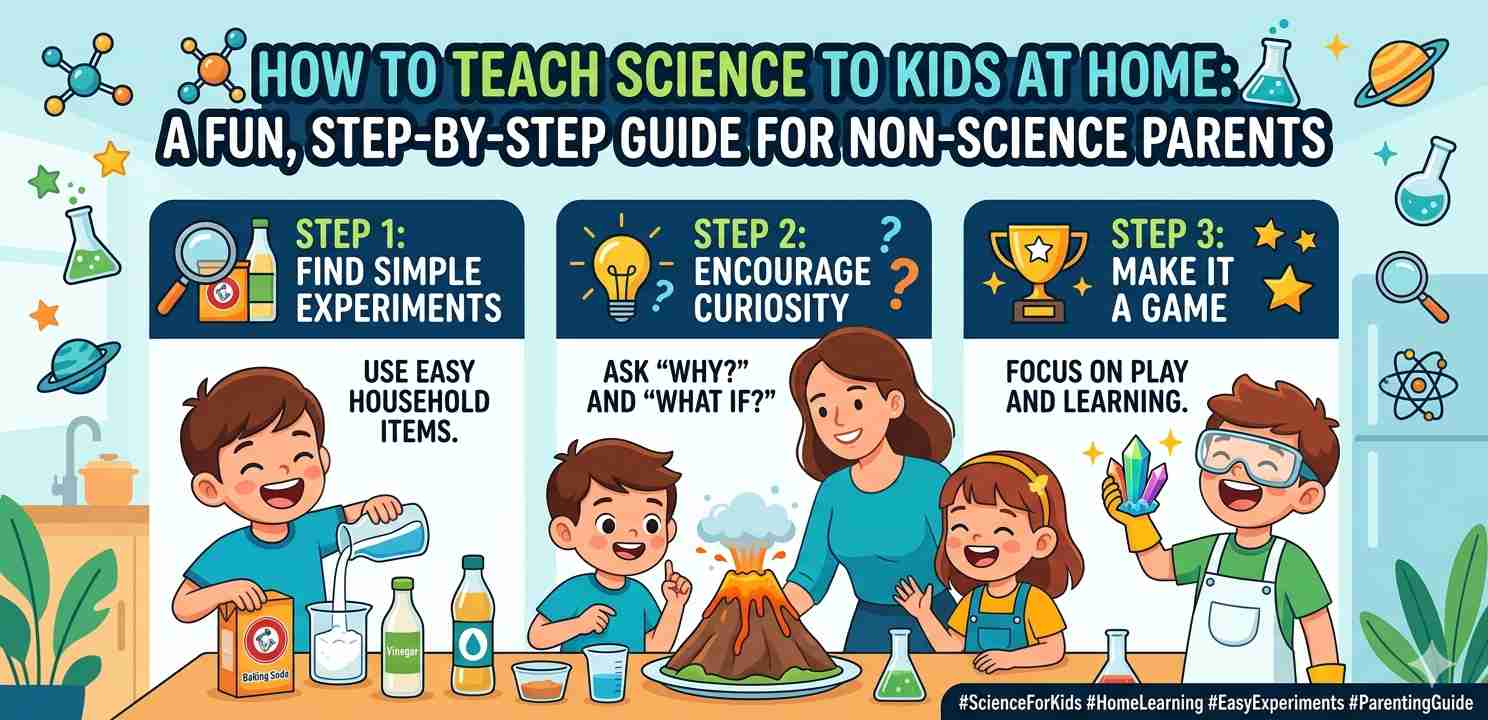
If you’ve ever wanted to teach science to kids at home but felt completely lost because you’re not a science person yourself — you’re not alone. A lot of parents feel the same way. They worry they’ll say something wrong, confuse their child, or just make a mess without actually teaching anything useful.
The good news? You don’t need a degree in biology or chemistry to guide your child through science. You just need curiosity, a few everyday materials, and a willingness to figure things out together.
Why Home Science Learning Actually Works
Schools are great, but classrooms move fast. Kids often don’t get enough time to really explore a concept before the lesson moves on. When you teach science to kids at home, you get to slow down, revisit ideas, and follow your child’s natural questions wherever they lead.
There’s also something different about learning at home. Kids feel safer asking “why” for the fifth time when it’s just you and them at the kitchen table. That comfort creates better understanding — and honestly, more fun too.
Start With What Your Child Already Notices
Before you plan anything, just watch your kid for a few days. What questions do they ask naturally? Do they wonder why the sky changes color at sunset? Why ice melts? Why plants grow toward windows?
Those everyday curiosities are your best starting point. When you teach science to kids at home, the most effective lessons are the ones that start from something your child already finds interesting. You’re not introducing science from scratch — you’re giving a name and an explanation to things they’ve already noticed.
Building a Simple Science Routine at Home
You don’t need a fancy schedule or expensive curriculum. A light routine works much better, especially for younger kids.
Pick Two or Three Days a Week
Trying to do science every day can feel like pressure — for both of you. Start small. Two sessions a week, maybe 20 to 30 minutes each, is more than enough in the beginning.
If your child is excited and wants more, follow that energy. But don’t force it when they’re not in the mood. Science should feel like discovery, not homework.
Use a Simple “Wonder → Try → Talk” Approach
This three-step method works really well when you’re figuring out how to teach science to kids at home without a formal curriculum:
- Wonder: Start with a question. “What do you think will happen if we add baking soda to vinegar?”
- Try: Do the experiment or explore the idea together.
- Talk: After, discuss what happened. Was it what you expected? Why or why not?
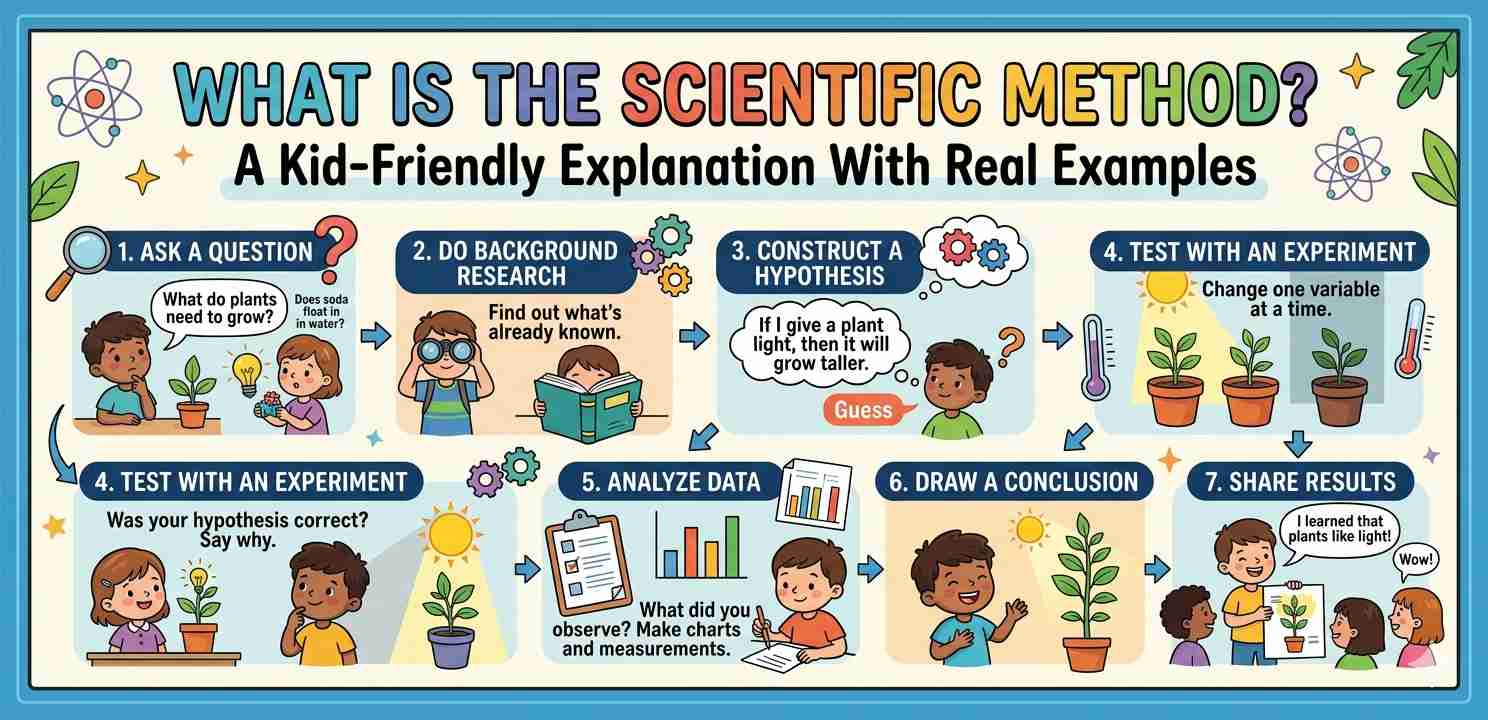
This mirrors the actual scientific method without making it feel formal or scary.
Everyday Materials That Make Great Science Tools
Here’s something most parents don’t realize: you already have most of what you need to teach science to kids at home. Science doesn’t require a lab.
Some items that work surprisingly well:
- Baking soda + vinegar — classic acid-base reaction, always a hit
- Cooking oil + water — teaches density and why liquids don’t always mix
- A flashlight and a dark room — for light, shadows, and even basic optics
- Plants and sunlight — observe photosynthesis without even knowing the word
- Ice cubes and salt — explore melting points and the concept of freezing
The goal is to let your child observe, predict, and notice. You don’t need to have all the answers. It’s actually better if you say “I’m not sure — let’s find out together.” That models scientific thinking better than pretending to know everything.
Age-Appropriate Science Topics for Kids
Not every topic works for every age. Here’s a rough guide that helps when you’re planning how to teach science to kids at home across different stages.
Ages 4–6: Observation and Senses
At this age, kids learn by touching, smelling, looking, and listening. Keep experiments sensory and simple. Try sorting rocks by size and color. Watch ice melt. Grow bean sprouts in a cup with wet cotton.
The point isn’t to teach scientific vocabulary. It’s to build the habit of paying close attention to the world.
Ages 7–10: Cause and Effect
Kids this age can start making predictions. Ask them what they think will happen before doing an experiment. Then talk about whether their prediction was right — and why or why not.
Good topics here include basic electricity (with a simple circuit kit), plant biology, weather patterns, and how machines work. YouTube channels like SciShow Kids are also genuinely helpful for this age group.
Ages 11–13: Systems and Concepts
Older kids can handle more abstract ideas. At this stage, you can teach science to kids at home by exploring ecosystems, the human body, basic chemistry concepts, or even introductory physics through building projects.
This is also a good age to introduce how to read and evaluate information — a skill that’s honestly useful for life, not just science.
How to Handle Questions You Can’t Answer
This is the part most parents dread. Your child asks something and you genuinely have no idea. What do you do?
The honest answer: say so. “That’s a great question. I don’t know — let’s look it up.”
This is actually one of the best things about learning at home. You get to model intellectual humility. You show your child that not knowing something isn’t a failure — it’s the starting point for learning. That’s what science actually is.
For reliable kid-friendly explanations, resources like NASA’s Space Place are accurate, simple, and well-organized. Bookmark a few trusted sites so you’re not scrambling when questions come up.
Keeping Your Child Motivated Over Time
Even kids who love science can lose interest if the approach gets repetitive. Here are a few ways to keep the energy going when you teach science to kids at home over the long term.
Let them lead sometimes. Ask your child to pick the experiment for the week. Even if they choose something you’ve already covered, their ownership of the choice changes how engaged they are.
Document what you do. A simple science notebook — even just a regular notebook where they draw and write about experiments — makes the learning feel real. Kids love flipping back through their own “discoveries.”
Connect science to things they already love. If your kid is into cooking, explore food science. If they love superheroes, talk about physics. If they’re obsessed with animals, study habitats and adaptations. Science is everywhere.
Be patient with mess and failure. Not every experiment works perfectly. A vinegar-baking soda volcano might fizzle. A plant might not grow. That’s fine — talking about why something didn’t work is genuinely good science practice.
Common Mistakes to Avoid
When you’re first figuring out how to teach science to kids at home, a few things can accidentally make it less effective.
Explaining too much too soon. Let kids observe and guess before you explain. If you immediately tell them the answer, they skip the most important part — thinking it through.
Choosing activities that are too advanced. A frustrated child shuts down fast. Start easier than you think you need to, and build up from there.
Treating every session like a test. The moment it feels like an exam, the curiosity disappears. Keep the tone light and exploratory, not evaluative.
Simple Science Projects to Try This Week
If you’re not sure where to start, here are three easy experiments that work well when you teach science to kids at home for the first time:
- Density jar: Layer honey, dish soap, water, vegetable oil, and rubbing alcohol in a clear glass. Watch how they don’t mix. Talk about why.
- Invisible ink: Write a message on paper using lemon juice. Let it dry. Hold it near a light bulb. The heat reveals the writing. Simple chemistry, huge reaction from kids.
- Static electricity balloon: Rub a balloon on hair or a wool sweater. Hold it near small pieces of paper, a thin stream of water from a tap, or your arm hair. Sparks curiosity every time.
None of these need prep beyond what’s already in your kitchen. That’s the point.
Final Conclusion
Teaching science at home doesn’t require expertise — it requires curiosity and consistency. When you take time to teach science to kids at home, you’re not just covering a school subject. You’re building a way of thinking: asking questions, testing ideas, observing carefully, and staying open to being wrong.
The most important thing you bring to these sessions isn’t knowledge. It’s presence and patience. Your child doesn’t need a perfect teacher. They need a curious adult who’s willing to figure things out alongside them.
Start small. Stay flexible. And don’t worry too much about doing it “right.” Science is messy and uncertain by nature — and that’s exactly what makes it worth exploring