 editer@kidkosh.in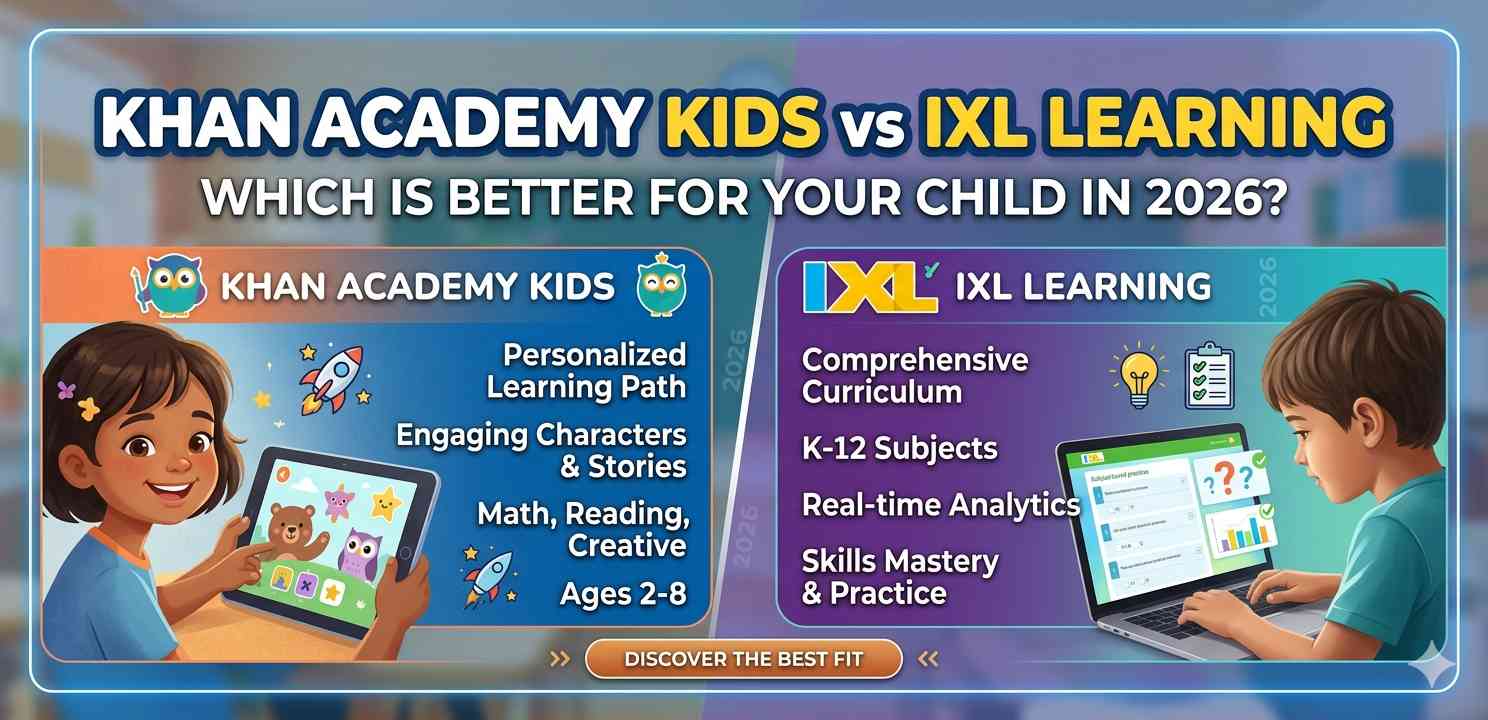
Choosing between Khan Academy Kids vs IXL Learning is one of the most common questions parents ask when they want their child to learn something meaningful on a screen. Both platforms have earned genuine trust over the years, and honestly, it’s not a simple pick. Each one works differently, targets a slightly different kind of learner, and comes with its own strengths and limitations.
This article breaks it all down — clearly, without jargon, and based on what actually matters for kids in 2026.
What Is Khan Academy Kids?
Khan Academy Kids is a free learning app designed primarily for children between the ages of 2 and 8. It covers early literacy, basic math, social-emotional learning, and reading skills through interactive stories, games, and videos.
The app is developed by Khan Academy — the same nonprofit behind the popular free learning platform for older students. Khan Academy Kids carries that same nonprofit spirit: completely free, no ads, and built with the goal of making education accessible for every family.
One thing that stands out is how the app feels. It’s warm, colorful, and guided by a cast of friendly animated characters. For younger children who are just starting school, that kind of environment makes a real difference.
What Is IXL Learning?
IXL Learning is a subscription-based platform that covers a much wider age range — from pre-K all the way through 12th grade. It focuses heavily on structured skill practice in math, language arts, science, and social studies.
Unlike Khan Academy Kids, IXL takes a more data-driven approach. Every time a child answers a question, the platform tracks performance and adjusts the experience accordingly. Parents and teachers get detailed reports showing exactly where the child is strong and where they need more work.
IXL is widely used in schools across the United States and in many countries globally. That kind of institutional trust says something about how seriously the platform is built.
Khan Academy Kids vs IXL Learning: Age and Grade Range
This is one of the clearest differences between the two platforms.
Khan Academy Kids is built for early learners — typically ages 2 through 8, which roughly covers pre-K through second grade. If your child is in that age window, the app fits naturally.
IXL Learning covers pre-K through grade 12, which makes it useful for much longer. A family with multiple children at different grade levels might find IXL more practical since it scales with the child as they grow.
If you have a 5-year-old right now, both platforms could work. But if you’re thinking two or three years ahead, IXL has the longer runway.
Curriculum and Subject Coverage
Khan Academy Kids
The curriculum in Khan Academy Kids is focused and age-appropriate. You’ll find:
- Early reading and phonics
- Basic counting and number sense
- Social-emotional skills (sharing, empathy, feelings)
- Creative drawing and logic activities
- Short reading books with guided comprehension
It’s not trying to be everything. It’s trying to be exactly what a 4–7-year-old needs, and it does that well.
IXL Learning
IXL goes much deeper across more subjects:
- Math from counting to calculus
- Language arts including grammar, writing, and vocabulary
- Science aligned to state standards
- Social studies
- Spanish (for select grade levels)
For older children especially, IXL offers a level of subject depth that Khan Academy Kids simply doesn’t compete with — because it was never designed to.
Learning Style: How Each Platform Teaches
In the Khan Academy Kids vs IXL Learning debate, teaching style matters just as much as content.
Khan Academy Kids uses story-driven learning. Children follow characters through adventures, and skills are woven into those narratives naturally. For younger kids, this kind of contextual learning tends to stick better than repetitive drills.
IXL uses a mastery-based model. A child practices questions on a topic until they demonstrate consistent understanding, measured through a “SmartScore” that goes up to 100. If they get something wrong, the score drops and they get more practice on that concept.
This model works very well for structured practice. But it can sometimes feel like pressure, especially for younger or more sensitive children who get frustrated when their score drops after making a mistake.
Pricing: Free vs Subscription
This is a big one for families on a budget.
Khan Academy Kids is completely free. No hidden fees, no premium tier, no ads. You download the app, create a profile, and your child can access everything immediately. That’s genuinely rare for educational apps of this quality.
IXL Learning costs money. As of 2026, IXL offers individual subject plans and an all-subjects plan. Pricing varies by region, but families typically pay somewhere in the range of $9.95 to $19.95 per month depending on how many subjects and children are included. Schools often get bulk pricing, which is why many teachers recommend it — but for home use, the cost adds up.
If budget is a concern, Khan Academy Kids wins this category without question.
Platform Availability
Both platforms are available on multiple devices, which is helpful.
Khan Academy Kids is available on iOS, Android, and Amazon Fire tablets. It works well on smaller screens and doesn’t require a constant internet connection once content is downloaded.
IXL Learning is available as a web app on desktop and laptop browsers, and also has apps for iOS and Android tablets. It works best on a larger screen — especially for older students doing longer practice sessions.
For young children using a shared family tablet, Khan Academy Kids tends to be a more comfortable experience. IXL’s interface is cleaner and more functional on a proper screen.
Parental Controls and Progress Tracking
Khan Academy Kids
Parents get a simple dashboard showing which books the child has read, which activities they’ve completed, and how much time they’ve spent in the app. It’s easy to read and doesn’t overwhelm you with numbers.
IXL Learning
IXL’s reporting is significantly more detailed. You can see skill-by-skill performance, time spent, question accuracy, and overall grade-level progress. There’s also a “Diagnostic” feature that tests a child across skills and tells you their approximate level in each subject area.
For parents who want a clear academic picture, IXL’s reports are genuinely useful. Especially if you’re homeschooling or supplementing school at home and want data that connects to what the teacher is seeing.
Khan Academy Kids vs IXL Learning: Which One Is Right for Your Child?
Here’s the honest answer: it depends on your child’s age and what you’re trying to achieve.
Choose Khan Academy Kids if:
- Your child is between 2 and 8 years old
- You want a free, playful, low-pressure learning experience
- You’re focused on early literacy and foundational math
- Your child responds better to stories than drills
Choose IXL Learning if:
- Your child is 5 years or older and you want a long-term platform
- You want detailed progress data and curriculum-aligned practice
- Your child is comfortable with structured, skill-based learning
- You’re willing to pay for a more comprehensive academic tool
Some families actually use both. Khan Academy Kids in the early years for joyful exploration, and IXL as the child gets older and needs more structured practice. That’s not a bad strategy at all.
What Teachers and Parents Are Saying in 2026
Teachers who use IXL in classrooms frequently mention how useful the diagnostic reports are for identifying gaps. It saves time in planning and helps them give targeted support.
Parents using Khan Academy Kids often appreciate that it doesn’t feel like school. Kids don’t realize they’re learning, which is exactly the point for that age group.
Both platforms have strong communities of loyal users. The fact that both have grown year over year says a lot about their real-world value.
You can explore Khan Academy Kids directly at Khan Academy’s official site and learn more about IXL’s features at IXL Learning’s website.
For related reading on choosing the right educational tools, you might also find our guide to the best learning apps for kids in 2026 and our comparison of free vs paid educational platforms helpful.
Final Conclusion
When it comes to Khan Academy Kids vs IXL Learning, there’s no single winner — and that’s actually a good thing. It means you have two genuinely solid options, each well-suited to a different kind of learner at a different stage of childhood.
Khan Academy Kids shines for early learners who need warmth, playfulness, and zero financial barrier. IXL Learning earns its place for structured, skill-focused practice across a wider age range — especially when detailed tracking matters.
Take a look at your child’s age, learning style, and your family’s needs. Try Khan Academy Kids for free first if your child is young. If they’re older or you want more depth, give IXL a trial run. The best platform is simply the one your child actually uses and benefits from.