 editer@kidkosh.in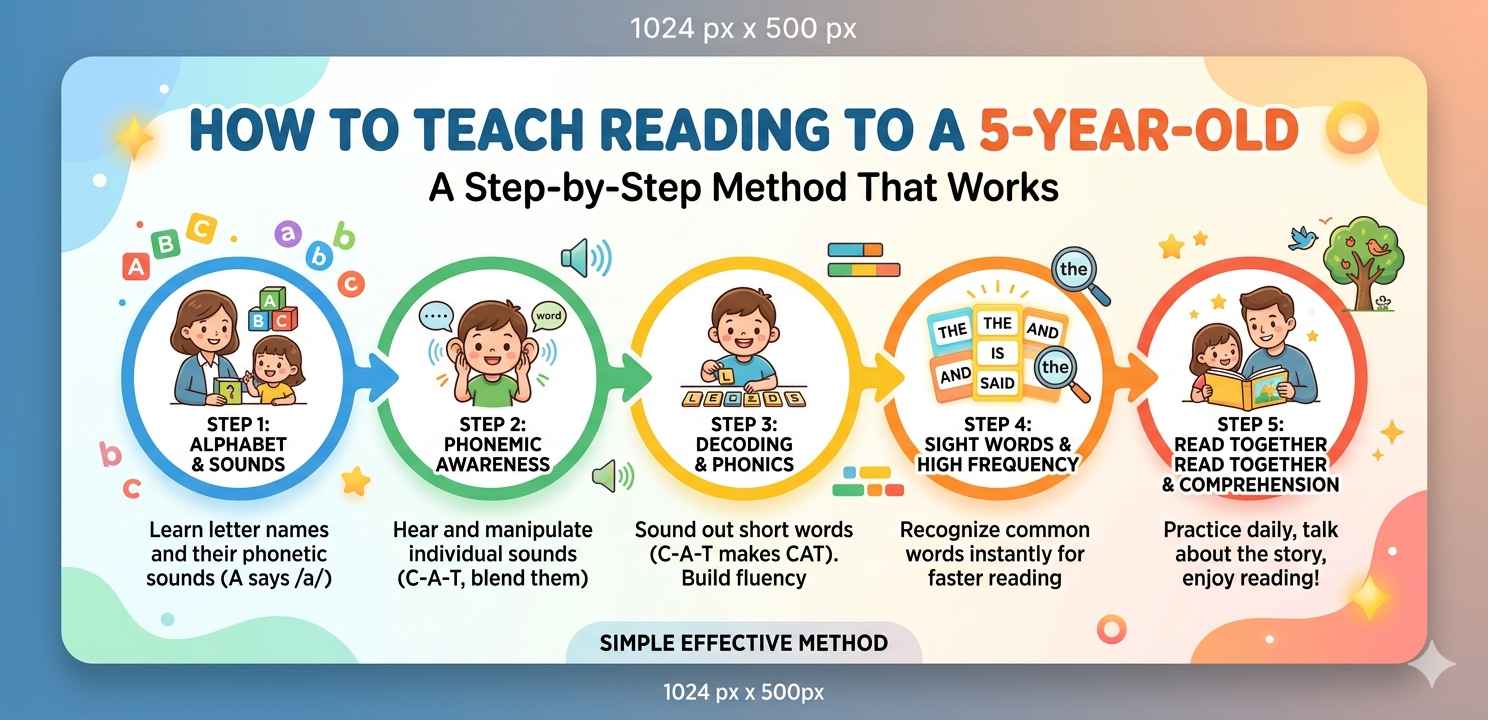
Teaching a young child to read is one of the most rewarding things a parent or caregiver can do. If you’re trying to teach reading to a 5-year-old, you’ve already taken the most important step — you’ve decided to be involved. That matters more than any curriculum or fancy tool.
But honestly, it can feel overwhelming. There’s a lot of conflicting advice out there. Some people say start with phonics. Others say focus on whole words. Some apps promise results in weeks. It gets confusing fast.
This guide cuts through all of that. What you’ll find here is a practical, experience-based approach that works for most kids at this age — broken into clear steps you can actually follow at home.
Why Age 5 Is a Good Time to Start
Five-year-olds are developmentally ready for early reading in most cases. Their brains are wired for language at this stage. They’re curious, they ask endless questions, and they love repetition — which is basically the foundation of learning to read.
That said, not every child develops at the same pace, and that’s completely normal. Some kids are ready at 4. Others might take until 6 or 7 before things fully click. The goal here isn’t to push — it’s to create the right environment and introduce the right skills so that when they are ready, progress comes naturally.
Step 1: Build Phonemic Awareness Before Anything Else
Before you teach reading to a 5-year-old using actual books or flashcards, they need to understand that words are made of sounds. This is called phonemic awareness, and it’s the foundation of everything.
You don’t need worksheets for this. Try simple games:
- Ask your child what sound “cat” starts with.
- Clap out syllables together: “ba-na-na” (three claps).
- Play rhyming games. “What rhymes with hat? Bat? Mat? Sat?”
Even 5–10 minutes a day of this kind of play makes a noticeable difference over a few weeks. Kids who develop strong phonemic awareness tend to pick up reading more easily than those who skip this stage.
Step 2: Introduce Phonics — The Right Way
Phonics means connecting letters to their sounds. When you teach reading to a 5-year-old using phonics, you’re giving them a tool they can use independently — they can decode new words on their own instead of memorizing every single one.
Start With the Most Common Sounds
Don’t try to cover the whole alphabet at once. Start with high-frequency consonants and short vowel sounds:
- Consonants: s, a, t, p, i, n (these can form lots of simple 3-letter words)
- Short vowels: a, e, i, o, u
Once your child can identify those sounds reliably, start blending them together. “S…a…t. Sat!” This blending step is where many kids struggle, so be patient and keep it playful.
Use Multi-Sensory Techniques
Kids at this age learn with their whole body. Let them:
- Trace letters in sand or a tray of salt
- Form letters with playdough
- Tap out sounds on their fingers
These aren’t just fun — they help the learning stick.
Step 3: Sight Words Complement Phonics
Some words in English don’t follow regular phonics rules. Words like “the,” “said,” “was,” and “you” just need to be memorized by sight. These are called sight words, and learning a small set of them dramatically speeds up reading fluency.
When you teach reading to a 5-year-old, you don’t need to introduce hundreds of sight words right away. Start with 10–20 of the most common ones (the Dolch pre-primer list is a good starting point — you can find it at Sight Words — dolchsightwords.org).
Use flashcards, simple matching games, or just point them out naturally when reading together. “Look — there’s ‘the’ again. We’ve seen that word three times on this page!”
Step 4: Read Aloud Together Every Day
Reading aloud to your child — even after they start learning to read on their own — is incredibly valuable. It builds vocabulary, exposes them to sentence structure, and most importantly, it makes reading feel like something enjoyable rather than a chore.
When you read aloud, run your finger under the words. This helps your child connect the spoken words to the printed ones. Point out individual letters and words occasionally. “Can you find the word ‘dog’ on this page?”
Aim for at least 15–20 minutes of shared reading daily. It doesn’t have to be structured. Bedtime stories count. Reading cereal boxes counts. The point is consistency.
Step 5: Let Them Try to Read to You
Once your child has some phonics knowledge and a handful of sight words, it’s time to flip the script. Let them try reading simple books to you.
Good book choices at this stage include:
- Bob Books (Series 1 is excellent for beginners)
- I Can Read Level 1 books
- Oxford Reading Tree Stage 1
When they get stuck on a word, resist the urge to just tell them the answer immediately. Wait a few seconds. Ask, “What sound does it start with?” Let them try to work it out. This struggle — within reason — is actually where the learning happens.
That said, if they’re getting frustrated, just tell them the word and move on. Reading time should never feel like a test.
Step 6: Make It Part of Daily Life
One of the most effective ways to teach reading to a 5-year-old isn’t found in any workbook. It’s simply pointing out print in the real world.
- Read signs when you’re driving. “Look — that says STOP.”
- Point out letters on food packaging during breakfast.
- Let them help you write a grocery list, even if they just copy the letters.
These small moments add up. Kids who see reading and writing happening naturally around them tend to develop literacy skills faster than those who only encounter it in formal lessons.
How Long Should Practice Sessions Be?
This is a question almost every parent asks. And the honest answer is: shorter than you think.
At age 5, a child’s attention span is roughly 5–10 minutes for focused tasks. So two or three short sessions of 5–10 minutes each are more effective than one long 30-minute push.
End sessions before your child gets bored or frustrated. Always end on something they can do successfully. That last feeling of “I got it right” is what makes them want to come back tomorrow.
Common Mistakes to Avoid
When parents or teachers try to teach reading to a 5-year-old, a few patterns tend to slow things down:
Pushing too fast. If a child isn’t ready for phonics blending yet, drilling it daily won’t help — it’ll just create anxiety around reading. Step back to phonemic awareness games and try again in a few weeks.
Using screens as the main method. Apps and videos can supplement learning, but they shouldn’t replace the human connection of reading together. Kids learn from people, not just screens.
Neglecting comprehension. It’s possible for a child to decode words out loud without actually understanding what they read. After reading, ask simple questions: “What happened? What do you think this character is feeling?” This builds genuine reading comprehension, not just word recognition.
Helpful Resources Worth Bookmarking
If you’re looking for structured guidance beyond this article, two particularly solid options:
- Reading Rockets — reading.org is a research-based site full of strategies, activities, and reading guides for parents and educators. It’s free and genuinely useful.
- Also check out related guides on supporting your child’s early literacy at home, including how to build vocabulary in young children and choosing the right early reader books by age.
When to Seek Extra Support
Most children who are learning to read at age 5 will progress steadily if given consistent, low-pressure practice. But if your child is significantly struggling after several months of regular practice — having trouble identifying letter sounds, mixing up letters constantly, or showing frustration during most reading activities — it’s worth speaking with their teacher or a reading specialist.
Early intervention for things like dyslexia or processing differences makes a real difference. Catching it early means better outcomes. There’s no harm in asking for an assessment if you have concerns.
Final Conclusion
To teach reading to a 5-year-old successfully, you don’t need an expensive curriculum or special training. What you need is consistency, patience, and a genuine willingness to make reading a warm, low-pressure part of everyday life.
Start with phonemic awareness. Move into phonics. Add sight words gradually. Read aloud daily and let them read to you when they’re ready. Point out print in the world around you. Keep sessions short and always end on a positive note.
Reading opens every door. Helping your child learn to do it — one small step at a time — is one of the most lasting gifts you can give them.