 editer@kidkosh.in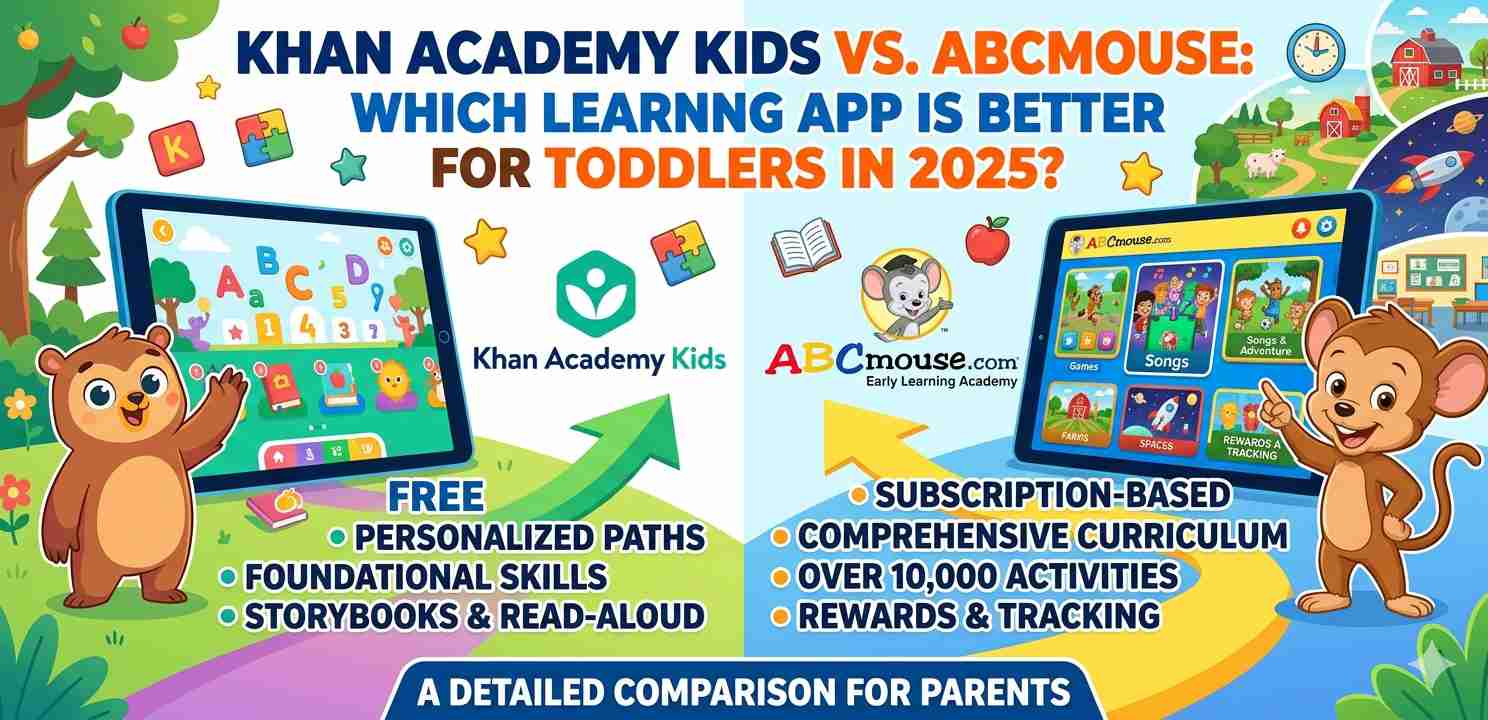
Choosing the right learning app for your toddler is honestly harder than it looks. There are dozens of options out there, but Khan Academy Kids vs ABCmouse is the comparison most parents end up landing on — and for good reason. Both are well-known, both are built for young children, and both promise to make early learning fun.
But they work very differently. One is completely free. The other costs money every month. One focuses on structured curriculum, while the other leans heavily on gamified rewards. So which one should you actually install on your child’s tablet?
Let me break this down in plain language, based on what each app actually does — not just what the marketing says.
What Is Khan Academy Kids?
Khan Academy Kids is a free learning app made by Khan Academy, a nonprofit educational organization. It’s designed for children aged 2 to 8 and covers subjects like reading, math, social-emotional skills, and basic science concepts.
The app uses a character called Kodi the bear along with a group of animal friends to guide kids through lessons. There are no ads and no in-app purchases. That’s a big deal when you’re talking about an app for toddlers.
One thing parents really appreciate is that the content feels thoughtful and age-appropriate. It doesn’t just throw flashy animations at your child — it actually tries to build real learning habits.
What Is ABCmouse?
ABCmouse is a subscription-based learning platform for kids aged 2 to 8. It’s been around since 2010 and covers over 10,000 activities across reading, math, art, music, and science.
The platform works like a virtual school campus. Kids earn tickets and badges as they complete activities, which they can use to customize their avatar and virtual classroom. This reward system is a core part of how ABCmouse keeps kids engaged.
Unlike Khan Academy Kids, ABCmouse costs around $12.99 per month (with discounts available for annual plans). There’s a free trial, but long-term access requires a paid subscription.
Khan Academy Kids vs ABCmouse: Head-to-Head Comparison
Content Library and Learning Depth
When it comes to raw volume, ABCmouse wins easily. It has thousands of activities, books, songs, and puzzles — all organized into a step-by-step learning path. If variety is what you’re looking for, ABCmouse delivers more surface area.
But Khan Academy Kids goes deeper in specific areas. Its early reading and math content is genuinely well-structured. The app follows a curriculum that’s actually aligned with educational standards, which makes it more than just digital entertainment.
For parents who want their toddler to build foundational skills before kindergarten, Khan Academy Kids often edges ahead in terms of educational quality per activity.
Cost and Accessibility
This is where Khan Academy Kids vs ABCmouse gets really lopsided. Khan Academy Kids is 100% free — no hidden charges, no premium tiers, no subscriptions. You download it and use everything.
ABCmouse requires a paid subscription after the trial ends. For families on a tight budget, that $12–13 per month adds up. Over a year, that’s over $150 just for one app.
If cost is a deciding factor for you, Khan Academy Kids is the obvious answer.
Interface and Ease of Use for Toddlers
Khan Academy Kids has a clean, focused interface. A toddler can navigate it pretty easily, especially once they learn which character leads which activity. The design avoids clutter and keeps distractions low.
ABCmouse is a bit busier. There are more buttons, more options, and more going on at once. Younger toddlers (ages 2–3) sometimes get overwhelmed by the amount of stuff on screen. The virtual campus is fun, but it can also pull kids away from actual learning toward just clicking around and collecting rewards.
That said, slightly older kids (ages 5–7) tend to enjoy ABCmouse more because they can appreciate the reward system and track their own progress.
Parental Controls and Reporting
Both apps give parents some visibility into their child’s activity. ABCmouse has a more detailed progress report dashboard — you can see which skills your child is working on and where they’re struggling.
Khan Academy Kids also has a parent section, and it ties into Khan Academy’s broader platform. You can monitor learning history and see which lessons your toddler completed.
Neither app is perfect in this area, but ABCmouse is slightly more detailed in its reporting features.
Which App Is Better for Different Types of Learners?
For Visual Learners
Both apps use animation and colorful illustrations. ABCmouse has more variety in its visual formats — videos, interactive books, and animated lessons. For a child who responds well to lots of visual stimulation, ABCmouse offers more to explore.
For Early Readers
If your priority is helping your toddler learn to read, Khan Academy Kids has some excellent phonics and reading exercises. The lessons are well-sequenced and don’t rely on the child memorizing words randomly. It builds reading from the ground up.
For Kids Who Need Motivation
ABCmouse wins here. The ticket system, avatar customization, and classroom rewards give kids clear reasons to keep going. For a child who gets bored quickly or needs external motivation to engage, ABCmouse’s gamified structure can be genuinely useful.
Does the Free vs. Paid Model Actually Matter?
Yes — and here’s the real-world angle. Many parents start with ABCmouse because of the free trial, get their child hooked on the reward system, and then feel locked in once the subscription kicks in. Kids can get attached to their avatar and progress.
With Khan Academy Kids, there’s no such lock-in because it’s always free. You can use it for a week, stop for a month, and come back without losing anything or paying more.
For long-term and stress-free use, the free model of Khan Academy Kids just makes life simpler. You can also explore other educational apps for toddlers alongside it without worrying about overlapping subscription costs.
Age-by-Age Recommendation
Ages 2–3: Khan Academy Kids is probably the better starting point. The interface is simpler, the characters are calming rather than overstimulating, and the foundational lessons are appropriate for very young children.
Ages 4–5: Either app works well. If your child is curious and self-motivated, Khan Academy Kids still holds up. If they need more variety or game-like rewards, ABCmouse might keep them more engaged.
Ages 6–8: ABCmouse expands its value here with more complex content across multiple subjects. Khan Academy Kids remains solid for reading and math, but ABCmouse’s breadth becomes more of an advantage as kids grow.
What Parents Are Actually Saying in 2025
From what parents share in forums and app reviews, a few patterns are clear. Khan Academy Kids gets praised for being ad-free, genuinely educational, and stress-free to manage. Parents with multiple kids especially appreciate that there’s no subscription cost per child.
ABCmouse gets positive reviews for keeping kids engaged for longer stretches and for the variety of content available. But some parents feel the reward system — while effective — can shift focus from learning to just earning tickets.
According to Common Sense Media, both apps rank well for educational value, but Khan Academy Kids consistently gets cited for being the stronger choice for structured early childhood learning.
Offline Access and Device Compatibility
Khan Academy Kids works on both iOS and Android. Some content is available offline once downloaded, which is useful for travel or areas with weak internet.
ABCmouse also supports iOS and Android, along with Amazon Fire tablets. However, offline access on ABCmouse is more limited, and the platform generally requires a stable connection for the full experience.
If your household has an Android tablet without consistent Wi-Fi, this might tip the decision toward Khan Academy Kids.
Final Conclusion
So in the debate of Khan Academy Kids vs ABCmouse, there’s no perfect universal answer — but there is a clearer picture once you know your priorities.
If you want a completely free, educationally solid, low-distraction app that builds real early learning skills, Khan Academy Kids is the stronger choice for most families. It’s especially well-suited for toddlers aged 2 to 5.
If your child is slightly older, already likes game-based learning, and you’re willing to pay for a broader content library, ABCmouse can offer more variety and sustain interest for longer.
For parents who aren’t sure, the honest answer is to try Khan Academy Kids first — it costs nothing, it’s well-built, and most toddlers take to it quickly. You can always add ABCmouse later if you feel your child needs something more.
Either way, the best learning app is the one your child will actually sit down and use with curiosity. Screen time with purpose beats passive screen time every single time.