 editer@kidkosh.in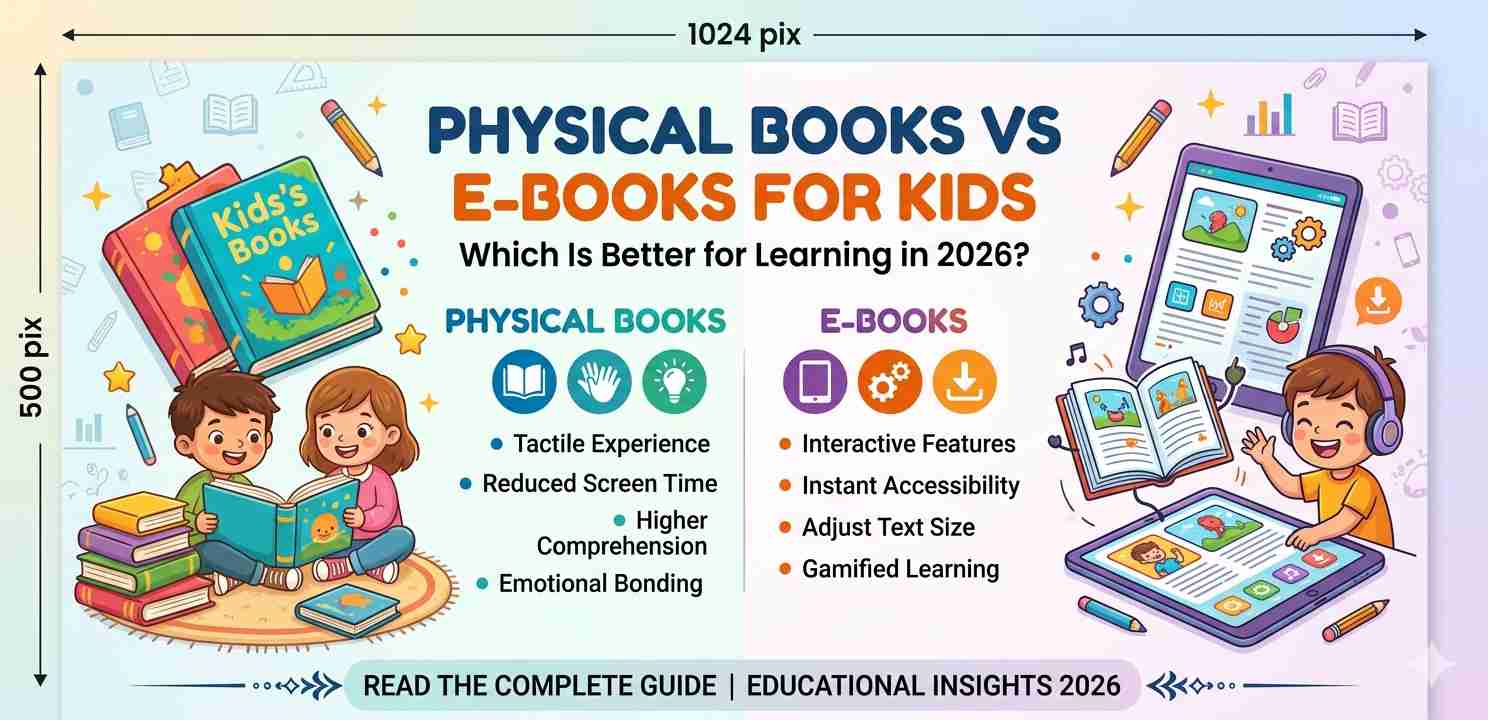
Every parent hits this moment at some point. You’re standing in a bookstore or scrolling through an app store, wondering whether your child is better off with an actual paperback or a glowing tablet screen. The debate around physical books vs e-books for kids has only grown louder in 2026, especially as more schools shift toward digital tools and kids spend increasing hours on devices.
There’s no single right answer. But there’s a lot worth understanding before you decide.
Why This Question Matters More in 2026
The reading habits of children today are shaped differently than they were even five years ago. Tablets are cheaper. Digital libraries are larger. And post-pandemic learning gaps have pushed educators to rethink how kids absorb information.
Still, plenty of research continues to back the value of print. So the physical books vs e-books for kids conversation isn’t just about convenience — it touches on how children learn, how they retain information, and how they relate to reading as a habit.
How Kids Actually Read: Print vs Screen
Here’s something most parents don’t know: children read differently on screens than they do on paper. Studies from educational psychologists suggest that kids tend to skim digital content. They jump around, tap things, and get distracted by notifications or animations.
With a printed book, there’s nowhere else to go. The child moves line by line, page by page. That linear movement helps build reading stamina — something that’s increasingly hard to develop in a world full of short-form content.
In the physical books vs e-books for kids comparison, print tends to win on focused reading, while e-books offer more interactivity. Both have value, but the context matters a lot.
The Case for Physical Books
Deeper Comprehension and Memory Retention
There’s consistent evidence that kids remember more from print than from screens. When a child reads a story in a physical book, the act of turning pages creates a kind of spatial memory. They remember “that part near the end” or “the page with the picture of the wolf.” This anchoring doesn’t happen the same way on a scrollable screen.
For younger children, especially those between 4 and 8 years old, picture books with physical pages are particularly effective. The tactile experience — touching the page, pointing to pictures — builds vocabulary and story comprehension in ways that a touchscreen swipe doesn’t replicate well.
No Screen Time Guilt
One of the biggest practical advantages in the physical books vs e-books for kids debate is that physical books don’t come with screen time baggage. Pediatricians and child development experts often recommend limiting screen exposure for children under 10, and reading a paperback doesn’t count against that limit.
Parents can feel fully comfortable handing a 6-year-old a stack of books for an hour without any concern about blue light, eye strain, or digital overstimulation.
Bedtime Reading Works Better in Print
If your child reads before bed — which is genuinely one of the best habits you can build — a physical book is clearly the better tool. Screens suppress melatonin production. Even a 20-minute e-book session on a bright tablet can delay a child’s sleep onset.
A print book, on the other hand, is calming. It signals to the brain that it’s time to wind down. This alone makes physical books worth having in a home with young readers.
The Case for E-Books
Accessibility and Variety at Low Cost
For families who can’t afford a large home library, e-books are a game changer. Apps like Epic!, Kindle Kids, and Google Play Books give children access to thousands of titles at a fraction of the cost. A single subscription can cover an entire year of reading material.
In the physical books vs e-books for kids context, this affordability factor genuinely levels the playing field. A child in a small town with limited library access can now read the same books as someone in a city with a well-stocked public library.
Built-In Learning Tools
Many e-book platforms for children come with built-in dictionaries, read-aloud features, and comprehension questions. When a child encounters an unfamiliar word in a print book, they might skip it. In a good e-reader app, they can tap it and get an instant definition without leaving the page.
For kids who are learning to read — especially early readers or those with dyslexia — these features can be transformative. Audio support, adjustable fonts, and highlighted text as words are spoken can make reading more accessible and less intimidating.
Lightweight for Travel and School
Physical books are heavy. A child’s backpack can only fit so many. With an e-reader or tablet, a kid can carry an entire library to school, on a road trip, or to a waiting room. That convenience matters for building consistent reading habits.
Age-Specific Recommendations
Ages 2–6: Lean Toward Physical Books
For toddlers and preschoolers, physical books are almost always the better choice. Board books, picture books, and touch-and-feel books engage the senses in ways that support early language development. The parent-child ritual of turning pages together also builds emotional connection.
Ages 7–12: A Healthy Mix Works
School-age children can benefit from both. Physical books work well for story reading, bedtime, and in-depth learning. E-books are useful for research, supplemental reading, and classroom assignments.
In this age group, the physical books vs e-books for kids debate becomes less about which is better and more about which is right for the situation.
Ages 13 and Up: E-Books Gain Ground
Teenagers often prefer e-books for the portability and the ability to read privately. For assigned reading and research, digital formats also offer convenience. At this stage, kids typically have the self-regulation to manage screen time more responsibly.
What Schools Are Doing in 2026
Most schools today use a blend of both formats. Physical textbooks still dominate in many classrooms for core subjects, while digital platforms supplement reading programs. Google Classroom, Seesaw, and similar tools have made e-book integration seamless for teachers.
However, many educators express a preference for print during foundational reading years. The general consensus is that physical books vs e-books for kids isn’t a competition — it’s a toolkit, and the best readers use both.
The Parent’s Role: Guiding the Choice
Ultimately, no format replaces an engaged parent. A child who is read to regularly — regardless of whether it’s from a book or a tablet — develops stronger literacy skills than one left to read alone.
That said, a few practical guidelines help:
- Use physical books for bedtime reading and early literacy development
- Allow e-books for independent reading and travel
- Check that any e-reading app is ad-free and age-appropriate
- Set boundaries around interactive features that interrupt reading flow
- Visit your local library regularly — both physical and digital sections
For more guidance on children’s reading development, the American Academy of Pediatrics offers evidence-based recommendations on screen time and literacy. For curated e-book resources, Common Sense Media provides detailed reviews of reading apps for all ages.
You might also enjoy exploring how to build a reading routine for children or the best beginner chapter books for kids aged 6–9 if you’re looking to expand your child’s reading life.
Final Conclusion
After weighing everything, the physical books vs e-books for kids debate doesn’t have one winner in 2026 — it has two different tools for different moments. Print builds focus, memory, and calm. Digital formats offer access, support, and convenience. Neither one is the enemy of the other.
The smartest thing a parent can do is stay curious about how their specific child learns best. Some kids thrive with the tactile feel of paper. Others engage more deeply when text is interactive and supported by audio. Pay attention, experiment a little, and don’t feel pressured to pick a side permanently.